
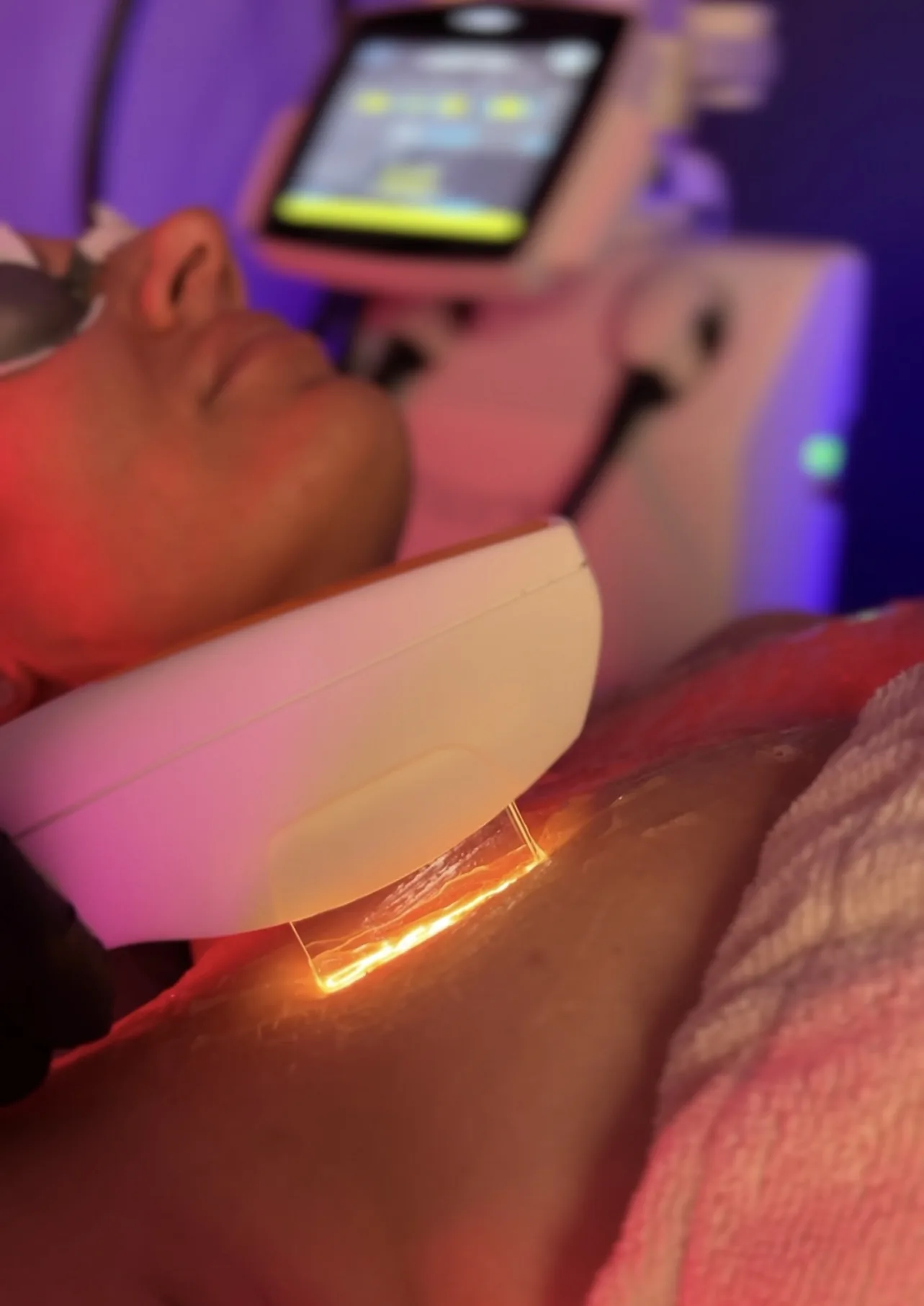
This page describes the technology
Here you will find the principle behind it, the choice of filters, how a session goes and safety, that is what is common to all IPL treatments.
If you are looking for a particular problem, go straight to the treatment page: redness and thread veins, pigmentation, acne-prone skin. There we describe the assessment, how it goes and when we choose IPL and when a laser.
On this page
What selective photothermolysis is
IPL, that is Intense Pulsed Light, uses short, intense pulses of polychromatic light. A laser emits coherent, monochromatic radiation of a precisely defined wavelength. IPL generates incoherent light with a broad spectrum, covering the visible band and the near infrared.
The mechanism, however, is the same as in laser therapy. Light energy is absorbed by particular molecules of the skin, called chromophores, and turned into heat. The heat damages or inactivates the structure that absorbed it, with minimal action on the tissue around. This phenomenon is called selective photothermolysis.
The whole difference between IPL and a laser comes down to one thing: a laser has one wavelength from the factory, while with IPL the range is chosen with filters before each treatment. Hence the versatility of a single device, and hence less precision than with a dedicated laser.
A broad band and a narrowed band
In IPL technology we distinguish two working modes: broadband and narrowband light. Broadband emits a wide spectrum of wavelengths, which gives versatility but comes with lower precision. Narrowband narrows the range with a filter, which allows the energy to be directed better at melanin or haemoglobin and reduces the risk of complications.
In our platform the narrowing happens in two stages. Double filtration, optical and water-based, first cuts off the whole range above 950 nm, that is the one which would heat the water in the skin without reaching any of the chromophores. From what remains, the applicator cuts out a band matched to the indication.
The bands of the applicators in our platform
The spectrum of the lamp
Pigment applicator, 530 to 750 nm
Vascular applicator, 555 to 950 nm
400 nm
530
750
950
1200 nm
Above 950 nm: the range cut off by double filtration. It reaches neither melanin nor haemoglobin, and it heats the water in the skin, so it raises the risk without benefit.
530 to 750 nm: the pigment applicator. Pigmentation, photorejuvenation and inflammatory acne lesions.
555 to 950 nm: the vascular applicator. Redness and telangiectasia. The band starts at a range well absorbed by haemoglobin and reaches further, which allows it to reach vessels lying deeper.
A schematic comparison, with the bands following the platform manufacturer's specification.
A broad band
Versatility: one device handles pigmentation, thread veins, acne-prone skin and photorejuvenation.
Lower precision, because the energy is spread over a wide range of wavelengths.
A narrowed band
High precision of action on a particular chromophore.
A lower risk of side effects, for example pigmentation after the treatment.
Greater effectiveness with a particular problem, such as redness or thread veins.
With a broad band some of the energy is absorbed by structures we are not aiming at, for example the melanin of the epidermis. That is exactly why variants with a narrowed spectrum were developed and why with vascular lesions we use a filter rather than the full band.
Three chromophores, three different targets
Choosing the filter begins with the question of what is to absorb the energy. Three main chromophores count in the skin, and each of them corresponds to a different problem.
Melanin
Hair and discolouration
Energy absorbed by the pigment turns into heat, which breaks up the pigment. The broken-down pigment is cleared by the skin's natural processes.
Haemoglobin
Blood vessels, in the oxygenated and deoxygenated form
A rise in temperature leads to thermal damage to the wall of the vessel, its closure and gradual disappearance.
Water
Deeper layers of the skin
A chromophore that matters in photorejuvenation, where the aim is to improve the firmness and condition of the skin rather than a single lesion.
What we use IPL for
IPL is a non-invasive method in which the energy reaches selected skin lesions. Below are four groups of indications; with each we give the treatment page, where we describe the assessment and how it goes in more detail.
Redness and thread veins, including telangiectasia
A filter narrowed to the range absorbed by haemoglobin. The most common use of IPL, especially with couperose skin.
Pigmentation
Sun-related, hormonal, post-sun and post-inflammatory. The common denominator is excess melanin in the epidermis or in the dermis.
Acne-prone skin
The light is absorbed by bacterial porphyrins, and the energy limits the activity of the sebaceous glands. A supporting approach, not a substitute for treatment.
Photorejuvenation
A distributed rather than a spot target: evening out the tone and improving the condition of the skin, with water as the chromophore.
With acne-prone skin and with rosacea, IPL is a supporting approach alongside treatment led by a dermatologist, not a substitute for it. We support the assessment of pigmented lesions with digital dermoscopy, but that supports a decision; it is not a diagnosis. With atypical lesions we refer to the dermatologists we work with before the treatment, not after it.
What the research says
Below are three studies that the literature describing the action of IPL refers to. With each we give the type of study and what does not follow from it, because conclusions from studies on cells and from pilot studies carry a different weight than the results of large clinical trials.
Broadband light changed the activity of genes in ageing skin towards the pattern of younger skin.
A team from Stanford compared young skin, untreated ageing skin and ageing skin after broadband light treatments. Ageing of the skin was associated with a change in the level of expression of 2265 RNA molecules, and 1293 of them came closer after the treatments to the level observed in young skin.
Type of examination
A pilot study in humans, a small group
What does not follow from it
The authors themselves call it a pilot. It is an indication of a mechanism, not proof of a lasting reversal of ageing and not a basis for promising a result.
IPL reduced the inflammatory reaction and the excess pigmentation caused by UVB radiation.
Epidermal keratinocytes and melanocytes were exposed to UVB radiation and then to green light of 525 to 530 nm and yellow light of 585 to 592 nm. The light limited the expression of pro-inflammatory cytokines and melanogenic genes, and the combination of both ranges worked more strongly than either on its own.
Type of examination
An in vitro study, on cells
What does not follow from it
Cells in a dish are not a patient's skin. The result explains why the tone can be more even after a course of treatments, but it does not carry over directly to a clinical result.
With inflammatory acne lesions two mechanisms have been described: a reaction to bacterial porphyrins and a reduction in the sebaceous glands.
Porphyrins produced by bacteria absorb light and pass into an excited state, creating reactive oxygen species. Separately, a reduction in inflammation and in the size of the sebaceous glands after treatments has been described, along with a fall in the level of tumour necrosis factor TNF-alpha.
Type of examination
Clinical and review papers, with mixed results
What does not follow from it
Reviews record diverging results between studies. That is why we treat IPL as a supporting approach alongside dermatological treatment, not as a therapy for acne.
None of these papers entitles anyone to promise a result. We give them because a patient has the right to know what a proposed treatment rests on and where what is known comes to an end.
The settings chosen by the person carrying out the treatment
Being able to vary the settings makes it possible to adapt the treatment to the skin phototype and to the particular problem. A patient does not have to know them, but it is worth knowing that it is these, rather than the power of the device, that settle effectiveness and comfort.
Filtering the spectrum
The cut-off filter sets the lower limit of the band, that is it decides which chromophore will absorb the energy.
Fluence, that is energy density
It governs the power of the pulse. Chosen carefully, with escalation between sessions rather than within one.
Pulse duration
It has to match the size of the target, that is the so-called thermal window. Too long and it scatters the heat, too short and it builds it up.
Number of sub-pulses
Spreading the energy over several smaller portions protects the epidermis at the same total dose.
Spot size
It affects how deep the energy reaches and how quickly a larger area can be covered.
How the treatment goes
The treatment is carried out by a cosmetologist and no anaesthesia is used. We deliberately do not apply an anaesthetic cream: it would block the natural sensation of heat and limit the contraction of the vessels, that is the very effect the patient comes for.
1
Assessment: a medical history, judging the phototype and ruling out contraindications. Protecting areas with permanent pigment and pigmented lesions.
2
Thorough cleansing of the skin and putting on protective goggles.
3
Applying cooling gel. The gel improves the conduction of the pulses, increases comfort and protects the surface of the skin.
4
Exposure: the cosmetologist moves the handpiece over the treatment area, watching how the skin responds to successive pulses.
5
Protecting the skin after the treatment and going through the aftercare for the coming days.
During the exposure you feel warmth. The more chromophores there are in a given area, for example blood vessels or pigmentation, the stronger the sensations can be, but they stay within the bounds of comfort.
The results develop gradually and for a few days they can look the opposite of what is expected. Pigmentation first darkens, then flakes away. Thread veins may darken for a moment before they are absorbed. Redness often comes to the surface first and then fades.
The treatment on video
The recording shows the handpiece at work on skin with redness: applying the gel, placing the handpiece and the way the pulses are delivered.
Recording from the NL Clinic practice in Katowice. IPL treatment in an area with redness.
A course of treatments and the intervals
A single treatment does not complete the therapy. We usually recommend a course of 3 to 6 treatments at intervals of 2 to 4 weeks, depending on the problem, the type of skin and the severity of the changes. After the course we suggest one or two top-up sessions a year.
Number of treatments
Usually 3 to 6 in a course.
Intervals
From 2 to 4 weeks.
First changes
They can be visible after the first sessions, but the direction of the therapy is judged after the whole course.
Maintaining the result
One or two top-up sessions a year.
A good time of year
Autumn and winter, because constant sun protection is easier then. In summer the therapy is possible with rigorous protection.
We run the therapy under review: after each session we assess how the skin responded and, if needed, change the settings or extend the interval. Before the course begins the cosmetologist holds a consultation to assess the type of skin, the history of the changes and the contraindications, and to set the aim of the therapy.
Combining with other treatments
IPL is sometimes one element of a wider plan rather than the whole therapy. Below are the combinations we use most often, together with the role light plays in them. Whether and when to combine treatments is decided by the assessment, not by the set of possibilities alone.
IPL works on redness, pigmentation and acne lesions, while mesotherapy nourishes and regenerates the skin.
A peel exfoliates the epidermis and evens the tone at the surface, while IPL acts on changes lying deeper.
Platelet-rich plasma or fibrin
A combination aimed at regeneration: the light deals with pigmented and vascular changes, the preparation prompts rebuilding.
IPL evens out the tone, radiofrequency works on the firmness and structure of the skin.
A resurfacing protocol: the light prepares the skin, the laser leads the remodelling of the surface.
A protocol for deeper changes. IPL reduces redness and inflammation, the CO2 laser works in the dermis.
After the treatment
The treatment requires no recovery time. It may cause temporary swelling, tenderness and redness, which settle within a few hours or days.
Avoiding exposure to the sun and using a high UV filter cream daily, in winter as well.
Gentle care: mild cosmetics, without strong exfoliants in the first days.
For 24 to 48 hours no sauna, hot baths or other sources of heat.
For 24 to 48 hours no intense exercise and no chlorinated water.
Retinol and acids come back after a few days, at low concentrations increased carefully.
After the pulses the skin can be temporarily more sensitive. Care that supports the hydrolipid barrier works well, that is emollients, humectants and mild cleansers, along with consistent sun protection. A stable barrier means a more even response to the following sessions.
Contraindications and safety
Every treatment is preceded by a consultation and a detailed medical history. The situations below rule the treatment out or mean putting it off.
Must be reported before the session
A tattoo or permanent make-up in the treatment area. Pigments are not exposed; we protect the area and work around it.
Moles and pigmented naevi. We protect them or work around them, and atypical lesions require a dermatological assessment first.
The full list of medicines and supplements. Some therapies, for example certain antibiotics and systemic retinoids, increase the skin's reactivity to light.
A darker skin phototype. A higher level of melanin in the epidermis calls for a more careful choice of band and energy.
A planned event: a wedding, a trip, a photo session. We plan the last session 2 to 3 weeks beforehand.
Protective goggles are compulsory at every treatment, including with mild redness, because even reflected light can irritate the eyes. Around the eyes additional shields and appropriate settings are used.
Editorial responsibility
Responsible for the content
NL Clinic, Katowice
How the content is created
Last updated
14 August 2026
Data confirmed by the clinic's materials: the treatment is carried out by a cosmetologist, no anaesthesia is used and the reason for that decision, three chromophores, a course of 3 to 6 treatments at intervals of 2 to 4 weeks, one to two top-up sessions a year, the contraindications and the recommendations after the treatment. We do not give the trade names of devices, because the regulations limit advertising of medical devices addressed to the public. The material is for information and does not replace a consultation or an assessment.
The questions we are asked most often
How does IPL differ from a laser?
A laser emits coherent, monochromatic light of one precisely defined wavelength. IPL emits incoherent light with a broad spectrum, and the range is narrowed with filters: with us to a band of 530 to 750 nm or 555 to 950 nm. The principle of action is the same: energy absorbed by a chromophore turns into heat.
Do broadband and narrowband light feel different during the treatment?
The sensations are usually similar, that is short pricks and warmth. Narrowband light is sometimes felt as more pinpoint, because it reaches the chromophore more precisely, while broadband gives an impression of a slightly wider reach. Contact cooling and the right pulse settings increase comfort.
When is the best time to plan a course of IPL, winter or summer?
Autumn and winter are most convenient, when constant sun protection is easier and exposure to UV is lower. In summer the therapy is possible, but it requires more rigorous sun protection and avoiding sunbathing before and after the sessions. The timing is decided by the indications and by lifestyle.
Is IPL safe around a tattoo or permanent make-up?
The pigments of a tattoo or permanent make-up are not exposed directly. Areas with pigment are protected and worked around, because they may absorb energy excessively. Any permanent pigment in the treatment area has to be reported before the session.
What about moles and pigmented naevi in the treatment area?
Pigmented lesions are protected or worked around, and atypical naevi require a dermatological assessment beforehand. IPL does not serve to treat naevi. We support the assessment of lesions with digital dermoscopy, but that supports a decision; it is not a diagnosis. Safety comes before aesthetics.
Can darker skin phototypes have IPL?
Yes, but with more care. With higher phototypes the level of melanin in the epidermis rises, which calls for a more careful choice of bands and energy and for rigorous sun protection, in order to limit the risk of post-inflammatory hyperpigmentation.
What do the settings mean: fluence, pulse duration, number of sub-pulses?
They are the language of safety and effectiveness. Fluence, that is energy density, governs the power. The pulse duration has to match the size of the target. Sub-pulses spread the energy in order to protect the epidermis. The person carrying out the treatment decides on them; a patient does not have to know them, but it is worth understanding that they affect precision and comfort.
Why are protective goggles compulsory, even with mild redness?
Because even reflected light can irritate the eyes. Around the eyes additional shields and appropriate settings are used. The safety of your sight comes before the pace of the therapy.
Can I use retinol and acids during a course of IPL?
Yes, but to a schedule: usually stopping them for a few days before and after the session, and then coming back at low concentrations, increased carefully. The priority is a stable barrier and no irritation before the next pulse.
Does IPL affect the skin barrier and the skin microbiome?
After the pulses the skin may be temporarily more sensitive. Care that supports the hydrolipid barrier works well, that is emollients, humectants and mild cleansers, along with consistent sun protection. A stable barrier means a more even response to the following sessions.
How should treatments be planned around an important event?
With a buffer: the last session 2 to 3 weeks before the event. That gives time for redness to settle and for darkened pigmentation to flake away. For long-distance travel it is worth taking the climate and UV exposure into account.
How do you assess progress, since you do not publish before and after photographs?
We use standardised photographic documentation and comparisons under repeatable lighting conditions. This makes it possible to judge the direction of the changes reliably without building unrealistic expectations.
Which myths about IPL are worth dropping?
Three. That the more sun, the faster pigmentation will disappear, when in reality UV fixes it. That an SPF filter is needed only in summer, when UV-A works all year round. And that broadband light is always worse than narrowband, although it simply has different uses and is sometimes the right choice for combined targets.
Does the equipment matter?
Both the device and the procedures matter: regular calibration, testing and working to clearly described protocols. We work on a medical-class platform that allows bands and filters to be matched to the indications. What remains most important is the assessment and careful escalation of the settings.
Sources
Chang AL, Bitter PH Jr, Qu K, Lin M, Rapicavoli NA, Chang HY. Rejuvenation of gene expression pattern of aged human skin by broadband light treatment: a pilot study. Journal of Investigative Dermatology, 2013;133(2):394 to 402.
Intense Pulsed Light Attenuates UV-Induced Hyperimmune Response and Pigmentation in Human Skin Cells. International Journal of Molecular Sciences, 2021;22(6):3173.
Barakat MT, Maftah NH, Khayyat EI, Abdelhakim ZA. Significant reduction of inflammation and sebaceous gland size in acne vulgaris lesions after intense pulsed light treatment. Dermatologic Therapy, 2017;30:e12418.
Chang SE, Ahn SJ, Rhee DY et al. Treatment of facial acne papules and pustules in Korean patients using an intense pulsed light device equipped with a 530- to 750-nm filter. Dermatologic Surgery, 2007;33(6):676 to 679. The study was conducted precisely within the band of our pigmentation applicator.
Bjerring P, Christiansen K, Troilius A, Dierickx C. Facial photo rejuvenation using two different intense pulsed light (IPL) wavelength bands. Lasers in Surgery and Medicine, 2004;34(2):120 to 126. A paper comparing two bands, the basis of the distinction between broadband and narrowed light.
Taylor M, Porter R, Gonzalez M. Intense pulsed light may improve inflammatory acne through TNF-alpha down regulation. Journal of Cosmetic and Laser Therapy, 2014;16:96 to 103.
The description of selective photothermolysis, the spectrum ranges and the course of the treatment comes from the clinic's materials. The statements about the effect of light on gene expression, on the reaction after UVB and on inflammatory acne lesions rest on the publications above.
The content is for information. It does not replace a consultation, an examination or an individual assessment.