
On this page
How laser hair removal works
The mechanism is called selective photothermolysis. The skin contains chromophores, that is substances that absorb light of a particular wavelength: water, haemoglobin, melanin and proteins. The laser is chosen so that the energy is taken up by the melanin in the hair follicle rather than by the surrounding tissue.
The absorbed energy turns into heat, which damages the follicle and limits regrowth. Our devices use two wavelengths in a single pulse: one to damage the hair, the other to weaken the vessels that feed it. This allows us to work at lower power, so the treatment is felt less.
From this follows the most important limitation of the method. Since the target is melanin, the hair must contain enough of it and be darker than the surrounding skin. Blonde, red, white and grey hairs respond weakly or not at all, whatever the technology used.
The treatment on video
The hair growth cycle, or why a course
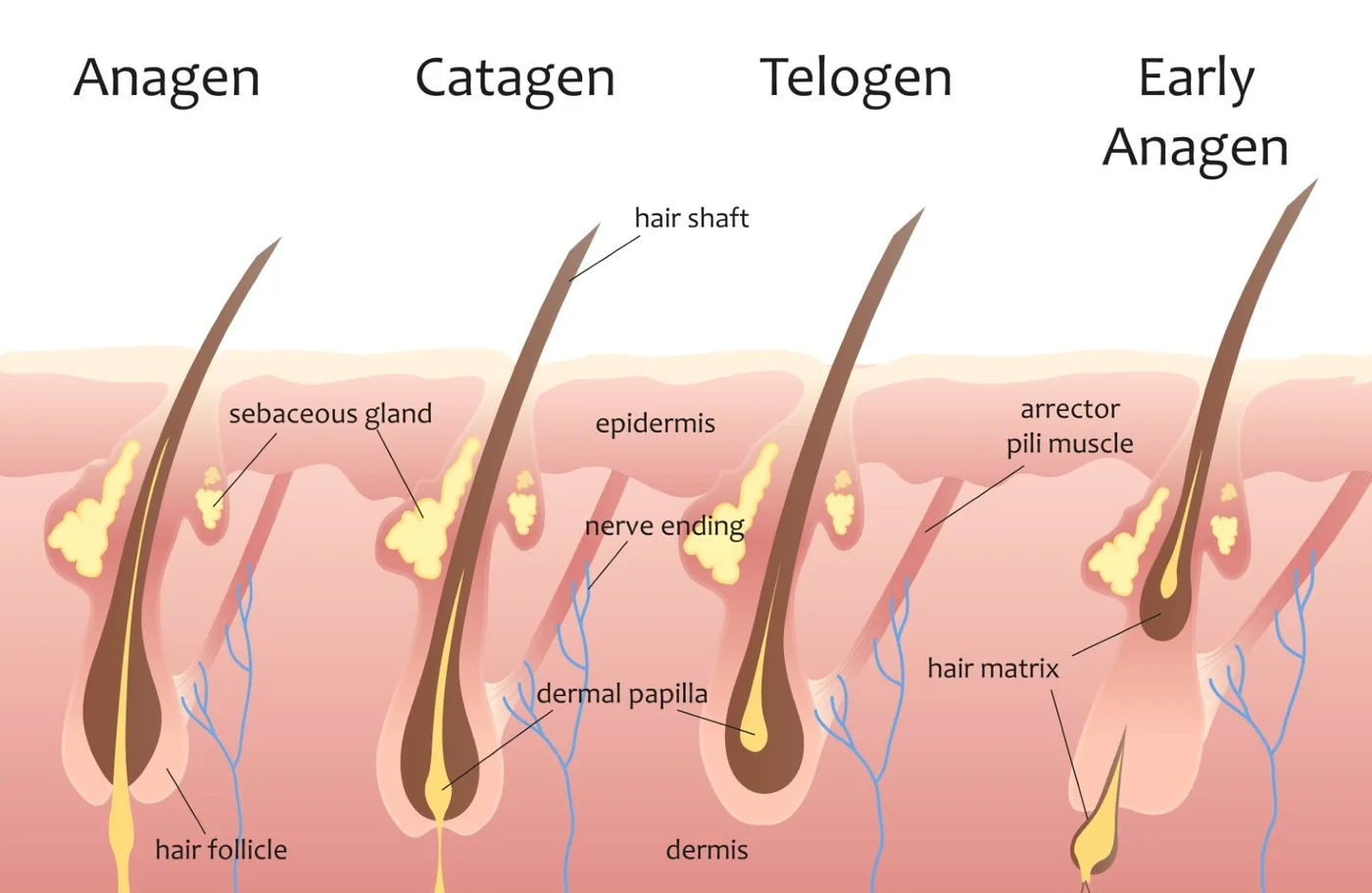
Hair does not grow continuously. It passes through three phases, and the laser works effectively only in the first of them.
Anagen, the growth phase
The cells in the follicle divide intensively and produce hair. On the body this lasts from 4 to 12 weeks, depending on the area. It is the only phase in which the laser works effectively.
Catagen, the transitional phase
Growth stops and the hair matrix regresses. It lasts 14 to 21 days.
Telogen, the resting phase
The hair dies off and is pushed out of the follicle until it falls out. It lasts 30 to 90 days, and it is this phase that sets the intervals between treatments.
At any given moment only 20 to 30 per cent of the hairs in a given area are in anagen. The rest are invisible to the laser. That is why one treatment cannot remove all the hair, and a course is planned so that successive sessions catch successive batches of hair as they enter the growth phase.
Three lasers and when each is used
There is no single laser that is good for everything. The choice depends on the skin phototype, the colour and thickness of the hair and the area of the body.
Hair-removal lasers at NL Clinic and when we choose which
| Laser (wavelength) | For which skin and hair | Phototypes per device documentation | Treatment feature |
|---|---|---|---|
| Diode, 810 and 940 nm | Most areas and phototypes; the basic tool | I to VI (interface settings) | Large spot, dynamic mode with short pulses, double cooling |
| Alexandrite, 755 nm | Lighter and finer hair on light skin | I to IV | Stronger affinity for melanin, additional medical cooler |
| Alexandrite and Nd:YAG together, 755 + 1064 nm | Areas with uneven hair growth; when the hair response changes during the series | I to V (combined mode) | Both wavelengths at the same spot, simultaneously or in sequence |
| Nd:YAG, 1064 nm | Darker phototypes and selected areas | higher phototypes | Absorbed less by epidermal melanin, lower risk of pigmentation |
The range of phototypes differs between devices and it is usually what decides the choice. The treatment documentation of our platform covers phototypes I to IV for 755 nm on its own and I to V in the combined mode with 1064 nm, while the interface of the diode laser allows phototypes I to VI to be set. This is why we work with the diode at higher phototypes, and the alexandrite stays with fairer skin. During a course it happens that successive sessions are carried out with different lasers, because the hair on one body is not uniform.
Who it suits and who it does not
A good candidate
Hair darker than the surrounding skin, with enough melanin in it.
Recurrent folliculitis and persistently ingrowing hairs that lead to painful lesions.
Irritation after shaving and waxing that keeps returning despite a change of method.
People undergoing hormone therapy, including transgender people, once a plan has been agreed with the cosmetologist.
The result will be limited
Blonde, red, white and grey hair, because the laser has nothing in it to aim at.
A fresh tan and fake tan, which raise the risk of burns and pigmentation. That is a reason to move the appointment, not to give it up.
Hair with a hormonal background, where the results can be smaller, more sessions are needed and top-up treatments are the rule.
If you are planning a tattoo in a place you want to treat, do it in this order: hair removal first, then the tattoo. The laser does not work over a tattoo, and the pigment absorbs energy, which risks a burn.
How many treatments and how often
Most people reach a reduction of 80 to 95 per cent of the hair after five to eight sessions. For some, four to six are enough; others need eight or more. The difference comes from the area, the density and thickness of the hair and the hormonal picture.
The interval between treatments is usually four to eight weeks and it is not arbitrary: it follows from the length of the telogen phase, which lasts 30 to 90 days depending on the area. The cosmetologist sets the schedule and adjusts it during the course, watching how the hair responds.
After a full course, top-up treatments are sometimes recommended, usually once or twice a year. Single hairs may become active again because of hormonal changes or natural regeneration, and that is not a sign that the course did not work.
Preparing for the treatment
Three weeks before
No long exposure to the sun. A tan lowers effectiveness and raises the risk of irritation.
Two weeks before
No fake tan. Pigment on the skin disturbs how the light is absorbed and changes the response.
Five to seven days before
Stop using retinol and strongly active cosmetics on the treatment area.
The day before or on the day of the treatment
Shave the area with a razor. Hair standing above the skin absorbs energy that is meant to reach the follicle.
On the day of the treatment
Clean skin, without lotions, oils or cosmetics. A layer of grease disturbs the contact between the handpiece and the skin.
Always
Tell us about changes in your health and about any medicines and supplements you take, including those that seem to make no difference.
Between sessions you may shave, but you must not pull the hair out. Waxing, tweezers and an epilator remove the hair together with the bulb, so the laser has nothing to act on and the whole course loses its point.
The treatment step by step
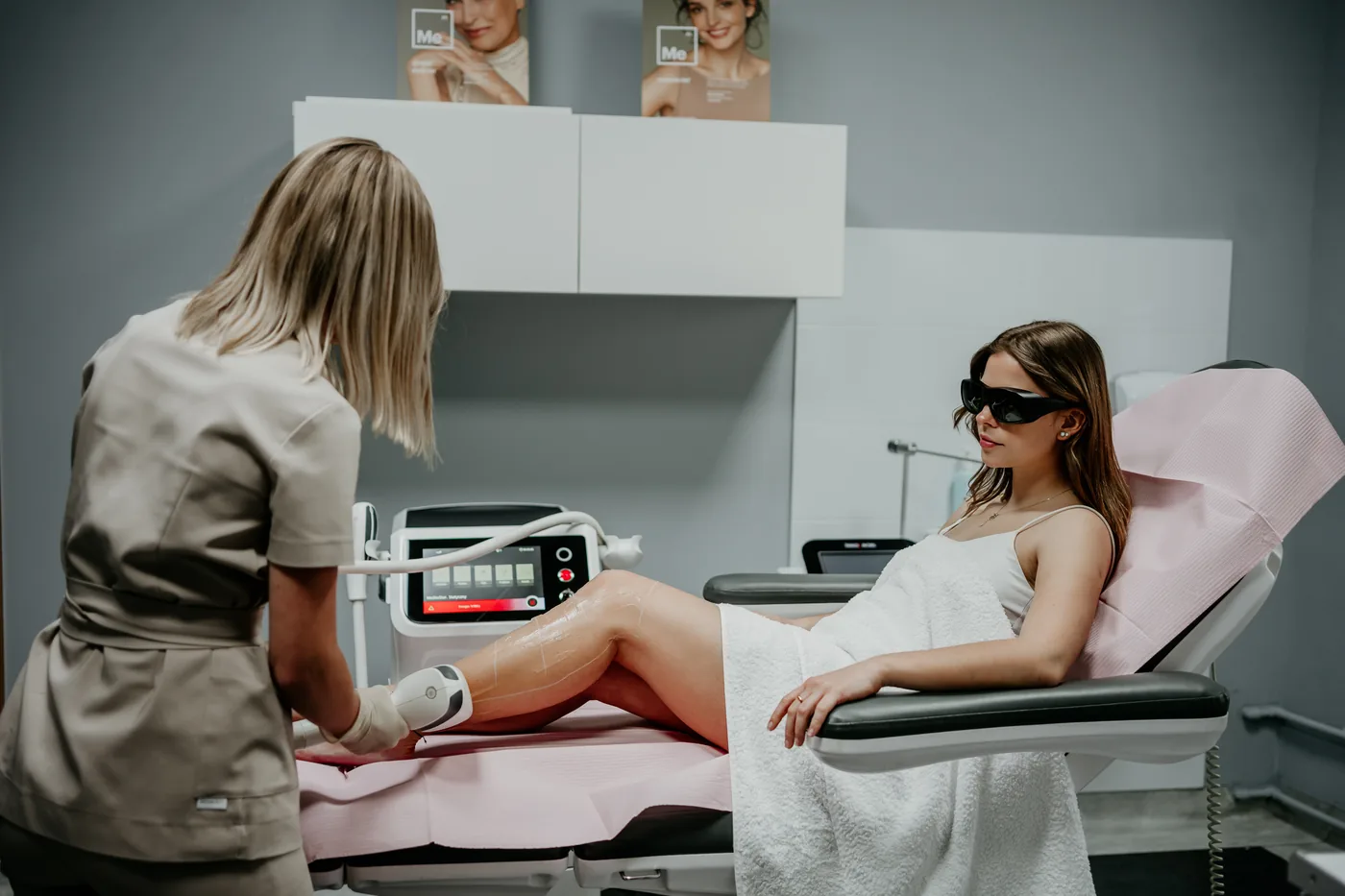
The treatment takes from 15 minutes to an hour, depending on the area. Comfort depends on the area: on the legs and back the skin is thicker and the treatment is often described as barely noticeable, whereas the upper lip, underarms and bikini area are more sensitive. The diode laser has double cooling, and with the alexandrite laser we additionally use a medical skin cooler.
After the treatment and perifollicular swelling
Redness, irritation and perifollicular swelling, that is slightly raised skin around the follicles, are expected reactions. They can last two to three days. The swelling results from melanin absorbing the energy and from temporary damage to the small vessels around the follicle, so its appearance is sometimes taken as a sign that the energy reached where it was meant to.
What is worrying are only symptoms that go beyond this picture: prolonged inflammation, signs of infection or an allergic reaction to the cooling agents. In that case call us rather than wait.
Sun
No sunbathing for two weeks after the treatment, with SPF 50 on exposed areas. That is a requirement, not a suggestion.
Aftercare
Nourishing and soothing preparations, for example with allantoin, panthenol or pure aloe vera extract without fragrance.
Exercise, sauna, swimming pool
Give them a miss for two to three days. Sweat and high temperatures irritate the skin after the treatment.
Active cosmetics
No retinol or strong active ingredients for a few days on the treated area.
Exfoliation
From about a week after the treatment, gentle exfoliation of the treated areas helps the hairs to fall out sooner.
The hairs usually start to fall out about two weeks after the treatment. This is normal and does not mean regrowth.
Contraindications to laser hair removal
The list here is longer than for care treatments, because we work with high-power light. The assessment includes questions about medicines, including photosensitising ones, and about exposure to the sun.
Tattoos and permanent make-up in the treatment area rule out working in that place. Retinoid therapy within the last six months and photosensitising medicines, including tetracyclines and some anti-inflammatory drugs, mean the treatment has to be postponed.
The questions we are asked most often
How many treatments do I need?
Most people reach a reduction of 80 to 95 per cent of the hair after five to eight sessions. For some, four to six are enough; others need eight or more. It depends on the area, the density and thickness of the hair and the hormonal picture.
How often are the following treatments done?
Usually every four to eight weeks, depending on the area. The interval follows from the length of the resting phase of the hair, which lasts 30 to 90 days. The cosmetologist sets the schedule and adjusts it during the course.
Does laser hair removal work on fair and grey hair?
Not in a way comparable with dark hair. The laser targets melanin, so blonde, red, white and grey hairs respond weakly or not at all. It is a physical limitation that no technology gets around.
Can treatments be done in summer?
They can, as long as you do not sunbathe before or after the treatment and you use sunscreen consistently. A fresh tan is a contraindication, because it raises the risk of burns and pigmentation.
Does it hurt?
Comfort depends on the area and on your own sensitivity. On the legs and back, where the skin is thicker, the treatment is often described as almost imperceptible. The upper lip, underarms and bikini line are more sensitive. Cooling the skin and using fast pulses clearly reduces what you feel, and for people who are very sensitive anaesthesia is possible.
Can I shave between sessions?
Yes, shaving is advised. What you must not do is pull the hair out with wax, tweezers or an epilator, because these remove the hair together with the bulb and the laser then has nothing to act on.
Is swelling after the treatment a complication?
No, it is an expected reaction. Perifollicular swelling shows that melanin in the follicle absorbed the energy and it usually settles within a few hours. What is worrying are only prolonged inflammation, signs of infection or an allergic reaction.
When will the hairs fall out?
Usually about two weeks after the treatment. It is a normal stage, not regrowth. Gentle exfoliation of the treated area helps during this time.
Is laser hair removal safe in pregnancy?
We advise against it in pregnancy, because there is not enough research confirming safety in this period. It is a situation where we wait rather than look for a way round.
Is the result permanent?
After a full course most hairs do not grow back, but that does not mean the matter is closed for good. Hormonal changes and natural regeneration can reactivate single follicles, which is why top-up treatments once or twice a year are usually recommended.
This material is for information and does not replace a consultation or an assessment of suitability for the treatment.