
Legal note
The content is for information. It does not replace a consultation, an examination or an individual medical assessment.
Botulinum toxin is a medicinal product dispensed on a doctor's prescription. This page describes a healthcare service performed at our clinic and is not an advertisement for the medicinal product or an encouragement to use it.
In a communication from August 2025, the Office for Registration of Medicinal Products, Medical Devices and Biocidal Products stated that botulinum toxin preparations should be administered only by a doctor or a dentist.
On this page
When sweating becomes hyperhidrosis
Sweating is a function essential for life: sweat cools the body through evaporation and protects it against overheating. The problem starts when the amount goes beyond that need.
Sweat production exceeding 50 mg within five minutes is considered pathological. In practice, this means sweat trickling in streams from under the arms, dripping from the hands, or produced on the feet in an amount that soaks the shoes.
This is not a matter of aesthetics or hygiene. Hyperhidrosis makes work, social contact and everyday activities such as shaking hands or holding a pen more difficult, and it is most intense during the period of greatest professional activity.
Primary versus secondary hyperhidrosis
This distinction determines whether the treatment makes sense at all. That is why it is the first thing we establish at the consultation.
Primary hyperhidrosis
It affects specific areas, symmetrically on both sides of the body: the palms, the soles of the feet, the armpits, the face and the scalp.
It usually appears in childhood or adolescence and may lessen with age. The cause is not precisely known.
This is the form in which treatment with botulinum toxin is the appropriate approach.
Secondary hyperhidrosis
It affects the whole body, not selected areas.
It results from illnesses and infections or from hormonal changes: menopause, diabetes, an overactive thyroid. Sometimes the cause remains unexplained.
It first requires diagnosis and treatment of the cause. A local treatment is not the solution here.
Factors affecting sweating include febrile illnesses, high ambient temperature and humidity, emotions and stress, metabolic disorders such as an overactive thyroid, diabetes and menopause, neurological causes, and taste stimuli: coffee, chocolate and spicy seasoning. Some of these are a sign that the cause needs to be looked for outside an aesthetic medicine practice.
The treatment on video
A recording from our treatment room, without editing to speed the work up.
How botulinum toxin reduces sweating
Sweat glands are controlled by nerve fibres. The preparation blocks conduction in these endings at the injection site, so the glands stop receiving the signal to produce sweat.
The effect is local and concerns only the area covered by the treatment. Sweating in the remaining parts of the body stays unchanged, since there is no question of switching off thermoregulation as a whole.
It is worth adding that treating primary axillary hyperhidrosis is one of two registered indications for botulinum toxin type A in Poland, alongside vertical frown lines between the eyebrows. Working on the hands and feet is an off-label use, which the doctor explains during qualification.
Areas where the treatment is performed
Underarms
The most common location and one of two registered indications for botulinum toxin type A in Poland.
Hands
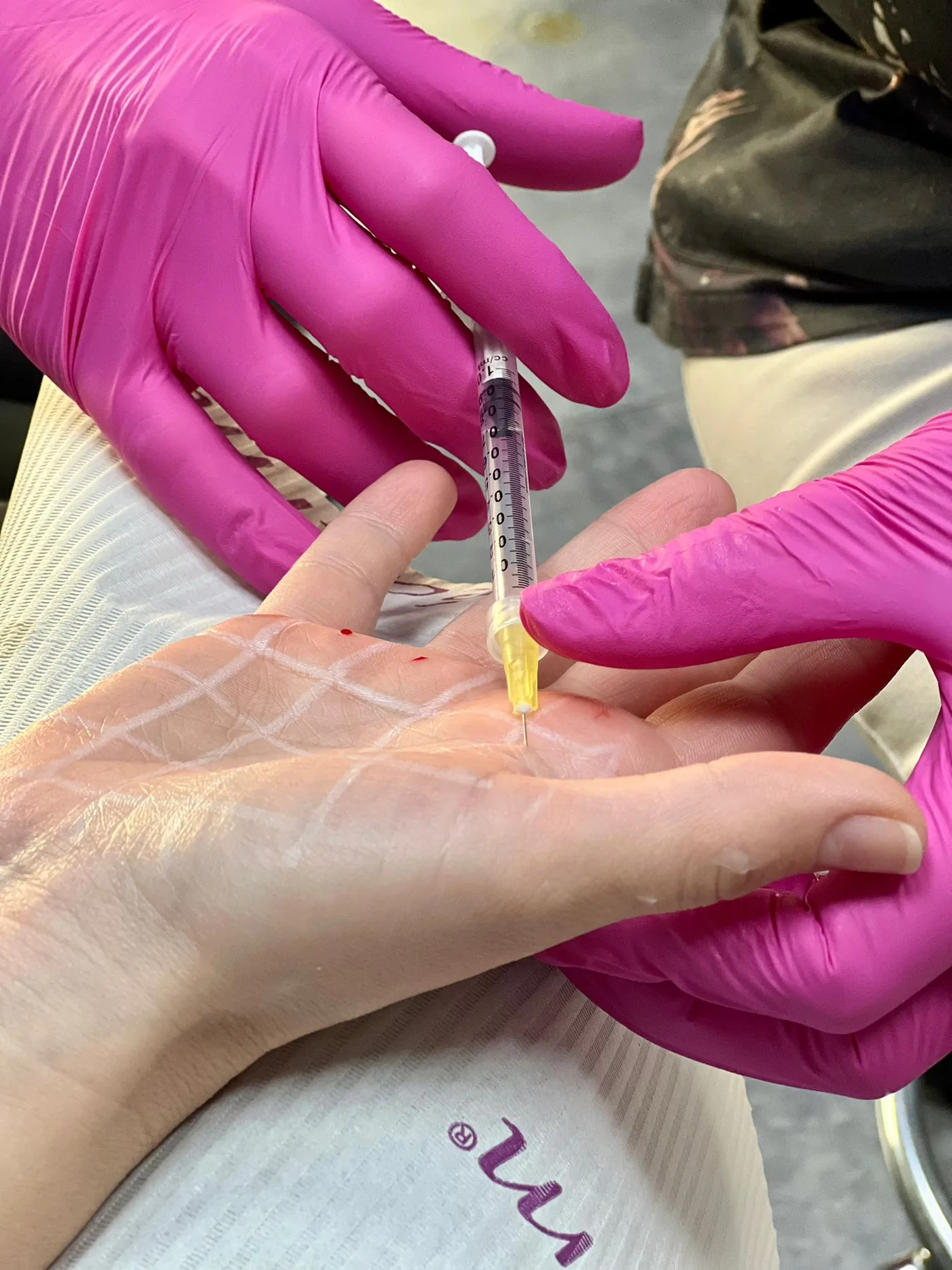
An area that is particularly troublesome at work and in professional contacts. The skin here is more sensitive, so we use anaesthesia more often.
Feet
Sweating that soaks through footwear. As with the hands, the treatment tends to be more noticeable.
Face and scalp
A less common location, requiring a more careful injection plan because of the proximity of the facial expression muscles.
The treatment step by step
The procedure itself takes about thirty minutes, and the first visit including qualification about forty-five minutes. Anaesthetic cream is not required, but we use it for comfort, especially on the hands and feet, where the skin is more sensitive.
Results and how long it takes to see the effect
The first results appear after about a week, and the full effect after about four weeks from the treatment. The effect lasts from six to twelve months, after which it fades, so the course needs to be repeated.
This is a range, not a promise. The duration of effect depends on the area, the dose and individual response, and can be shorter in some people. As with wrinkle treatments, in some patients the preparation works less well because of antibodies produced by the immune system.
What the treatment will not do
It does not treat secondary hyperhidrosis. If sweating affects the whole body and results from a systemic illness, the starting point is diagnosis and treatment of the cause, not a local treatment.
It does not remove the problem permanently. The effect is temporary, and the course needs repeating every few months, up to around a year or more.
It does not work outside the injection area. A treatment on the armpits will not affect sweating in the hands, and the other way round.
It does not stop thermoregulation. The body still cools itself through sweating in the remaining areas of the body.
Contraindications to hyperhidrosis treatment
Medicines affecting neuromuscular conduction are especially important here, including aminoglycosides and macrolide antibiotics. Report all preparations you take during qualification, including those used occasionally.
The questions we are asked most often
How long does the result last?
From six to twelve months. The first results are visible after about a week, the full effect after about four weeks. After that the effect fades and the course needs to be repeated. This is a range, not a promise, since the duration depends on the area, the dose and individual response.
How do you know it is hyperhidrosis and not normal sweating?
Sweat production exceeding 50 mg within five minutes is considered pathological. In practice, this means sweat running in streams from under the arms, dripping from the hands, or soaking through shoes, occurring regardless of temperature and exertion.
Is it safe to block sweating?
The effect is local and concerns only the injection area. The body still cools itself through sweating in the remaining areas, so thermoregulation as a whole is preserved. Medical qualification serves, among other things, to rule out situations in which the treatment would not be advisable.
Does the treatment hurt?
The sensation is a series of pricks with a very fine needle at the marked points. On the armpits most people tolerate it well, on the hands and feet the skin is more sensitive, which is why we more often use anaesthetic cream there.
Will I sweat more in other places?
This is a common worry. The treatment works only in the injection area and does not shift sweating elsewhere. If you notice a clear change in other areas after the treatment, mention it at your follow-up visit.
Will the treatment help if I sweat all over my body?
Probably not, and that is an important distinction. Sweating over the whole body is secondary hyperhidrosis, usually resulting from a systemic illness or hormonal changes. In that case, the starting point is diagnosis with a GP or endocrinologist, not a local treatment.
When is the best time to have the treatment?
Before the season when sweating bothers you most. The full effect appears after about four weeks, so if summer matters to you, plan the treatment in spring, not in July.
Can I exercise after the treatment?
For the first 24 hours, skip intensive exercise, the sauna and hot baths. After that you return to your usual activity, and the restrictions no longer concern sweating itself.
Do you have to repeat the treatment at the same interval every time?
No. The next appointment is set when you start noticing sweating returning, not by the calendar. For some people that means once a year, for others twice.
How much does hyperhidrosis treatment cost?
The cost depends on the area and the dose of the preparation, which is why we keep one current aesthetic medicine price list. You will get an exact quote at the consultation, once the scope of the treatment has been established.
The content is for information. It does not replace a consultation, an examination or an individual medical assessment.