
On this page
What it involves
The skin has the ability to repair itself. Micro-punctures of a chosen depth cause a controlled injury, to which the body responds with inflammation and the start of healing. That is when fibroblasts begin to work on collagen, elastin and hyaluronic acid.
The second mechanism is simpler: the microchannels created by the punctures make it easier for active ingredients to penetrate deep into the skin. That is why preparations designed for work with microneedles are used during the treatment, although they are not necessary in every protocol.
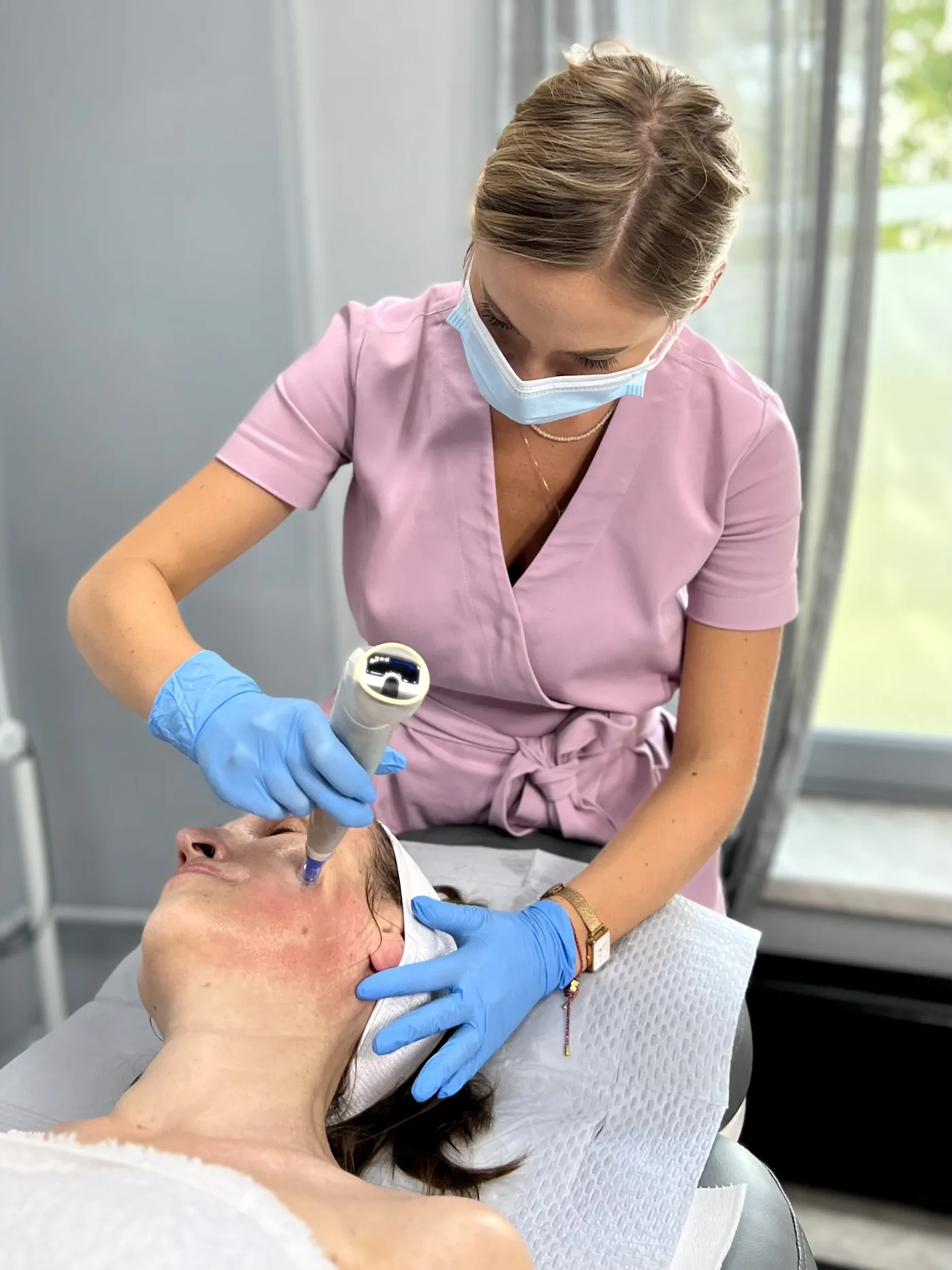
We perform the treatment on the face, neck and décolletage, as well as on the thighs, buttocks and scalp. The shape of the handpiece also allows work in areas requiring precision, around the eyes and lips.
A recording of the treatment
Recordings from our treatment room. The first shows the course of microneedling, the second compares microneedling with classic needle mesotherapy.
The recordings do not play on their own and download only on click. We do not publish before and after material, because without an identical frame, lighting and time interval such a comparison is misleading.
The device and operating parameters
We work with a certified device with pulsating needles and single-use needle cartridges.
0.2 to 3 mm
The working depth range, chosen to suit the area and the indication.
16 needles, 33G
A single-use, sterile needle cartridge, replaced after every treatment.
Vertical movement
The pulsating needles enter the skin perpendicularly, without stretching the tissue.
3 to 6 sessions
A typical series, at intervals of 3 to 4 weeks.
The working depth is chosen to suit the area: shallower on the thin skin of the lower eyelids, deeper on the cheeks and within scars and stretch marks. We replace the cartridge after every treatment.
Indications
Microneedling is sometimes chosen when the aim is to remodel and improve the quality of the skin, not to change the features.
With pigmented lesions of unclear nature and with severe hair loss, a medical assessment is needed first. The cosmetologist will say so at the consultation and indicate the right order.
Results: after which treatment and for how long
A typical plan is three to six treatments at intervals of three to four weeks, together with home care. The interval is not accidental: the skin needs time to go through a full healing cycle before it receives the next stimulus.
The results build up, because the mechanism relies on tissue remodelling. Some people notice better hydration and elasticity after the first session, whereas changes in density, texture and the appearance of scars usually appear after the whole series. The scale of improvement cannot be promised before the skin is assessed, and in some people it is limited.
What decides the result
The device is one, but the way it is used changes the result. Below are the variables set at the assessment and corrected during the series.
Working depth
The range of 0.2 to 3 mm is not a single setting for the whole face. Work is shallower on the thin skin of the eyelids and forehead, deeper on the cheeks and within scars and stretch marks.
Number of passes and the target state
The aim is not the strongest possible reaction, but a specific picture of the skin after the treatment: usually even erythema, and when working on scars sometimes pinpoint bleeding. The number of passes is chosen accordingly.
The preparation used during the treatment
Moisturising and regenerating ingredients designed for work with microneedles enhance the effect of the treatment, but they are not necessary in every protocol. That is a decision, not a standard.
Type and age of scars
Fresher and shallower scars respond better than old and pitted ones. Some require laser therapy in addition, which we say before the series starts, not after the third session.
Intervals between sessions
Three to four weeks is the time needed for a full healing cycle. Shortening the interval does not speed up the effect, it only piles stimuli onto skin that is still rebuilding.
What to do after the treatment
Sun protection, stopping irritating ingredients and a few days without the sauna, swimming pool or intense exercise. This part of the plan depends entirely on the patient and genuinely changes the result.
The first session is also an exploratory one: based on how the skin reacted and how long it took to heal, the settings for the next ones are corrected. That is why the whole series is not set in advance, on the basis of the description of the problem alone.
Microneedling mesotherapy step by step
The whole visit most often takes an hour, with an anaesthetic cream working for about twenty to thirty minutes. For some protocols working without anaesthesia is preferred, which is decided by the person performing the treatment together with the patient.
Healing and post-treatment recommendations
Because the treatment works through injury, the skin needs a few days to heal. Immediately after the visit it may be red, warm, tight and slightly swollen. During healing it may peel, itch and react to the sun more strongly than usual. Healing takes from two to seven days and depends on the intensity of the work, the area, the skin's characteristics and lifestyle.
The first hours
We wash the skin only after about eight hours, with a gentle water-based product, preferably one for sensitive skin.
Cosmetics to stop
For a few days we set aside retinol, vitamin C and acids, and other ingredients with irritating potential.
Sun
The skin is sensitive to radiation at this time. SPF 50 plus sunscreen and avoiding exposure are a condition, not a suggestion.
Exercise, sauna, swimming pool
A few days' break. Sweat, high temperature and chlorine increase the risk of irritation and infection. Gentle walks are fine.
Make-up
Usually safe the next day, light and mineral, applied with clean brushes.
We give full recommendations on site, matched to the protocol performed. If the treatment was combined with acids or a laser, healing goes differently and the recommendations are stricter.
Contraindications to microneedling mesotherapy
The following situations rule out the treatment or require postponing it until they are cured. We check the list during the assessment, together with a question about medication, supplements and allergies.
We do not perform the treatment during pregnancy and breastfeeding. Anticoagulant treatment increases the risk of bruising, so report it before the visit, and any modification of the treatment is decided only by the treating doctor.
A home roller versus the device in the clinic
Microneedle rollers for home use are not the equivalent of the treatment in the clinic. A hand-guided roller works at an angle and stretches the skin, with no control of depth, and there are no aseptic conditions at home. The consequences are often the opposite of what was intended: irritation, wounds, scars, pigmentation and bacterial infections. That is why we do not recommend microneedling on your own.
Microneedling or needle mesotherapy
Both methods belong to mesotherapy, but they place the emphasis differently. Which one makes sense is decided by the assessment of the skin, the aim of the therapy and the time you have for healing. Below are the differences, so you know what we are talking about in the clinic.
Microneedling
Works through a mechanical stimulus. Micro-punctures trigger healing, and the preparation penetrates through the microchannels created.
Chosen for uneven texture, enlarged pores, scars and stretch marks, and also for work on larger areas of the body.
Requires 2 to 7 days of healing, with erythema usually visible for 1 to 3 days.
You are on this pageMesotherapy for the skin
Works through the composition of the preparation. Intradermal delivery point by point allows the composition of the preparation and the depth of its delivery to be controlled.
Chosen for dehydration, a loss of density and fine lines, when the aim is to nourish and hydrate the skin.
The papules from the injections usually disappear within a day; bruising is possible.
Go to needle mesotherapyThe questions we are asked most often
Is the consultation paid?
A consultation with a cosmetologist is free and does not commit you to having a treatment. If the skin needs a different approach first, we will say so directly. A consultation with an aesthetic medicine doctor is paid according to the price list.
How visible is it that a treatment was done?
Most often for 24 to 48 hours it is visible that something was done. With treatments combined with acids or a laser, this time is longer. If you have an important event, plan the treatment at least a week earlier, and do not combine the first visit with other methods.
How much does it hurt?
Sensations are individual; the most sensitive areas are the forehead and nose. With a low pain threshold we work shallower, slower and with breaks. Say so before the treatment starts.
Can the treatment make acne worse?
In itself it does not clog pores. With active pustular lesions we hold off until they calm down and propose a different approach first. After the treatment it is worth sticking to light, non-comedogenic formulas.
I have recurrent herpes, what then?
Report it before the visit. We do not work on active herpes, and with recurrences a short antiviral prophylaxis is sometimes introduced, after agreeing it with a doctor.
I have a darker phototype, what is the risk of pigmentation?
It requires more caution: shallower work, consistent SPF 50 plus and sometimes preparations that inhibit melanogenesis before and after the series. We do not perform the treatment on a fresh tan.
I take anticoagulants, what about bruises?
The risk of bruising increases. Report all medication and supplements. Do not stop anything on your own; any break is decided by the treating doctor.
What if I miss an appointment in the series?
Nothing is lost, we book the next one and return to the plan. What matters is consistency over the longer term, not perfect intervals to the day.
Can I fly after the treatment?
Better not on the same day. Cabin air dries the skin, so a barrier cream, sunscreen and hydration will come in handy, and avoiding the sun at your destination.
Before you decide
Consultation with a cosmetologist
The cosmetologist assesses the skin, says whether microneedling is a good choice at this moment and proposes a plan. The conversation does not commit you to having a treatment, and if the skin needs something else first, you will hear it directly. A consultation with an aesthetic medicine doctor is paid according to the price list.
This material is for information and does not replace a consultation or an assessment of suitability for the treatment.