
Let us start with the boundary
A worrying pigmented lesion requires a dermatological assessment first, not a lightening treatment.
This applies to lesions that change shape, colour or size, have irregular edges, itch, bleed, or appeared recently and are growing quickly. An aesthetic approach to an unassessed lesion could delay proper diagnosis.
We support the assessment of lesions with digital dermoscopy, which allows the lesion to be viewed under magnification and its appearance documented. It is decision support, not a diagnosis. In difficult cases we refer you to cooperating dermatologists rather than proceeding with a treatment on our own.
On this page
Five solutions and what each works with
Instead of one device for everything we have five, because pigment lies at different depths and absorbs light differently. Below is what each of them works with. This is a description of the mechanism, not a selection rule: the choice is made by the person conducting the treatment after assessing the lesion and the phototype, and for some lesions combining two technologies is more appropriate than one.
IPL
broadband light
A medical-grade platform allows the bands and filters to be matched to the indication. Used for sun spots, lentigines, freckles, melasma and post-inflammatory pigmentation.
IPL with an erbium glass laser
1550 nm
Combining work on pigment with the action of the erbium glass laser, which in our laser park is responsible for collagen remodelling and skin regeneration.
755 nm
A range with high absorption by melanin, working through selective photothermolysis. Adjustable settings allow the treatment to be adapted to different skin types, and larger spot sizes speed up work on large areas.
Thulium laser
1940 nm
The energy breaks up excess melanin, which leads to lightening of pigmentation. Used for dyschromia and photodamage, including melasma.
Picosecond laser
1064 and 532 nm
The pulse breaks the pigment up mechanically, not thermally, so less heat reaches the tissue around the target. Used for pigmentation and melasma.
Combining technologies in one plan, for example IPL with the erbium glass laser, is intended to increase the effectiveness of the therapy and limit the risk of new depigmentation or post-treatment pigmentation. The order and intervals are set by the person conducting the treatment.
Which lesions respond to therapy
Melasma is a separate case here. It recurs, often has a hormonal background and responds to overly aggressive settings with worsening of the lesions, which is why it is managed cautiously and in stages. More about the types of pigmented lesions and their mechanisms is on the skin pigmentation page.
Which origin of the lesion affects the course of therapy
A full description of the types of pigmentation and where they come from is on the skin pigmentation page. Here only what changes the way the laser treatment is conducted.
Intense ultraviolet radiation, including when using a sunbed.
Applying perfume or eau de parfum to areas exposed to sunlight.
A hereditary background and changes appearing with age.
A consequence of previous laser treatments.
The last item on this list matters in practice: pigmentation can be a consequence of a previous laser treatment. That is one of the reasons why settings are escalated cautiously and the phototype is assessed before every session.
The course of laser pigmentation removal
The treatment takes from 15 to 60 minutes. The time depends on the intensity of the pigmentation and on the size of the area being treated.
The beam acts selectively on cells with excess pigment, leaving the surrounding tissue largely untouched. The light penetrates the skin and reaches the areas where melanin is deposited, and the absorbed energy leads to its breakdown. The fragmented pigment is then removed by the body.
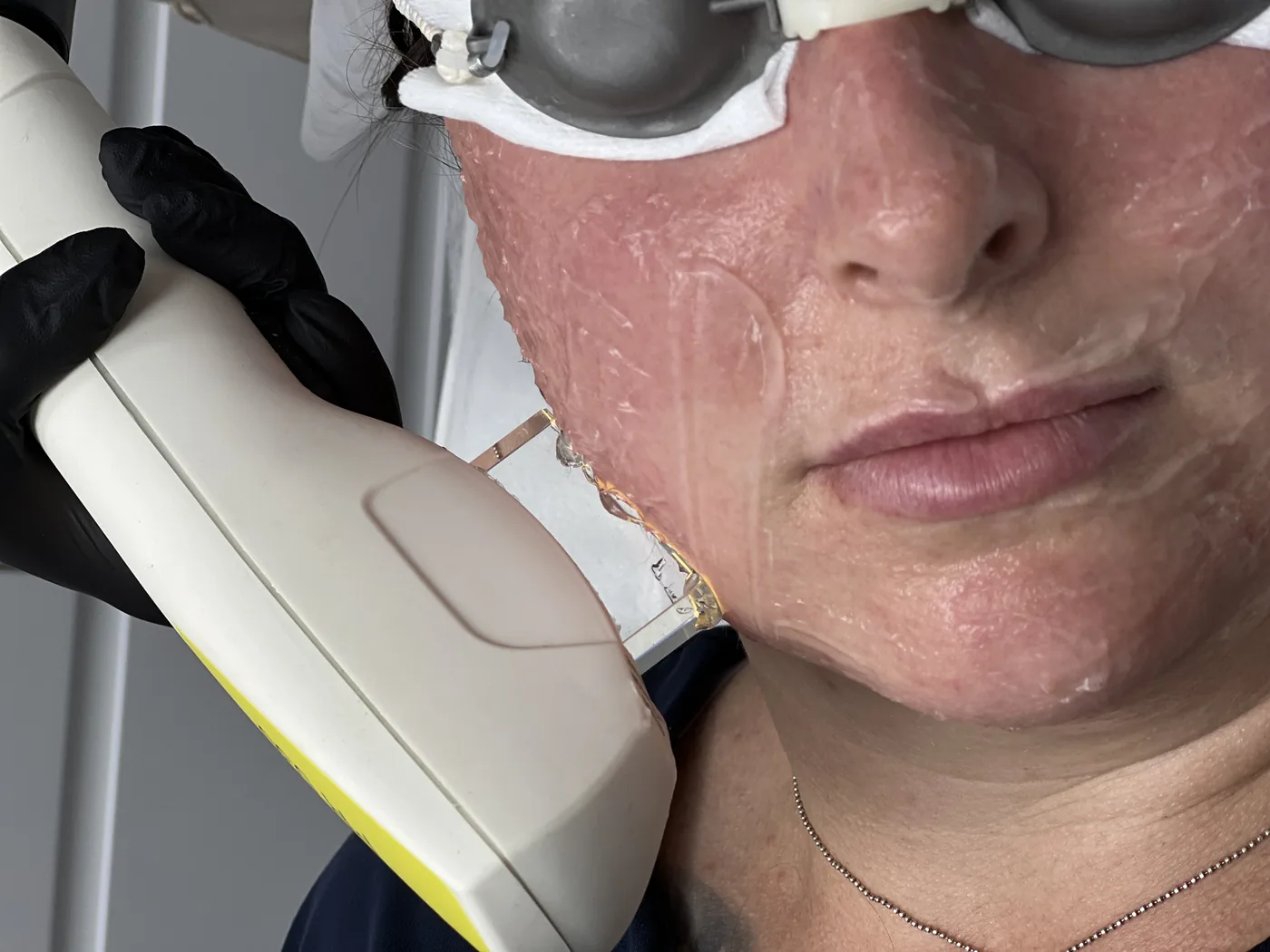
The treatment does not require a long recovery, but that does not mean there is no reaction afterwards. The skin may be transiently red, and at the site of the lesion darkening and gentle peeling may appear, which must not be hurried.
Why sun protection is part of the therapy
With this indication, sun protection is not an additional recommendation but a condition for the whole approach to make sense.
Ultraviolet radiation stimulates melanin production, so without a high-factor sunscreen the treatment works against a stimulus that arrives every day. This also applies to sunbeds. Proper protection of the skin from radiation and proper skincare are key to maintaining an even tone also after the series is complete.
What this treatment will not do
It will not establish the cause of the pigmentation. If hormones, contraception, replacement therapy or a systemic disease are behind it, the cause is managed with a doctor.
It does not protect for the future. Without sun protection melanin continues to form and the lesions return.
It does not replace the diagnosis of a pigmented lesion or a dermatological assessment.
It does not remove melasma permanently. With this condition the approach is long-term, with maintenance.
We do not give the number of sessions or the degree of lightening before an assessment. In some people the improvement is limited, and for some lesions a peel or topical therapy is more appropriate than a laser.
Contraindications to laser pigmentation removal
A fresh tan is an absolute contraindication here for as long as it lasts, not a matter of preference. Also tell us about the medication you take, because some of it increases the skin's sensitivity to light.
Editorial responsibility
Responsible for the content
NL Clinic, Katowice
How the content is created
Last updated
15 August 2026
The material is for information and does not replace a consultation, an examination or a dermatological assessment.
The questions we are asked most often
Why do you use several different devices for pigmentation?
Because one pigmented lesion is not the same as another. What matters is the depth at which the pigment lies, the extent of the lesion, the skin phototype and whether the lesion tends to recur. We have at our disposal IPL, IPL combined with the erbium glass laser, and the alexandrite, thulium and picosecond lasers. The choice belongs to the person conducting the treatment after assessing the lesion.
When does pigmentation require a visit to a dermatologist first?
Whenever a pigmented lesion is worrying: it changes shape, colour or size, has irregular edges, itches, bleeds, or appeared recently and is growing quickly. We do not perform a lightening treatment on a lesion that has not been assessed, because an aesthetic approach could delay proper diagnosis.
How long does the treatment take?
From 15 to 60 minutes. The time depends on the intensity of the pigmentation and on the size of the area being treated.
Can melasma be removed permanently with a laser?
No. Melasma tends to recur, especially with a persisting hormonal factor and with sun exposure. The approach reduces the visibility of the lesions but does not remove the cause. Without consistent sun protection the pigmentation returns, and with melasma overly aggressive settings can even make it worse.
Can I sunbathe after the treatment?
No. Protection from ultraviolet radiation is part of the therapy for this indication, not an additional recommendation. Radiation stimulates melanin production, so without a high-factor sunscreen the treatment works against a constantly arriving stimulus. This also applies to sunbeds.
Can a laser treatment itself cause pigmentation?
Yes, and that is why the assessment is decisive here. Post-treatment pigmentation is one of the possible consequences of laser treatments, especially with a darker phototype, a fresh tan and overly aggressive settings. Cautious escalation of settings and assessment of the phototype serve precisely to limit this risk.
The content is for information. It does not replace a consultation, an examination or a dermatological assessment.