
On this page
Three types of wrinkles
The distinction matters in practice, because each type results from a different mechanism and calls for a different direction of treatment.
Expression, or dynamic
They arise from many years of repeated movements of the muscles involved in facial expression. Over time, as the skin loses its ability to return to its initial state, they become visible at rest as well. They are sometimes the first change that patients notice, and they make the face look tired regardless of mood.
Static
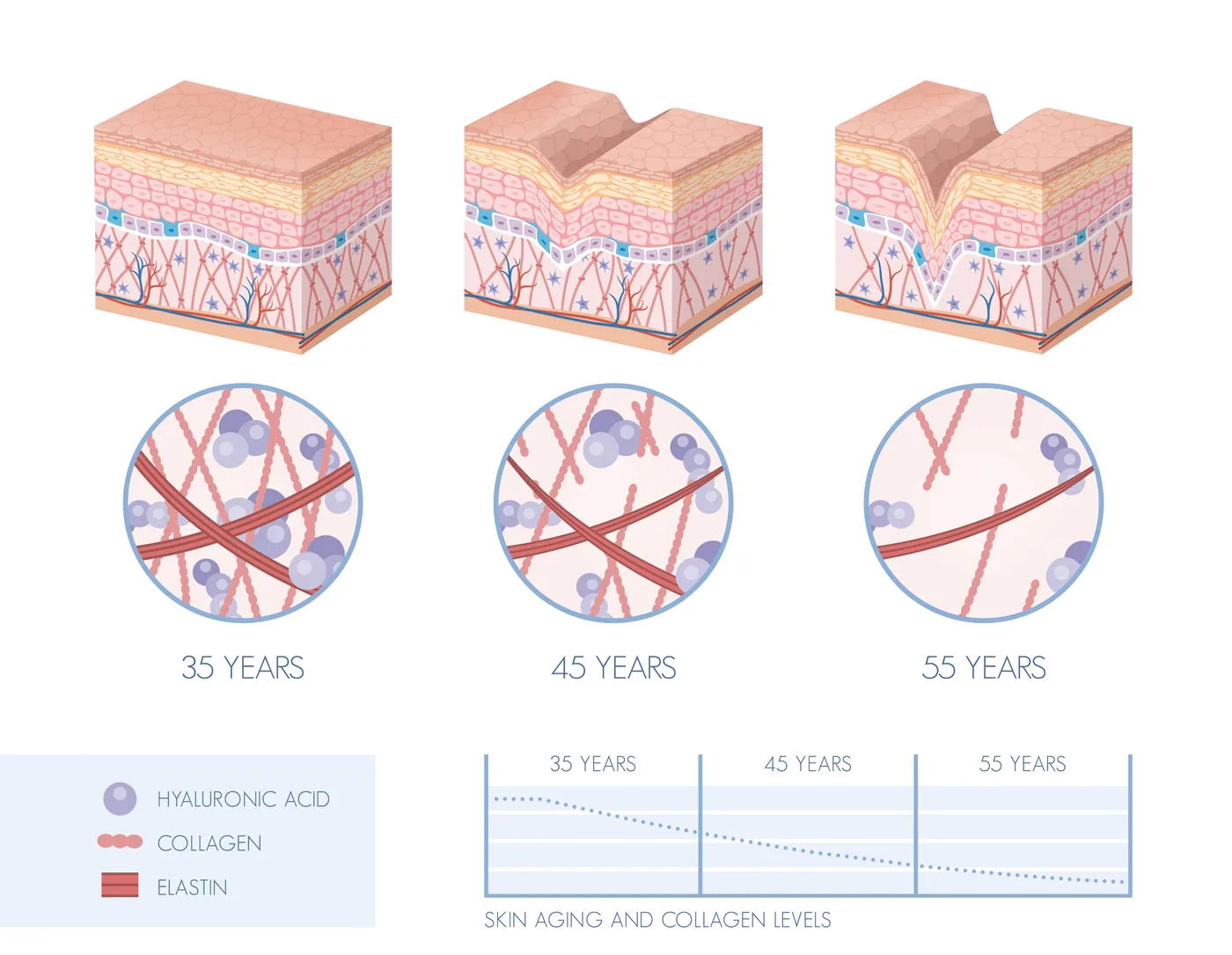
Fixed lines and folds, present when the muscles are relaxed. They do not disappear when the skin is stretched. They result from the loss of collagen, elastin and other components of the extracellular matrix, as well as from the loss of subcutaneous fatty tissue and changes in the bone tissue. In people with extensive sun damage, a static elastotic variant is described.
Gravitational
They appear when the skin loses its resilience and the contour of the face changes. They affect the areas where the tissues descend over time: the cheeks, the jawline and the neck.
Sleep wrinkles, which form when the skin is compressed during sleep, are described separately, as are the fine surface lines in people with dry skin, referred to as linear or glyphic.
Most common locations
- radiating lines around the eyes, commonly called crow's feet, linked to laughing and squinting
- vertical lines between the eyebrows, described as the frown line
- horizontal lines on the forehead, resulting from raising the eyebrows
- lines around the mouth: marionette lines and vertical lines crossing the lip contour
- the tear trough and the nasolabial lines within the group of static changes
Differences between women and men
The mechanisms of ageing are shared; the course differs. Men's skin is thicker, contains more collagen and loses firmness more slowly, so the changes appear later, although they may be deeper and more clearly marked.
In women, the level of oestrogens matters, as they affect collagen production. Their decline during the menopause accelerates the loss of firmness. The distribution of fatty tissue also differs: a greater volume around the cheeks and lips masks the losses for longer, whereas when there is less of it, the loss of volume becomes apparent sooner.
Wrinkles are a natural part of skin ageing, not a disease. Assessment of an area serves to establish what can be changed and what cannot, rather than to compare it with any standard of appearance.
Groups of methods that may be considered
Below are the directions of treatment only, without a description of how the procedures are carried out. Details of each method, preparation, reactions after the treatment and prices can be found on the treatment pages that the links lead to.
Eligibility and limitations
The choice of direction depends on the type of changes, their depth, skin quality, age, medicines taken and procedures undergone in the past. With expression lines the approach differs from the one used for fixed folds or for volume loss, so a single method rarely addresses all the reported changes at once.
We do not state the number of treatments or how long the effect lasts before the qualification assessment. These depend on the type of change, the method chosen and individual characteristics, and in some people the improvement may be limited.
Sun protection and skincare remain the basis, regardless of whether a procedure is planned. Without them, changes related to photoageing continue to progress.
Editorial responsibility
Responsible for the content
NL Clinic, Katowice
How the content is created
Last updated
15 August 2026
This material is informational in nature and does not replace a consultation or qualification.