
Legal note
The content is for information. It does not replace a consultation, an examination or an individual medical assessment.
Fillers are medical devices intended for administration by people with the appropriate qualifications. This page describes a health service carried out at our clinic and is not an advertisement for any particular device. We do not give the trade names of the products, because the doctor decides which to use during the assessment, on the basis of the area and the scope of change expected.
The products used at the clinic have medical device documentation and come from a legal distribution chain. Every product has packaging, a name and a batch number. You have the right to ask to see the device documentation before it is injected.
On this page
Fillers or hyaluronic acid
In everyday speech people say „fillers” and that is usually how the question sounds at reception. In medical records the same procedure is described as an injection of cross-linked hyaluronic acid, and in the literature as soft tissue filling. These are three names for one method.
Hyaluronic acid occurs naturally in the skin, where it binds water and keeps it hydrated. The product used for injection differs from it in one respect: the molecules are joined together, that is cross-linked. This is why the gel stays where it is injected for longer, instead of dispersing within a few days.
It should not be confused with the non-cross-linked hyaluronic acid used in mesotherapy. That one does not build volume; it hydrates and improves the quality of the skin. You will find the description on the page about needle mesotherapy.
How hyaluronic acid works in tissue
The gel injected into a chosen layer of tissue takes up space in it and binds water. The result visible on the surface comes from support underneath: a fold becomes shallower because the tissue above it stops sinking inwards.
The product is gradually broken down by enzymes and absorbed. The pace depends on the degree of cross-linking, the amount of material injected, how much the area moves and on individual metabolism. That is why the same product lasts a different length of time in two people, and a different length of time in two areas of the same face.
A filler makes up a loss of volume. It does not remove excess skin, does not change muscle tension and does not act on pigmentation. If the problem is laxity or the quality of the skin, the starting point is a different method, not more product.
Types of filler and how they differ
Products differ in density and in their ability to hold their shape under the pressure of tissue. That decides which layer and which area a given gel suits.
Soft gels
Thinner, with less ability to hold their shape. Injected shallowly, to smooth fine lines and hydrate delicate areas, for example around the eyes.
Gels of medium density
The most commonly used group. They make up volume in folds and in the cheek area, while keeping the tissue above the product mobile.
Dense gels
With a high ability to hold their shape. Injected deeply, when working on the support of structures, for example around the jawline and chin.
Besides hyaluronic acid, aesthetic medicine uses products based on other substances, among them calcium hydroxyapatite and poly-L-lactic acid. They act more slowly and differently, and above all they have no antidote that can dissolve them. That is an important difference when weighing risk. You settle the range of products available at the clinic with the doctor at the consultation.
The areas fillers are used in
Nasolabial folds
The lines running from the sides of the nose to the corners of the mouth. A common reason for a first visit, although the cause often lies higher up, in the cheek area.
Cheeks and the zygomatic area
Making up the volume that is lost earliest. Support in this area changes the picture lower down as well, along the line of the folds.
Tear trough
The under-eye area. The assessment here is careful, because a shadow under the eye does not always come from a loss of volume, and the skin is thin and prone to swelling.
Chin and jawline
Work on the proportion of the lower third of the face and on a defined contour.
Temples
Hollowing in this area changes the shape of the face, although patients rarely name it as a problem.
Lips
Contour, volume and hydration. A separate area with its own healing, described on its own page.
Hands
Making up volume on the back of the hand, where the loss makes tendons and vessels show.
The lip area has its own page, because it follows its own anatomy and its own healing. You will find the description in the part about lip contour and volume.
Who fillers suit and who they do not
The assessment begins with establishing whether what you see in the mirror comes from a loss of volume. A shadow under the eye is sometimes the result of a loss, but it is sometimes pigmentation or swelling, and then a filler will make things worse rather than better.
The doctor assesses the area in movement and at rest, checks the state of the skin, asks about earlier treatments and about every product injected before. Information about what was injected and when matters even if the treatment was carried out at another clinic several years ago.
A filler will not remove excess skin. With clear laxity, adding volume deepens the impression of heaviness rather than relieving it.
It does not act on pigmentation or on thread veins. A shadow under the eye of that origin requires a different method.
It is not a method for swelling. In people prone to retaining water, product in the under-eye area can increase it.
It does not replace lost bone mass or changes whose source lies outside the soft tissue.
Treatment course with hyaluronic acid
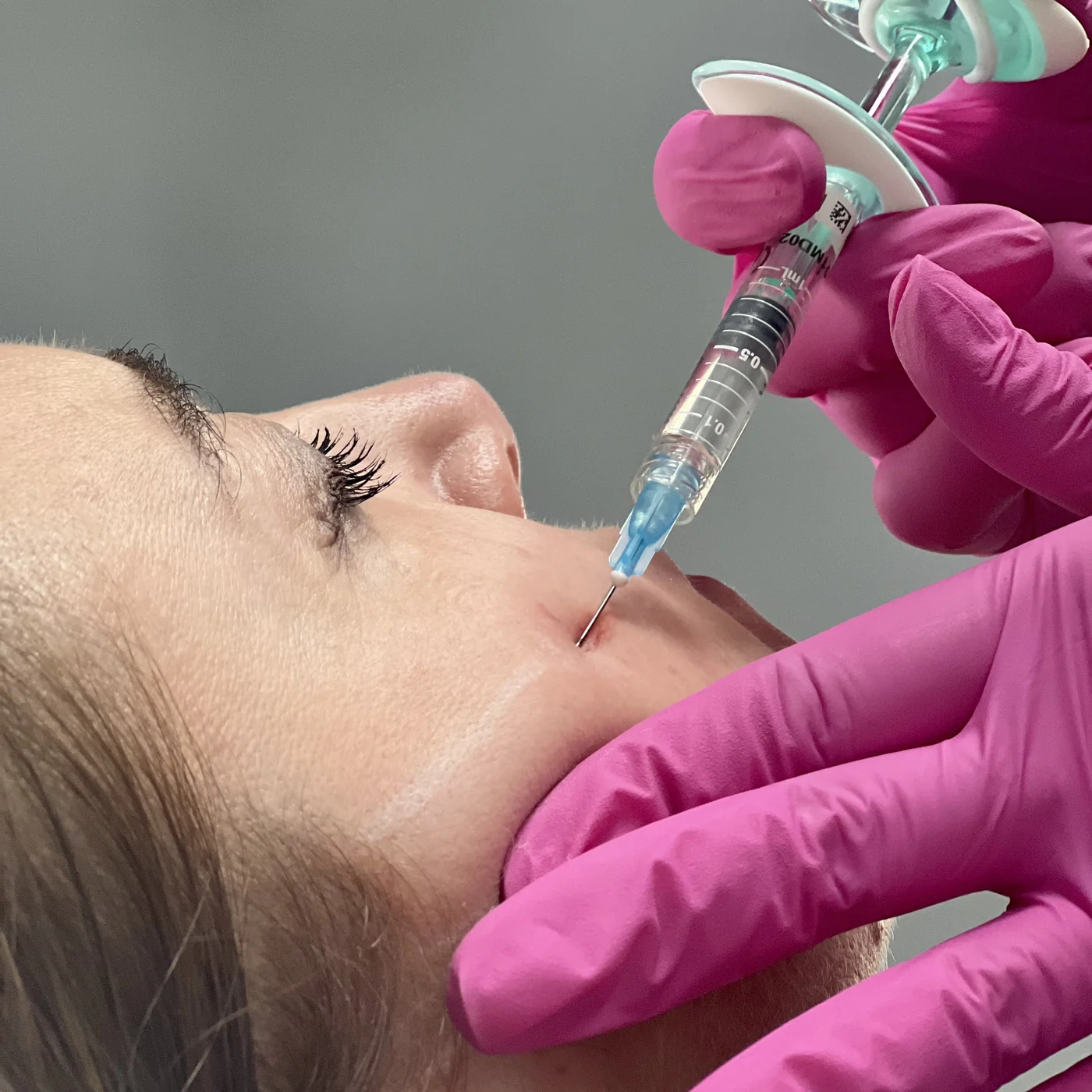
The treatment takes 20 to 60 minutes, depending on the number of areas. The product is injected with a needle or a cannula, that is a blunt-ended instrument which parts the tissue instead of cutting it. The choice belongs to the doctor and depends on the area and on the course of the vessels.
The treatment on video
A recording from our treatment room will show how the product is injected and what working with a cannula looks like. With injection treatments, seeing the procedure usually settles nerves better than any reassurance.
When making up volume, the angle of the photograph changes the picture more than the treatment does, which is why we take both frames in identical conditions.
We publish photos of results only with patients’ consent and under comparable conditions: the same framing, light, facial expression and time interval. The result is always individual.
The results and how long fillers last
The change in volume is visible immediately after the injection, but swelling clouds the first picture. The final distribution of the product is assessed after about two weeks, and only then is the real outcome visible.
The result usually lasts from several to a dozen or more months. That is a range, not a promise. In areas that move a great deal, above all the lips, the product is absorbed faster than in areas that move little, for example the temples or the jawline.
Once it is absorbed, the tissue returns to its starting state, changed by whatever has happened in the meantime through natural ageing. A filler does not stop that process and has no effect on what happens outside the place it was injected.
Reactions after the treatment and recommendations
Expected reactions
Swelling, tenderness and small bruises at the injection points. They usually settle within a few days; around the lips they are more pronounced.
No pressing on the area
For the first day do not massage or press the injection site. Sleep on your back if the treatment covered the cheek or eye area.
No high temperatures
Sauna, steam baths, swimming pool and sunbeds only after two weeks.
No exercise or alcohol for a day
For at least 24 hours no alcohol and no intense physical exercise, which increase swelling.
Sun protection
Sunscreen on the treated area for a few days, especially where there is bruising.
A follow-up after two weeks
An assessment of how the product is distributed once the swelling has settled, and a correction if needed.
We invite you for a follow-up appointment after two weeks. That is the moment when the swelling has settled, the product has spread through the tissue and it is possible to judge whether a correction is needed.
Complications after fillers
Swelling, bruising and tenderness at the injection site are expected reactions, not complications. They usually settle within a few days. We list separately the rare situations you need to know about before deciding, not afterwards.
Blocking or compression of a vessel
The most serious complication. The product may block the lumen of a vessel or press on it from outside, limiting the blood supply to the tissue. The symptoms appear during the treatment or in the hours that follow: severe pain, blanching, a bluish or blotchy colour of the skin, disturbed vision. It requires immediate contact and urgent medical treatment.
Lumps and unevenness
Palpable thickenings at the injection site, following from how the product is distributed or from a tissue reaction. Some settle on their own, some require medical intervention.
An inflammatory reaction and infection
Redness, warmth and growing pain a few days after the treatment require assessment. The risk rises where there is active inflammation in the area, including of dental origin.
Movement of the preparation
The material may change position with time, especially with large volumes in areas that move. This is assessed at the follow-up appointment.
When to call without waiting
Severe, growing pain, blanching or a bluish colour of the skin in the injected area, blotchy discolouration, and any disturbance of vision are situations that require urgent contact. Contact the clinic at once, at any hour. With these symptoms time matters.
+48 881 202 202Contraindications to fillers
Plan dental treatment and vaccinations with an interval from injections, because inflammation in the area increases the risk of a reaction to the product. Report medicines that affect blood clotting before the appointment, but do not stop anything on your own: every change is decided by the doctor treating you.
How they differ from botulinum toxin and from stimulators
Three groups of methods work on three different mechanisms, and confusing them is the most common reason for disappointment.
Fillers
They make up volume. They work where tissue has sunk and support is missing. The result is visible at once, though it is judged after two weeks.
Botulinum toxin
It limits the tension of a muscle. It works on wrinkles that arise from movement, that is expression lines. The result appears within a week.
Tissue stimulators
They prompt the skin to remodel using its own repair mechanisms. They act slowly, over weeks, and work on the quality of the tissue rather than on volume.
The questions we are asked most often
How long do fillers last?
Usually from several to a dozen or more months, depending on the product, the area and metabolism. In areas that move a great deal, above all the lips, the gel is absorbed faster than in areas that move little. That is a range observed in practice, not a statement about any one person.
Does a treatment with hyaluronic acid hurt?
What you feel is limited to a needle prick or the movement of a cannula in the tissue. An anaesthetic cream is used, and some products contain lidocaine. The lip area is more sensitive than the others and the sensations there are more pronounced.
Can a filler be removed?
Cross-linked hyaluronic acid can be dissolved with an enzyme, hyaluronidase. That is a medical procedure, used with complications and when the distribution of the product is unsatisfactory. Fillers based on other substances have no such antidote, and that is one of the more important differences between them.
How do fillers differ from botulinum toxin?
They are two different mechanisms. A filler makes up volume, so it works on folds that follow from its loss. Botulinum toxin limits muscle tension, so it acts on wrinkles from movement. They are sometimes used in one plan, but they do not replace one another.
What are the complications after fillers?
Swelling, bruising and tenderness are expected reactions. Rare, but requiring an immediate response, is the blocking or compression of a blood vessel. The symptoms are severe pain, blanching or a bluish colour of the skin and disturbed vision. In that situation contact the clinic at once, at any hour.
How much do fillers cost?
The cost depends on the area and the number of millilitres of product used, which is why we keep one current aesthetic medicine price list rather than scattered amounts on separate pages. You will learn the price at the consultation, once the plan is set. It is worth asking for the name of the product, the batch number and the device documentation, wherever you decide to go.
Does the face look artificial after fillers?
The look depends on the amount of product, the layer it is injected into and whether the place of the actual loss is the one being filled. An excess in one area changes the proportions of the whole face, which is why the plan is made for the face as a whole rather than for a single fold. Restraint in the amount of product is the doctor's decision, made on the basis of assessing the area.
When should the treatment be planned before an important event?
At least two weeks beforehand. Swelling and bruising usually settle within a few days, and the final distribution of the product is visible after about two weeks. That margin also gives time for a correction at the follow-up appointment.
Do fillers stretch the skin?
With repeated treatments using large volumes the tissue may remodel, and the area may stay enlarged even after the product has been absorbed. That is an argument for intervals between treatments and for careful planning of the amount, which the doctor discusses during the assessment.
Who may carry out a treatment with a filler?
A doctor, after a consultation and an assessment. Injecting a product into tissue requires knowledge of the course of the vessels in a given area and readiness to act in the event of a vascular complication, including access to hyaluronidase. It is worth asking directly about the qualifications of the person carrying it out, at every clinic.
The content is for information. It does not replace a consultation, an examination or an individual medical assessment.