
Legal note
The content is for information. It does not replace a consultation, an examination or an individual medical assessment.
A fat transfer covers harvesting the tissue, preparing it and injecting it, so from beginning to end it is a medical procedure carried out in sterile conditions. The material comes only from the person it will be given to, and it is not stored for later.
On this page
What a fat transfer is
A fat transfer, also called lipofilling, is the harvesting and grafting of the patient's own fat tissue. It belongs to the autologous treatments, that is those in which the material comes from the same person it will be given to.
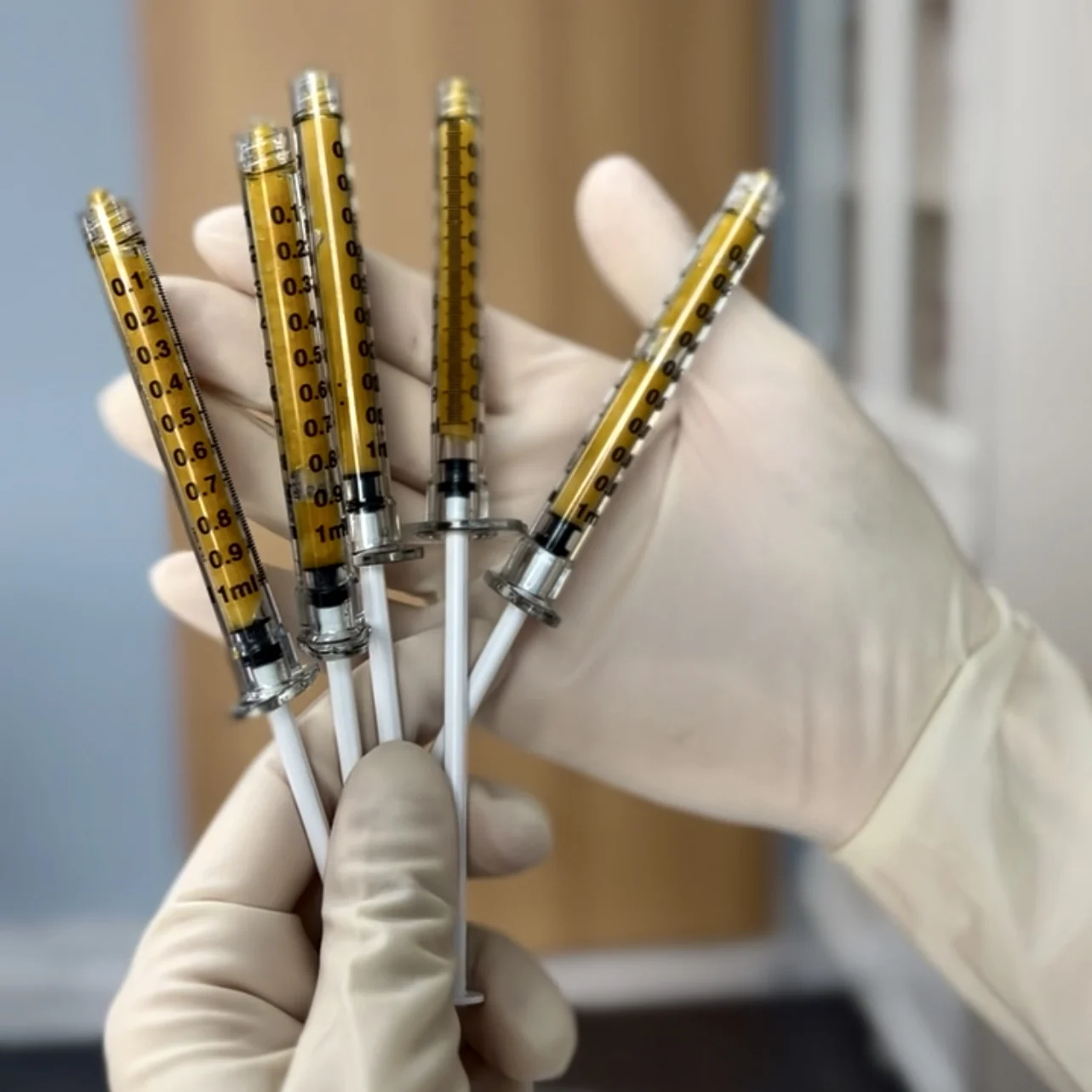
The tissue is harvested in sterile conditions, under local anaesthesia, most often from the abdomen or the flanks. During one treatment the doctor usually obtains 20 to 30 ml of fat tissue. The material is then cleaned, and diluted if needed, and injected with a cannula into the areas that need topping up.
The point of this method is not limited to filling. The transferred tissue contains stem cells, which prompt the tissue at the site to remodel itself and to produce new collagen fibres. This is why the result builds up long after the treatment itself.
Three fat fractions
One word, three different materials. What separates them is how far they have been processed, and that decides what each fraction is suited to.
Macrofat
The unprocessed fraction, with the largest particles. Harvested by liposuction and cleaned, without further breaking down. It contains the most whole, undamaged fat cells.
Used where a considerable volume is needed: in rebuilding larger tissue deficits, including after an injury.
It gives a noticeable volumetric result straight away, with a higher survival rate of the transferred cells, but it is less precise in use.
Microfat
A more processed form with smaller particles, obtained by filtering macrofat.
Used in precise work: on the contours of the face, filling wrinkles and improving the structure of the skin in delicate areas.
It gives a subtler volumetric result than macrofat, but it allows precise work.
Nanofat
The most processed fraction, with very small particles, created by processing microfat further. It contains released growth factors.
Used where the aim is the quality of the skin: with fine wrinkles, revitalisation and on the scalp.
It does not build volume. It works on the texture and density of the tissue, by prompting repair processes.
The doctor carrying out the treatment decides which fraction to use, based on the area and the aim. It is not the patient's decision, because the harvesting and preparation technique follows from it.
The role of stem cells
The stem cells contained in the harvested tissue have the ability to change into various types of cells and have regenerative properties. In practice this helps the transferred fat to bond better with the tissue at the site.
The action is not limited to filling a deficit: the cells activate renewal processes at cell level and prompt the fibroblasts to produce collagen. This is why tissue after a fat transfer can be denser and firmer than the added volume alone would suggest.
An effect on angiogenesis, that is the forming of new blood vessels at the site, is also described. This matters in practice: the transferred tissue will survive only where it becomes supplied with blood. From this follows the relationship between the size of a portion of material and its resorption, because smaller portions gain a blood supply more easily than large ones. It is one of the explanations for why it is not possible to say in advance how much of the graft will take. A fuller account is on the page about fat transfer with stem cells.
Classic fat transfer and nanofat
The division into three fractions describes the material. This comparison is about something else: about how the choice between the unprocessed fraction and nanofat changes the course of the treatment and what you can expect from it.
Precision and particle size
The unprocessed fraction consists of larger portions of tissue, which limits precision in delicate areas. Nanofat has very small particles, so it allows work in places where the skin is thin.
Range of action
The unprocessed fraction works above all on volume. Nanofat does not build volume; it draws on the regenerative properties of stem cells, so it answers the quality of the skin.
Instruments and how demanding the treatment is
Nanofat is injected with thinner needles and cannulas, which limits discomfort and shortens recovery. Working with the unprocessed fraction requires thicker instruments and can be more demanding.
Treatment areas
Nanofat is used where the skin is thin and demanding: the eye area, lips, hands, and the scalp. In these areas, the use of the unprocessed fraction is limited.
Cost and length of the procedure
A treatment with nanofat can cost more, because preparing the material takes longer. It is a difference worth knowing about when planning, because it affects the price of the whole procedure.
Nanofat does not replace the unprocessed fraction, because it does not build volume. When working on a deficit, both are sometimes used in one treatment: the denser fraction where filling is needed, the processed one where the quality of the skin counts.
Indications for a fat graft
Restoring volume in the face
The cheeks, temples and eye area, that is the areas that lose fat tissue with age. Also filling the tear trough.
Wrinkles and folds
Filling fine lines and deeper folds, including nasolabial ones, when their basis is a loss of tissue.
Improving the quality of the skin
Work on the elasticity and firmness of the tissue of the face and neck, using the processed fraction and the stem cells it contains.
Scars
Improving the appearance of scars, including post-acne and atrophic ones, by filling the deficit and prompting the skin to regenerate.
Tissue atrophy
Restoring volume lost through illness or injury.
Evening out the unevenness and hollows left by an earlier treatment.
Hands
Restoring volume on the back of the hand, where the loss makes veins and tendons show.
Scalp
Enriching the scalp with stem cells and growth factors, considered where hair is thinning.
Treatments in intimate areas, including labial augmentation with your own tissue, are carried out as part of aesthetic gynaecology. Assessment there follows separate rules.
Areas and separate treatment pages
Four areas have their own pages, because both the technique and the healing differ.
Volumetry with fat
Work on the volume of the face with your own tissue rather than a synthetic preparation. The most often chosen treatment in this group.
Facial volumetry with your own fatEye area
The skin of the eyelid is thin and has no thicker layer of fat beneath it, which is why signs of time show here earliest. A separate technique and a more careful assessment.
Lipotransfer in the eye areaHand revitalisation
Restoring volume, making veins and tendons less visible and improving the texture of the skin. Swelling and bruising here usually settle within a few days.
Lipotransfer in hand revitalisationHair
Injecting the processed fraction into the scalp, considered where hair is thinning. The approach starts with establishing the cause of the hair loss.
Lipotransfer, a transplant of one's own fatHow the treatment goes
The treatment takes 60 to 180 minutes, depending on the scope. It is not carried out under general anaesthesia, only under local anaesthesia, and special cannulas are used to harvest and inject the material.
The treatment on video
A recording from the treatment room will show the tissue being harvested, the material being prepared and injected with a cannula. With a treatment that raises more concern than an ordinary injection, seeing the procedure has particular value.
We publish photos of results only with patients’ consent and under comparable conditions: the same framing, light, facial expression and time interval. The result is always individual.
Results and the healing schedule
With a fat transfer, time matters more than with other filling treatments, because the transferred tissue has to take in its new place.
The preparation is injected with a small surplus, because part of the material will be absorbed entirely over the following weeks. This is deliberate, not a mistake, and it is why immediately after the treatment the area looks fuller than it finally will.
According to the clinic's observations the result lasts up to three years. That range is individual and depends on the area, the amount of material transferred and how much of it takes in its new place.
Fat transfer and fillers
Both treatments add volume, but they differ in the material, in how they go and in what has to be reckoned with afterwards.
Fat transfer
The material is your own tissue, harvested during the treatment. It requires recovery, and swelling affects two places at once. The result builds up over three months and, according to our observations, lasts up to three years. It cannot be reversed.
Hyaluronic acid filler
The material is a gel injected into the tissue, with nothing harvested. No recovery time, the result is visible straight away and assessed after two weeks. It lasts a shorter time, but it can be dissolved with an enzyme.
A fat transfer is sometimes considered for people with allergies and autoimmune conditions, for whom a synthetic filler is not the right choice. The decision belongs to the doctor, because the list of contraindications to a fat transfer itself is longer than for an injection of hyaluronic acid.
Preparing for the treatment
Medicines and supplements
A few days before the treatment, stop taking blood-thinning medicines, including aspirin, and supplements that increase the risk of bleeding. Only after agreeing it with the doctor treating you.
Alcohol and lifestyle
Avoid alcohol before the treatment. Diet and general condition affect healing, and with a tissue graft also how much of it takes.
Assessment
Raise any doubts and tell us about your health at the consultation. It is only there that the date, the scope and the final cost of the treatment are set.
Do not stop any medicine on your own: changes are decided by the doctor treating you. Raise any doubts and tell us about your health at the consultation before the treatment.
Recovery and recommendations
This is a treatment after which you need to plan some rest. Depending on the scope, recovery takes from a few days to a week, so it is worth choosing a date with your commitments in mind.
Rest
From a few days to a week, depending on the scope of the treatment. This is not an optional recommendation: healing in two places at once takes time.
Swelling and bruising
They appear both where the tissue was harvested and where it was injected. They usually settle within a few days.
No intense exercise
For a few weeks after the treatment avoid intense physical exercise, so that the body can regenerate.
Aftercare and sun protection
Follow the doctor's recommendations on aftercare, including avoiding strong sun and using moisturising creams.
Watching the result
The full result is visible after a few weeks up to three months, when the body has adapted the transferred tissue. Assessing it earlier is misleading.
Swelling and bruising appear in two places at once: where the tissue was harvested and where it was injected. This is what sets a fat transfer apart from injection treatments and it is worth knowing before the treatment.
Contraindications
The list is longer than for injection treatments, because it covers both harvesting the tissue and injecting it.
Diabetes is not an absolute contraindication. What decides is how advanced the condition is and the blood glucose level before the treatment, which has to be controlled, and the patient should remain under the regular care of a specialist.
What a fat transfer will not do
It will not replace surgery. A fat transfer adds volume, but it does not remove excess skin.
It does not give a predictable amount of result, because it is not possible to say in advance how much of the transferred tissue will take in its new place.
It cannot be reversed. Unlike hyaluronic acid, there is no enzyme that dissolves transferred tissue.
It is not a treatment without recovery. If you cannot plan a few days of rest, this is not the right moment for it.
The questions we are asked most often
Where is the fat for a fat transfer taken from?
Most often from the abdomen or the flanks. It is harvested in sterile conditions, under local anaesthesia, and usually 20 to 30 ml of fat tissue is obtained. The material is then cleaned and prepared for injection.
Is a fat transfer done under general anaesthesia?
No. The treatment is not carried out under general anaesthesia, only under local anaesthesia. Special cannulas are used to harvest and inject the material.
How do macrofat, microfat and nanofat differ?
In how far they have been processed. Macrofat is unprocessed, contains the most whole fat cells and serves to rebuild larger volumes. Microfat is made by filtering macrofat and works well in precise work. Nanofat is the most processed, has very small particles and released growth factors, which is why it is used where the aim is the quality of the skin rather than volume. The doctor decides which fraction to use.
When is the full result of a fat transfer visible?
The full result takes up to three months. The first 7 to 10 days are a period of regeneration; only after that is the actual filling visible. The preparation is injected with a small surplus, because part of the material is absorbed over the following weeks, which is why immediately after the treatment the area looks fuller than it finally will.
How long does the result of a fat graft last?
According to the clinic's observations the result lasts up to three years. The range is individual and depends on the area, the amount of material transferred and how much of it takes in its new place. That amount cannot be predicted before the treatment.
Does a fat transfer require recovery?
Yes, from a few days to a week depending on the scope of the treatment. Swelling and bruising appear both where the tissue was harvested and where it was injected. Intense physical exercise should be avoided for a few weeks. This is what sets a fat transfer apart from injection treatments.
With your own fat, is there a risk of allergy?
The material comes from the same person it will be given to, so there is no risk of a reaction to a foreign preparation or of intolerance to it. What remains is the risk connected with the treatment itself: swelling, bruising, infection and uneven take of the transferred material. The list of contraindications here is longer than for an injection of hyaluronic acid.
How much does a fat transfer cost?
The date, the scope and the final cost are set at the consultation with the doctor, after the assessment, because they depend on the area and the amount of material needed. Current amounts are kept in one aesthetic medicine price list.
The content is for information. It does not replace a consultation, an examination or an individual medical assessment.