
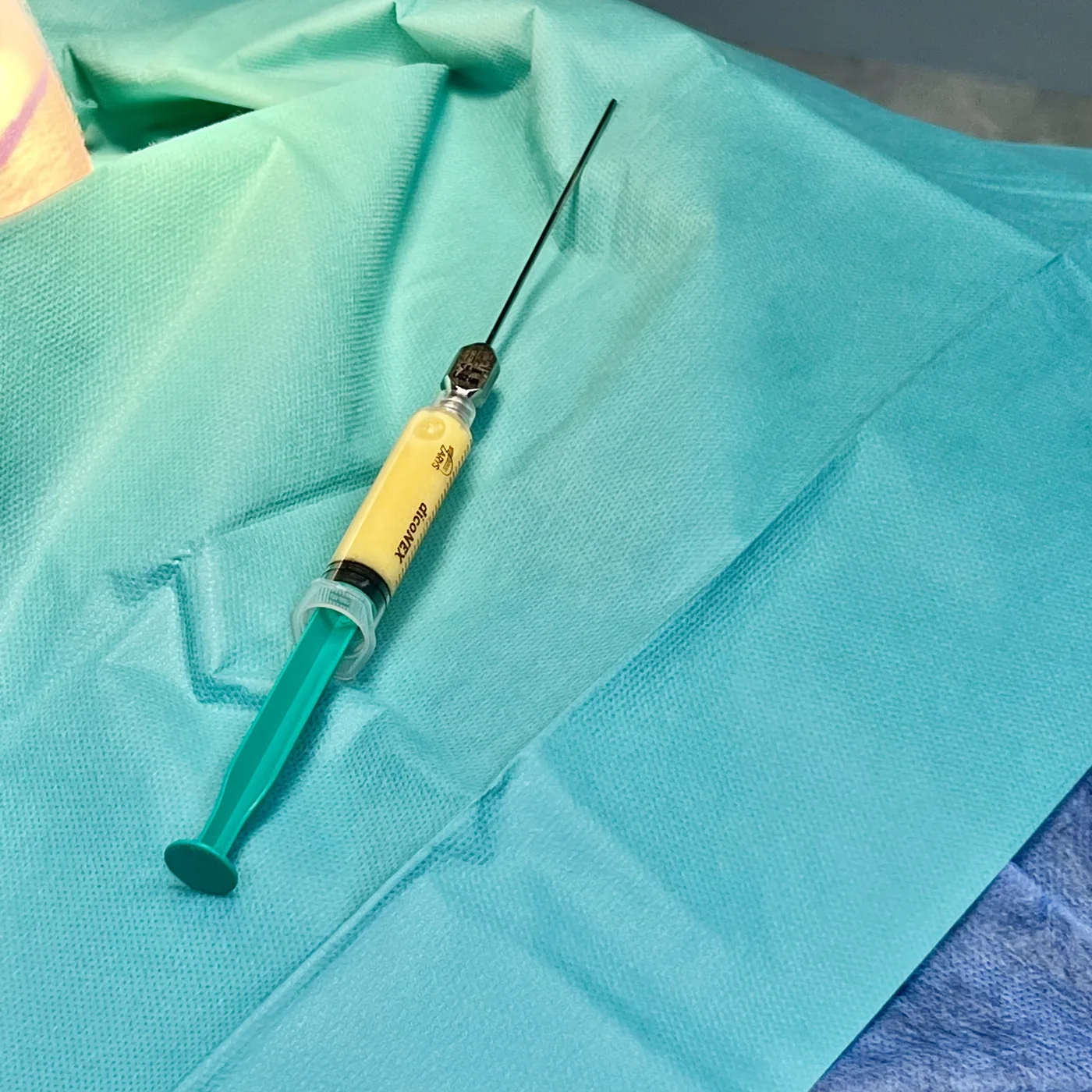
This page describes one variant of the treatment
We cover the three fat fractions, the healing schedule, the full list of contraindications and preparation for the treatment on the lipotransfer page. We have described hyaluronic acid volumetry separately.
The content is for information. It does not replace a consultation, an examination or an individual medical assessment.
On this page
Fat as a volumetric material
Various materials are used in facial volumetry: hyaluronic acid, poly-L-lactic acid and your own fat tissue. Each works differently, and the choice belongs to the doctor after assessing the area and the expected scope of change.
What sets fat apart from the others is that it is a living material. The transplanted tissue integrates with the tissue at the injection site, and the stem cells it contains stimulate the skin to remodel. The consequence, however, is a lack of predictability: it is not possible to determine in advance how much of the material will take in the new location.
The material is autologous, meaning it comes from the same person it will be administered to. There is therefore no risk of a reaction to a foreign substance or of rejection. The procedural risk remains, described on the lipotransfer page.
Fraction preparation
The tissue is usually taken from the abdomen, thighs or buttocks. The moment of collection, however, is only the beginning: the key stage is the preparation of the material.
The process involves separating pure fat fractions from other components, primarily blood and tissue fluid. The aim is to achieve a consistency that allows the material to be distributed evenly within the tissue. The quality of this stage determines how much of the transplanted fat will take in the new location.
With a sufficient amount of collected material, several areas can be treated at once within a single procedure, including areas beyond the face. This limits the number of treatments needed, and therefore also the cost and total recovery time.
Facial areas
Cheeks
Making up the volume that is lost earliest. Support in this area changes the picture lower down as well, along the line of the folds.
Tear trough and eye area
Filling of hollowing in the infraorbital area. Qualification here is more cautious, because the eyelid skin is thin.
Jawline and facial contour
Administering the material along the jawline improves the definition of the lower face contour.
Lip area
Work on vertical lines around the mouth and on the volume of the area itself.
Forehead and temples
Filling in temple hollowing and irregularities in the forehead area that change the oval of the face.
The eye area has its own page, because eyelid skin is thin and requires a different technique and more careful qualification. You will find the description in the section on lipotransfer around the eyes.
Who qualifies for the treatment
With tissue transfer, qualification covers more than just the treatment area. Four conditions have practical significance here.
Good state of health
No significant medical problems that could affect the healing process or increase the risk of complications. The full list of contraindications is on the lipotransfer page.
Realistic expectations
Understanding the possibilities and limitations of the method. With tissue transfer, some variables remain outside the doctor's control, so expecting a precisely planned result is not justified here.
Stable body weight
Transplanted tissue behaves like any other: with a marked drop or gain in weight, the result changes. Stable weight gives a more lasting result.
Sufficient amount of tissue
There must be a sufficient amount of fat tissue at the donor site. With very low body weight, the treatment can be unfeasible.
People with hypersensitivity to the ingredients of synthetic fillers are sometimes qualified for this treatment precisely because the material is their own. The decision belongs to the doctor, because the list of contraindications for lipotransfer is longer than for hyaluronic acid injection.
Corrections and touch-ups
Fat volumetry often requires corrections and top-ups. This is not a flaw in the procedure, but a consequence of the fact that transplanted tissue must take, and part of it is absorbed over the following weeks.
We talk about this before the treatment, so that a second visit is not a surprise. When planning the treatment, it is worth allowing for the possibility of a top-up from the start and including it in the cost as well.
Recovery and the compression bandage
Swelling and bruising after the treatment are expected and occur in two places: where the tissue was taken from, and where it was administered. The body needs time to recover, which means rest and limited physical activity.
For some treatments, wearing a compression band for a few days is required. The decision depends on the scope of the treatment and the donor site. The doctor gives this information together with the other recommendations, so it is worth asking about it before setting a date, if you have work commitments planned for that time.
Fat or hyaluronic acid
This is not a choice between a better and a worse material, but between two different treatments, which place a different burden on the patient and behave differently in the tissue.
Your own fat tissue
A living material that integrates with the tissue and contains stem cells. It requires harvesting, anaesthesia of two areas, and a few days of recovery. It more often requires corrections, and the unit cost is higher. It cannot be dissolved.
Hyaluronic acid
A gel administered without harvesting, in a shorter treatment and without recovery time. The volume administered is known, the effect is visible straight away, and the preparation can be dissolved with an enzyme. It lasts for a shorter time and requires repeating.
When choosing, it is worth considering not only how long the effect lasts, but also whether you can plan a few days of recovery and whether you are ready for a possible correction. We discuss this at the consultation, before setting a date.
The treatment on video
The recording from the practice will show the preparation of the fat fraction and the administration of the material into the cheek area.
We publish photos of results only with patients’ consent and under comparable conditions: the same framing, light, facial expression and time interval. The result is always individual.
The questions we are asked most often
Who qualifies for volumetry with your own fat?
There are four conditions: good general health, realistic expectations of the result, stable body weight, and a sufficient amount of fat tissue at the donor site. With unstable weight, the result can vary, because transplanted tissue behaves like any other.
Where is tissue for facial volumetry taken from?
Most often from the abdomen, thighs or buttocks. The harvested material is then prepared: pure fat fractions are separated from blood and tissue fluid, to achieve a consistency that allows even distribution in the tissue. The quality of this stage determines how much material takes.
Is one treatment enough?
Fat volumetry often requires corrections and top-ups, because it is not possible to predict how much of the transplanted material will take in the new location. This sets it apart from a filler, where the volume administered is known. It is worth allowing for this in the plan and in the cost.
Do you need to wear a compression band after the treatment?
For some treatments, wearing a compression band for a few days can be required. The decision depends on the scope of the treatment and the donor site, and the doctor gives this information together with the other recommendations.
Which areas of the face does fat volumetry cover?
The cheeks, the tear trough and eye area, the jawline and facial contour, the mouth area, and the forehead and temples. The scope is established after assessing the proportions of the whole face, not a single spot.
Is fat better than hyaluronic acid?
This is not a choice between better and worse, but between two different treatments. Fat is your own material and integrates with the tissue, but it requires harvesting and recovery, can be more expensive, and more often requires corrections. A filler works straight away, does not require recovery, and can be dissolved. The choice depends on the area, your expectations, and how much time you can devote to healing.
How much does fat volumetry cost?
Because of the individual nature of the procedure, the cost is established at the consultation, together with the date and scope of the treatment. The unit cost is higher than with a filler, but with a sufficient amount of harvested material, several areas can be treated in a single procedure.
The content is for information. It does not replace a consultation, an examination or an individual medical assessment.