
Legal note
The content is for information. It does not replace a consultation, an examination or an individual medical assessment.
We describe substances, not brands. Preparations from this group are medical devices, and the choice of a specific product is decided by the doctor during the qualification. We give trade names only in the price list, where they serve to identify the item, not to encourage the treatment.
On this page
Why they are called hard
The division into hard and soft biostimulators is practical, not chemical. Hard ones work on supporting the tissue: they are administered deeper, and their task is to rebuild density and structure in places where the tissue has lost its support. Soft ones work on the quality of the skin and are administered shallowly.
The name does not mean that the preparation is hard to the touch or that it is administered into bone tissue. All three substances described below are administered into soft tissue, in a deeper layer than preparations from the soft group. We have described the full division into three groups on the page about tissue biostimulators.
Common mechanism: the preparation triggers a controlled response in the tissue, in which fibroblasts produce new collagen. It is this collagen that gives the effect, not the mere presence of the preparation. This is why the change builds up over weeks, and why it cannot be assessed the day after the treatment.
Poly-L-lactic acid, or PLLA
L-polylactic acid is a biodegradable polymer, used in medicine for decades, among other things in surgical sutures. In aesthetic medicine it is administered in the form of microparticles suspended in a carrier.
The mechanism has two stages and is worth knowing, because it explains the most common misunderstanding. Immediately after administration the area may appear fuller, but this is the carrier and swelling, not the intended effect. The carrier is absorbed over a few weeks, and during this time the appearance returns to its starting point. The actual change appears later, when the tissue responds to the presence of the microparticles by producing collagen.
This intermediate phase, when the initial filling has disappeared and collagen has not yet formed, can come as a surprise, which is why we discuss it before the treatment. The immediate effect comes from the preparation's carrier, which is absorbed, while the actual change appears later, together with collagen rebuilding.
The treatment on video
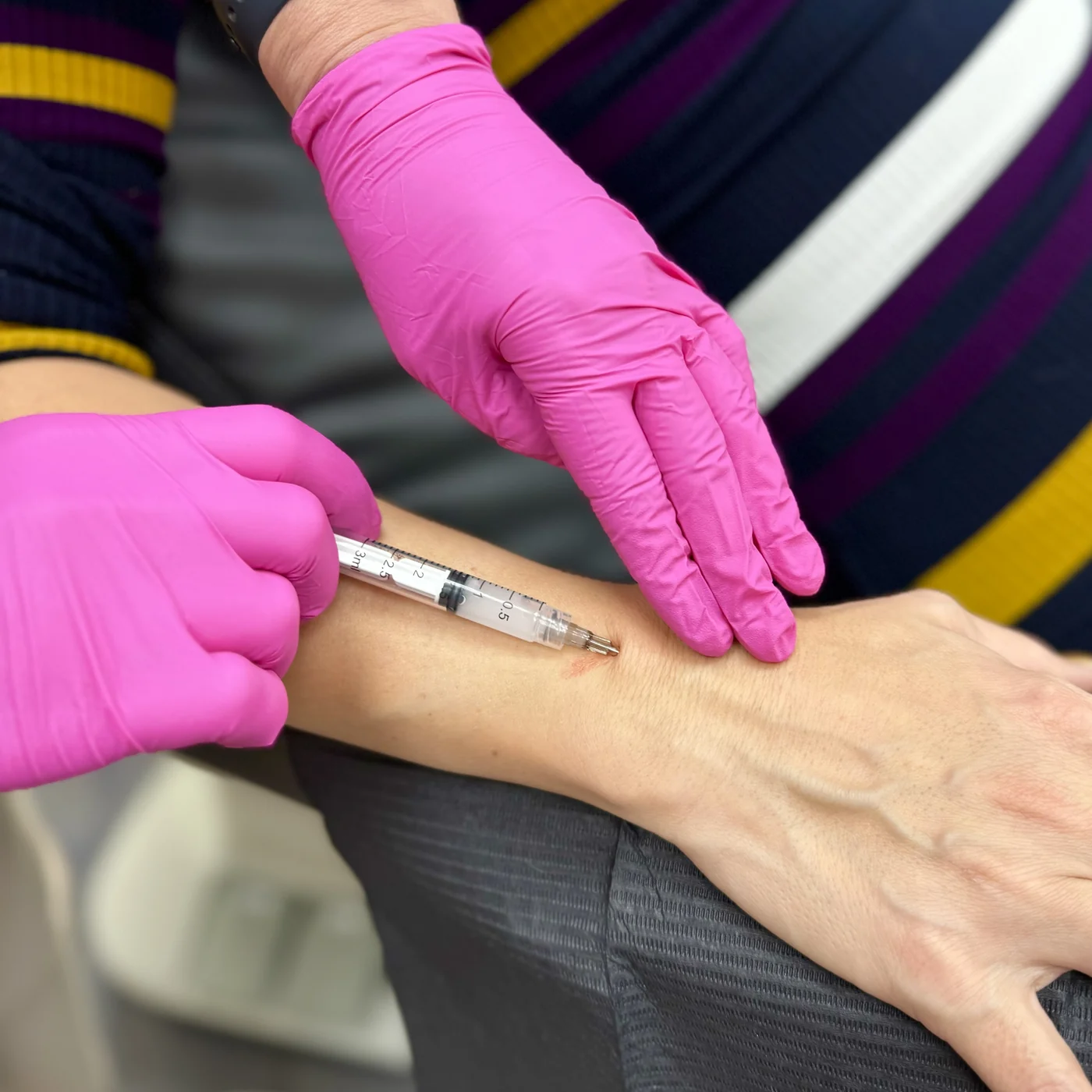
A recording from our practice shows the administration of polylactic acid: preparation of the product and the way of working in the tissue.
We publish photos of results only with patients’ consent and under comparable conditions: the same framing, light, facial expression and time interval. The result is always individual.
Calcium hydroxyapatite, or CaHA
Calcium hydroxyapatite is a mineral compound that occurs naturally in human bone tissue. In aesthetic medicine it is administered in the form of microspheres suspended in a gel, into soft tissue: deep, in a layer above the periosteum or subcutaneously. The name refers to the composition of the substance, not to the site of administration.
This group works in two ways. The carrier gel gives some support straight away, while the microspheres stimulate fibroblasts to produce collagen over the following weeks. This is why the preparation is sometimes chosen where both contour improvement and tissue densification are needed at the same time, for example around the jawline.
The preparation is well tolerated, but it is not neutral. The material must be distributed evenly, because a concentration of microspheres in one spot can produce a palpable thickening that cannot be removed with an enzyme.
Polycaprolactone, or PCL
Polycaprolactone is a synthetic, biodegradable polymer that breaks down gradually in the body. It is administered in the form of microspheres in a carrier, similarly to the two previous preparations.
What sets it apart is its breakdown time: longer than the other substances in this group, which translates into a longer lasting effect. However, the same feature is an argument for caution in choosing the amount, because if the material ends up distributed in an undesirable way, the waiting time for it to be absorbed is also longer.
Which preparation for which situation
This question is settled at the consultation, after assessment of the area. Below is the logic behind the choice itself, without favouring any particular substance.
Polylactic acid
Extensive improvement in skin density and firmness, also on the neck, decolletage and hands. Work on tissue quality across a wider area, not on a single contour.
The effect builds up the most slowly of this group. It requires patience and prior discussion of the transitional phase.
Calcium hydroxylapatite
Situations where support and tissue densification are needed at the same time, for example around the jawline or the cheek.
The carrier gives some support straight away. It requires even distribution of the material.
Polycaprolactone
When a longer lasting effect matters, with a similar mechanism of action.
A longer breakdown time also means a longer wait if the distribution turns out to be undesirable.
The choice is made by the doctor based on assessment of the tissue, previous treatments and what can realistically be achieved in this area. We do not ask patients to choose the substance, because this is a clinical decision, not a preference.
Indications for hard biostimulators
An indication is not the same as qualification. The same list also applies to other methods, and whether a preparation from this group is right for you, or for example a hyaluronic acid filler, is decided by an assessment of the area at your visit.
Treatment course and how many treatments are needed
The first treatment takes from 45 minutes. With firm preparations, one treatment is usually enough, and after three to four months we invite you to a consultation, where the doctor assesses the effect and decides whether a top-up is needed. This is what sets this group apart from soft preparations, where a series is planned from the start.
The results and when they are visible
The change builds up over weeks and concerns density, firmness and contour within the treated area. The first differences are sometimes reported after four to eight weeks, and the full picture is assessed at a consultation after three to four months.
The effect usually lasts from several months to over a year, depending on the substance, the area and individual regeneration. It is not permanent, although with polycaprolactone it tends to last longer than with the other preparations in this group. The basis of the effect is remodelled tissue, which is subject to natural ageing over time.
Reactions after the treatment
After administration, swelling, pain, tenderness, bruising and redness at the injection sites are possible. These reactions usually resolve after two to three days. The treatment does not require time off from daily activities.
No pressing on the area
For the first 24 hours, do not massage or press on the treated area, unless the doctor has advised otherwise. With some preparations, massaging the area is part of the recommendations, and in that case we show you how to do it.
No high temperatures
Sauna, steam baths, swimming pool and sunbeds only after two weeks.
No exercise or alcohol for a day
For at least 24 hours no alcohol and no intense physical exercise, which increase swelling.
Contact for worrying symptoms
Increasing pain, blanching or a bluish discolouration of the skin, as well as warmth and redness of the area appearing after several days, require contact with the clinic without delay.
We keep the full list of contraindications and description of complications, including delayed inflammatory reaction, in one place, on the page about tissue biostimulators. They apply to all three groups, and we do not want the reader to come across three different versions of the same list.
Why they cannot be dissolved
Hyaluronidase, the enzyme that dissolves fillers, works only on hyaluronic acid. Polylactic acid, calcium hydroxyapatite and polycaprolactone cannot be dissolved by any preparation. If the placement of the material turns out to be unwanted, the approach is different, longer and not always fully reversible.
This gives us a practical rule we follow: at the first treatment in a given area we work more cautiously, because the amount of preparation can be added to later, but it cannot be withdrawn.
The questions we are asked most often
Does the hard biostimulator show a result straight away?
Straight after administration the area may look fuller, but that is the preparation's carrier and swelling, not the final result. The carrier is absorbed within a few weeks, and the actual change comes from collagen produced by the tissue, building up over the following weeks. With polylactic acid this transitional phase is most noticeable.
How many polylactic acid treatments are needed?
With hard preparations, one treatment is usually enough. After three to four months the doctor assesses the result and decides whether a follow-up treatment is needed. This is a different logic to soft preparations, where a series is planned from the outset.
Is calcium hydroxyapatite administered into the bone?
No. The preparation is administered into soft tissue, most often deeply, in the layer above the periosteum or subcutaneously. The substance's name comes from its composition, since calcium hydroxyapatite occurs naturally in bone tissue, not from where it is administered. This is a common misunderstanding arising from the substance's name.
How long does the effect of a hard biostimulator last?
Usually from a few months to over a year, depending on the substance, the area and individual regeneration. With polycaprolactone it can be longer. The effect is not permanent, it is based on remodelled tissue, which is subject to natural ageing over time.
Can a hard biostimulator be dissolved?
No. Hyaluronidase works only on hyaluronic acid. Preparations made from polylactic acid, calcium hydroxyapatite and polycaprolactone cannot be dissolved, and if the material is placed unfavourably, the approach is different and longer. This is why, at the first treatment in a given area, we work more cautiously.
Will a hard biostimulator replace a filler?
Not in every situation. A filler adds volume immediately and at a chosen point. A hard preparation works on tissue support and density over a wider area, more slowly. For a sunken area needing precise correction, the doctor will choose a filler, and both methods can be part of a single plan.
How much does polylactic acid cost?
The cost depends on the substance, the number of ampoules and the area, so we keep one current aesthetic medicine price list instead of scattered figures on individual pages. You will learn the price at the consultation, once the treatment plan has been set.
Does a hard biostimulator treatment hurt?
We apply topical anaesthetic cream for comfort, although it is not required. The preparation is administered with a needle or a cannula. For two to three days after the treatment, swelling, tenderness, pain and bruising at the injection sites are possible.
The content is for information. It does not replace a consultation, an examination or an individual medical assessment.