On this page
How EMS training works
The device works in HIEMS technology, that is stimulation of the muscles with a focused high-intensity electromagnetic field combined with selective electrostimulation. The pulses trigger contractions of the muscle fibres with a force that cannot be produced by conscious tensing.
During one session the device generates about 36 thousand pulses. It acts directly on five muscle groups and indirectly on a dozen or so more, working on both fast-twitch and slow-twitch fibres, including the deep muscles.
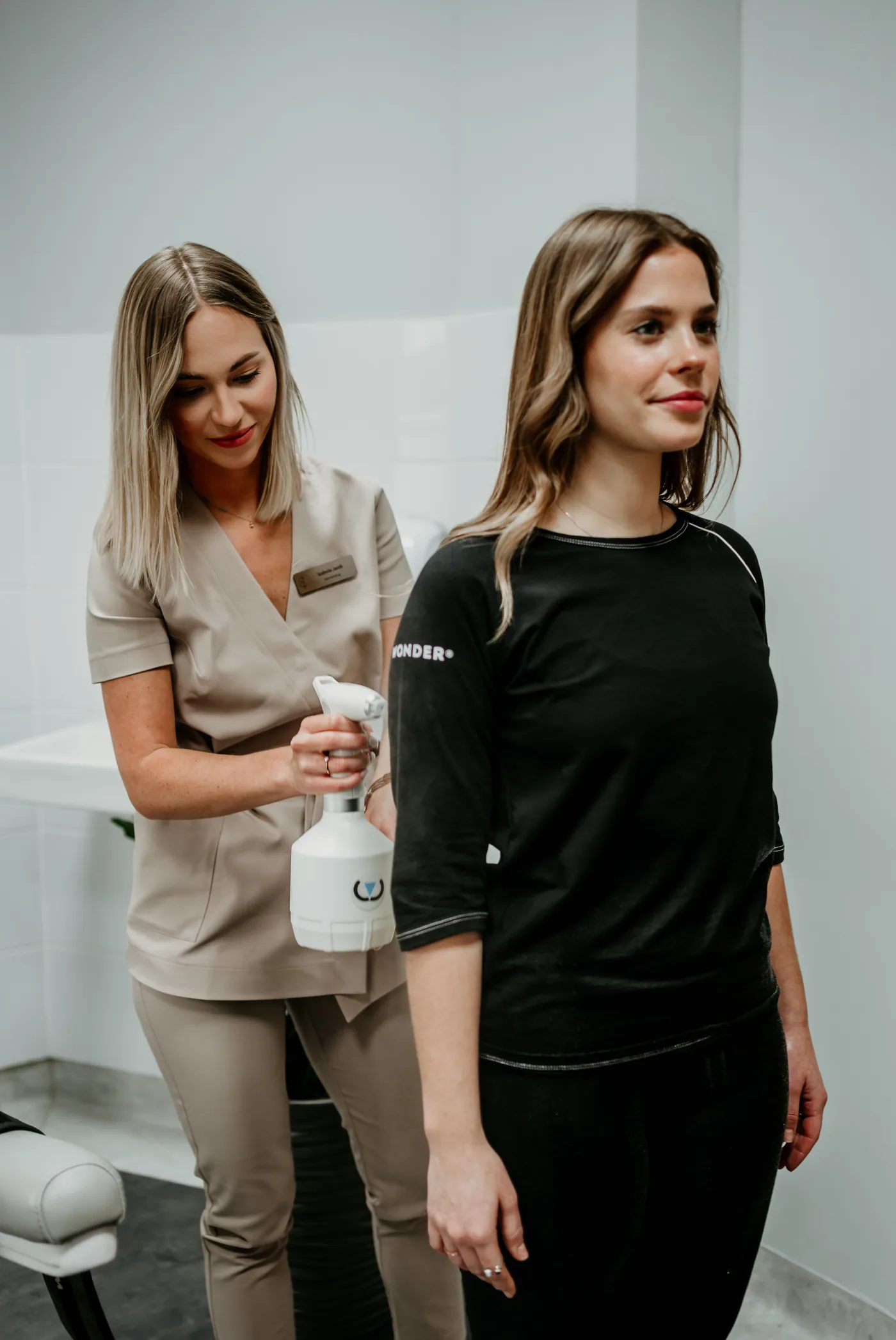
The treatment does not heat the tissues thermally and is conducted without contact, in a suit. It does not load the joints, which distinguishes it from classic resistance training and makes it possible for people with mobility limitations.
The training on video
Four areas at once
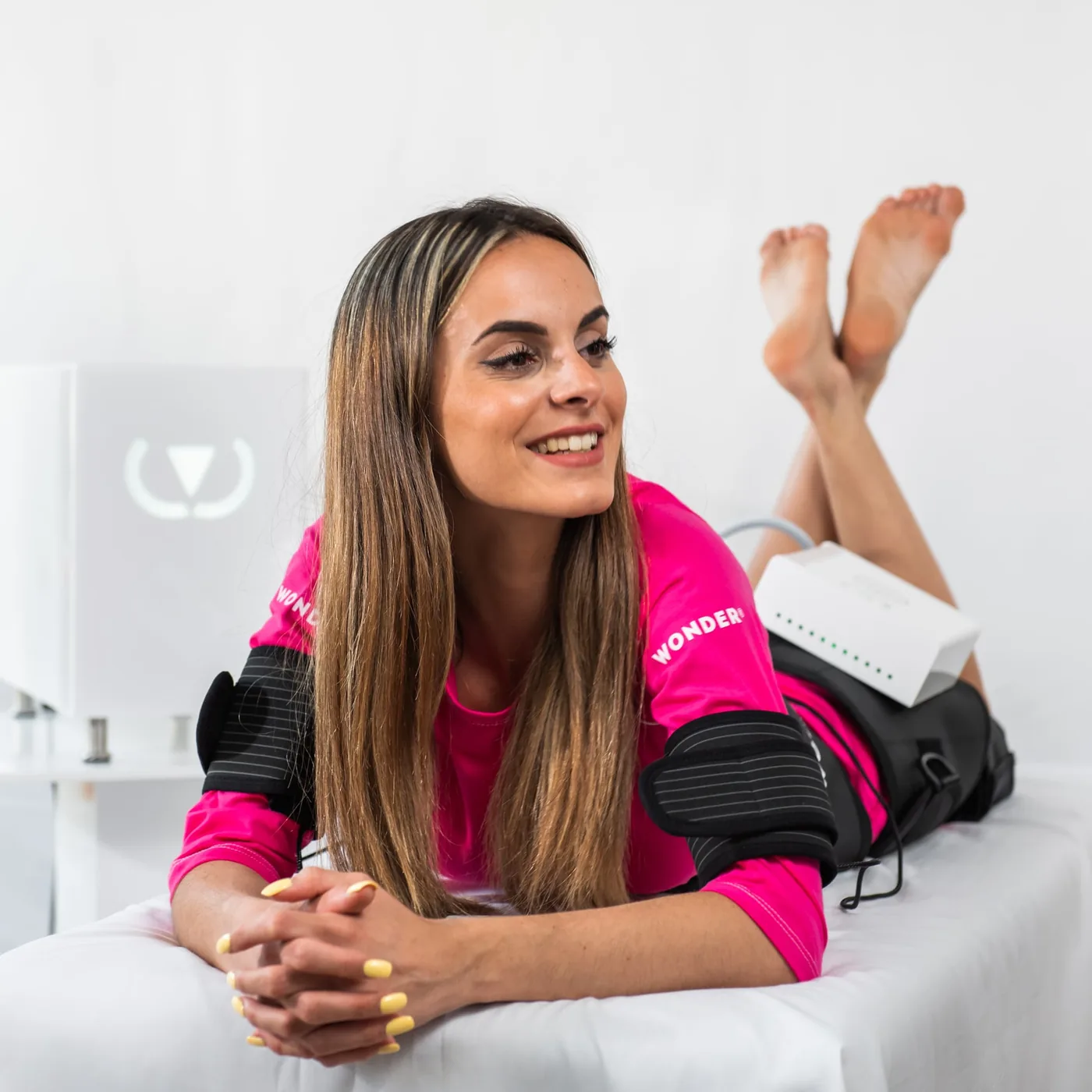
The electrodes are arranged so that four parts of the body work at once in one session: arms, abdomen, buttocks and legs. This distinguishes the technology from devices working on one area at a time.
Five treatment programmes
The settings can be taken from a ready programme or set individually. The choice depends on the goal, not on what sounds most attractive.
Definition
Aimed at people whose goal is body contouring. It speeds up the metabolism and warms up the muscles before the main work.
Hypertrophy
Work on muscle strength with a low risk of injury, at a deep level, with stimulation of all types of muscle fibres. The goal is fitness and endurance.
Cellulite
Stimulates the flow of blood and lymph, reduces lymphatic congestion and improves the nutrition of the tissues. Affects the appearance of skin unevenness.
Recovery
A regeneration programme after intensive training, injuries and trauma. It does not load the joints and helps with muscle pain and postural defects.
Expert
Fully individual settings, chosen by the person conducting the session for a specific situation, when the ready programmes do not match the goal.
Indications, that is who it is for
The regeneration programme is often chosen after injuries and trauma and for people with limited mobility, because the work takes place without loading the joints. After a previous injury it is worth consulting your treating doctor first.
The session step by step
The whole visit takes about fifty minutes, of which the stimulation itself is about twenty-five. It requires neither anaesthesia nor recovery time, so you return to your activities straight away.
The results and when they are visible
The number and frequency of sessions are chosen individually, with a reference point of one to three sessions a week and a series of six to ten treatments. At the beginning usually once or twice a week, to check how the muscles cope with the load. More often does not mean better: a muscle needs time to recover just as it does after training, and a schedule that is too dense risks overtraining. The change concerns above all muscle tone and strength, and next the contour of the chosen parts of the body. Some people also notice an improvement in skin quality where laxity was previously visible.
We do not say in advance by how much the circumference will decrease, because that depends on the starting point, diet and activity between sessions. Without a change of habits the effect is limited and short-lived, which we say plainly before the series starts, not after it.
What EMS training will not do
It will not replace training or exercise. It strengthens the muscles but does not build cardiorespiratory fitness and does not teach movement patterns.
It does not cause weight loss. The work concerns the muscles, and reducing body weight requires an energy balance, that is diet and activity.
It does not remove localised fatty tissue. Other methods work on that, for example ultrasonic cavitation, and they are often conducted in parallel.
It does not work once and for all. An unused muscle loses tone, so without maintenance the effect recedes.
Contraindications
An implanted pacemaker and metal implants rule out the treatment regardless of the condition of the muscles, because the device works with an electromagnetic field. Report them before the visit, so as not to book an appointment that will be cancelled anyway.
The questions we are asked most often
Will EMS training replace the gym?
No. It strengthens the muscles, but it does not build cardiorespiratory fitness, does not teach movement patterns and does not replace the energy balance. Treat it as a complement to activity, especially when for some reason you cannot train with weights.
How long does a session take?
The stimulation itself is about 25 minutes, the whole visit about 50 minutes including preparation and discussion. The treatment is performed in a suit, without contact.
Does it hurt?
It requires no anaesthesia. Strong muscle contractions are felt, which can be surprising at the first session, but they should not be painful. The intensity increases gradually and can be adjusted during the session.
How many sessions do I need?
The reference point is one to three sessions a week and a series of six to ten treatments, and at the beginning usually once or twice a week. The exact plan is set after assessing the goal and the starting point. A single session changes nothing permanently, so a series is planned, and its length is agreed at the consultation.
Will I be sore afterwards?
After a session there is often a feeling of muscle fatigue similar to that after training, sometimes also muscle soreness in the following days. That is the expected reaction to intensive muscle work.
Does EMS training cause weight loss?
Not in the sense of reducing body weight. It works on the muscles, and losing weight requires an energy deficit. It is, however, often combined with treatments aimed at fatty tissue, if that is the goal.
I have a pacemaker, can I have it?
No. An implanted pacemaker and metal implants are an absolute contraindication, because the device works with an electromagnetic field. Report this when booking, before you arrange a date.
Can I combine it with ultrasound cavitation?
Yes, that is a common variant, because the methods work on different things: EMS on the muscles, cavitation on fatty tissue. The order and intervals are set by the cosmetologist when planning.
Before you decide
Consultation with a cosmetologist
We start with qualification and a conversation about the goal, because the programme and the number of sessions depend on it. We also ask about your physical activity, so that the plan is realistic and not based on the assumption that the device will do everything for you. The conversation does not oblige you to have the treatment.
This material is for information and does not replace a consultation or an assessment of suitability for the treatment.