
On this page
When the question about thermal lifting usually comes up
It rarely comes after one look in the mirror. More often after a series of small observations that are hard to name in one word.
The facial contour changes faster than the skin
The complexion still looks good, but the jawline is less defined than in photographs from a few years ago, and the cheeks seem to sit a little lower.
Creams have stopped making a difference
Skincare is consistent and well chosen, only the result has stopped at the level of hydration. The firmness of the skin is a different layer and a different variable.
Skin after weight loss or after pregnancy
The figure has come back, the skin on the abdomen, arms or thighs has not yet. The question is usually whether it can be tightened without surgery and to what degree.
The neck and décolletage have got ahead of the face
The face is well cared for, and the skin below the jawline looks older. It is an area easy to miss in daily skincare.
Surgery is out of the question
Because of the cost, the recovery time, worry or the stage of life. The question arises of how much can be achieved with methods that do not take you out of everyday life.
None of these situations automatically means that radiofrequency is the right answer. With some of them the work is quite different, and sometimes the skin needs something simpler first. What settles it is what can be seen and examined on the spot: the thickness of the skin, its firmness when lifted, the state of the vessels, the history of treatments.
What a radio wave does in the skin
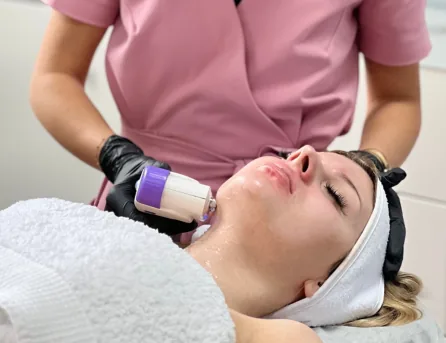
A radio wave passes through the epidermis and acts on the dermis, causing a sensation of warmth. The heating causes a momentary shortening and contraction of the collagen fibres, so the firmness of the skin changes immediately after the treatment. The second part of the process is slower: a raised temperature activates metalloproteinases, which break down damaged collagen, and fibroblasts respond by synthesising new fibres. That remodelling goes on for weeks after the visit.
Warming also changes the blood supply to the skin, and therefore the transport of oxygen and nutrients. Radiofrequency does not disrupt the surface of the skin, unlike some fractional treatments, and this results in a shorter return to daily activities.
It is worth separating two things which in treatment descriptions are usually stuck together in one sentence. The firmness of the skin and its remodelling are not the same result and do not appear at the same time.
The same day
Contraction of existing fibres
Heat shortens the collagen fibres the skin already has. Hence the impression of firm skin right after the visit. That effect is temporary and will not last for weeks on its own.
Over the following weeks
Synthesis of new collagen
Fibroblasts respond to the heat stimulus by producing new fibres. This part is not immediate, it requires a course, and it is what decides what will remain after several months.
Separating these two mechanisms explains the common disappointment after one treatment: the firmness from the first visit passes, and the remodelling has not yet begun. That is why the first session is not judged in terms of the final result.
Radio waves entered medicine in the nineteen-eighties, in treating pain and improving circulation. In the nineteen-nineties they began to be used in aesthetic dermatology, when it was noticed that heating tissue affects the elasticity of the skin.
What decides the result
The same treatment gives different outcomes in two people, and that is not a matter of luck. Below are the variables set before the first session. Each of them shifts the outcome in a different direction.
The thickness and firmness of the skin
Thin skin requires lower settings and a more careful handling of the handpiece. Thicker and laxer skin needs higher energy, so that the heat reaches where it is meant to act.
The variant of radiofrequency chosen
Superficial, fractional and microneedling waves differ in the depth at which they work. The same area can be approached in three ways, and the difference concerns both the intensity and the time of calm needed after the treatment.
The target temperature and how long it is held
The result depends not on the heating alone but on how long the tissue stays within the chosen range of temperature. That is set during the treatment, not before it.
The number of sessions and the intervals
With four sessions the result can differ from six, and an interval shorter than two weeks does not give the skin time to remodel. A whole course is usually two to five months.
What happens between sessions
Sleep, hydration, smoking and exposure to the sun affect how the skin responds to the stimulus. That part depends solely on the patient and is sometimes the difference between an average outcome and a good one.
The order relative to other treatments
Radiofrequency is sometimes one element of a plan, alongside mesotherapy, peels or laser therapy. The order and intervals matter, because the skin needs a break between stimuli.
These settings cannot be chosen from a description on the internet or from a price in a price list. They follow from how a particular skin behaves under the fingers and under the handpiece, and some of them are adjusted during the course, after the response to the first session.
What to combine it with and in what order
Radiofrequency is rarely the only treatment in a plan. It usually adds firmness to methods that work on something else: hydration, tone or volume. There is one rule and it follows from physiology, not from the diary: the skin needs a break between stimuli, and two strong stimuli in a short interval do not give a double result, only a double risk.
Mesotherapy
The most common combination, because the methods work on different things: radiofrequency on firmness, mesotherapy on hydration and density. They are carried out at separate appointments, with an interval set when planning the course.
Chemical peels
Not on the same day. The epidermis after exfoliation is sensitive, and heat on irritated skin increases the risk of a reaction. We come back to radiofrequency once it has healed, and with deeper peels the interval is clearly longer.
Fractional treatments and laser therapy
Separate appointments and an interval according to the protocol. Both treatments are a strong stimulus for the same tissue, so putting them close together burdens the skin rather than speeding up the result.
Fillers and botulinum toxin
The doctor sets the order and the interval, because heat also acts on tissue in which a preparation is present. They are usually carried out as separate appointments rather than as one combined treatment.
Threads and biostimulators
They require the decision of the doctor treating you and full healing after the earlier procedure. We do not work with heat energy in an area where threads have just been placed.
Home care
Part of the plan, not an extra. For the duration of the course we agree what to stop and what to introduce, because skin regenerating between sessions reacts differently than it does day to day.
The order in the plan depends on the aim. If the main problem is the quality and tone of the skin, radiofrequency is sometimes the second stage, after the epidermis has been put in order. If it is mainly about firmness, it is run as the axis of the plan, and the rest is added between sessions. The person carrying it out sets the schedule, knowing the whole rather than a single treatment.
Thermolifting versus other methods
Three questions come back most often at the clinic, and all of them concern the limits of the method.
Radiofrequency and a surgical face lift
They are not competitors, because they do different things. A lift removes excess skin and moves tissue, which heating cannot do. Radiofrequency works on the quality and firmness of the skin, which in turn a scalpel does not do: after surgery the skin sits better, but it does not become denser or better hydrated because of it.
The practical conclusion is that with a large excess of skin a course of radiofrequency will not replace the decision about surgery, and with thin, dehydrated skin surgery alone will not settle the quality of the skin.
Before surgery and after it
Treatments that improve the condition of the skin are sometimes carried out before planned surgery, and afterwards you come back to them only after full healing and only with the surgeon's agreement. The timing depends on the kind of operation and on how healing goes, which is why we give no number of weeks here. If you have fresh scars or are planning surgery in that area, say so at the consultation, before we set the plan.
Radiofrequency and fat tissue
Thermal lifting of the skin does not serve to reduce fat tissue. The aim is to heat the dermis rather than the layer of fat, and those are different devices, different settings and a different protocol from body contouring treatments.
It works the other way round too, and that is why the settings matter: heating too intensely in areas with a thin layer of fat, such as the temples or the cheeks in slim people, is a situation to be avoided rather than an aim of the treatment. If the subject is reducing volume, the right direction is body contouring treatments, not thermal lifting.
Four types of device
The division follows from the way the energy flows through the tissue. It decides the depth of action and whether a device is suited to the face or to large areas of the body.
Monopolar
A single-pole flow of energy, which penetrates to deeper layers of the skin.
Treating skin laxity over the whole body
Bipolar
The energy flows between two poles placed in one handpiece, so the action is limited to superficial layers.
Facial treatments
Multipolar
Multiple electrodes allow the tissue to be heated more evenly and the energy to be fractionated.
Face and body
Fractional microneedling
They combine radiofrequency with microneedling, which gives a more intense regenerative stimulation.
Scars, stretch marks, skin laxity
Variants of the treatment at NL Clinic
The three protocols differ in the device, the depth at which they work and how much calm the skin needs after the visit. The choice belongs to the person carrying out the treatment.
Uses
Face and neck
Firmness of the skin, fine wrinkles, the facial contour.
Body
Firming the skin and working on the appearance of cellulite, combined with other methods.
Regeneration
Scars, stretch marks and the density of the skin, with the microneedling variant.
Radiofrequency is sometimes considered with skin laxity, a loss of firmness and a need for gradual improvement in its quality. The scale of the change depends on age, the starting state of the skin and the number of sessions, which is why before the assessment we give neither a number of sessions nor an expected result.
What thermal lifting will not do
It will not replace surgery. With a large excess of skin and clearly falling contours the result of heating tissue is out of proportion to the expectations.
It does not make up lost volume. That is the task of other methods, discussed by the doctor.
It does not remove fat tissue. In body contouring it works on the quality and firmness of the skin rather than on reducing it.
It does not work once and for all. The skin goes on ageing, so the result needs maintaining, and how long it lasts depends on age, the state of the skin and lifestyle.
How it goes and the course of treatments
The recommended number of sessions is four to six, at intervals of two to four weeks. An improvement in firmness can be visible straight after the treatment, while the full result of the remodelling appears gradually, over several weeks from the end of the course.
After the treatment, extreme temperatures are out for 48 hours, that is sauna and cryotherapy, and we care for the skin with mild cosmetics. The treatment usually requires no recovery time and you can go back to everyday activities the same day.
Contraindications
A medical history precedes every treatment. Two contraindications here are specific to radiofrequency and follow from the flow of energy through tissue: a cardiac pacemaker and metal implants in the treatment area. Report them before booking, not in the treatment room.
The list is not closed, because some limits depend on the device and the protocol. With chronic conditions, implanted medical devices and during cancer treatment the assessment is carried out by a doctor.
The questions we are asked most often
Does the treatment hurt?
During it a sensation of warmth appears, sometimes tingling or tightness of the skin. The devices have cooling systems, and with selected protocols we use an anaesthetic cream. If the heat becomes unpleasant, say so, because the settings can be lowered during the treatment.
How long does one session take?
It depends on the area. The face takes less time than work on the body, and the whole visit is usually 60 to 90 minutes, including the conversation and preparing the skin.
When are the first changes visible?
An improvement in firmness can be visible straight after the treatment, because heating causes the existing collagen fibres to contract. That is a temporary effect. The change following from remodelling appears gradually, over several weeks after the course.
How many sessions do I need?
Usually four to six, at intervals of two to four weeks. The person carrying out the treatment sets the exact plan at the consultation, because it depends on the starting state of the skin and on the area.
How should I prepare for the appointment?
Come with cleansed skin, without make-up or creams on the treatment area. Report all implanted medical devices and metal implants, including those outside the treatment area.
I have a cardiac pacemaker; can I have the treatment?
No. A cardiac pacemaker is a contraindication to radiofrequency, as are metal implants in the treatment area. In such a situation we discuss other directions at the consultation.
Can the treatment be done in summer?
Yes, the procedure does not make the skin more sensitive to UV radiation, so it is carried out all year round. Daily sun protection remains part of skincare regardless of the treatment.
How should I look after my skin after the treatment?
For 48 hours avoid extreme temperatures, that is sauna and cryotherapy, and care for the skin with mild cosmetics. You go back to make-up and everyday activities the same day.
Will thermal lifting replace a surgical face lift?
No. With a large excess of skin and clearly falling contours the result of heating tissue is too small against the expectations. At the consultation we say so plainly, rather than proposing a course that does not answer the problem.
How much does it cost?
The price depends on the area and the variant of the treatment, which is why we keep one current price list for cosmetology treatments. We discuss the cost of the whole course at the consultation, before the first treatment.
Before you decide
Consultation with a cosmetologist
Most of the variables on this page are settled only at the skin: what its thickness and firmness are, which variant makes sense, how many sessions are really needed and whether to start with radiofrequency at all or with something else.
The cosmetologist assesses the skin, checks the contraindications and presents a plan together with the cost of the whole course. The conversation does not commit you to having the treatment. A consultation with an aesthetic medicine doctor is paid for in line with the price list, as is preparing a home care plan.
This material is for information and does not replace a consultation or an assessment of suitability for the treatment.