
On this page
When the question of mesotherapy usually comes up
Usually not after one specific change, but after several small observations that are hard to sum up in one word.
Skin looks different in the morning than in the evening
Fine in the evening, dull in the morning, with a network of fine lines that disappear after moisturising. This is usually the first sign of dehydration, not wrinkles.
Make up has started to settle into lines
Foundation that used to sit smoothly now highlights fine grooves and needs touch ups during the day. It is more often about skin structure and hydration than the cosmetic itself.
Skin has not returned to form after summer
Uneven tone, roughness and a feeling of tightness persist despite returning to your usual skincare routine.
Photos show something different to the mirror
In the mirror skin looks familiar, in photos you can see tiredness and a loss of radiance. A camera mainly captures the way light reflects off the surface of the skin.
Something you care about is coming up
A wedding, a photo shoot, an important meeting. That is usually when the question comes up of where to start and how much time is needed for skin to look better, not just different.
None of these situations means that mesotherapy is automatically the right answer. Some of them call for a completely different approach, and skin sometimes needs its skincare routine sorted out first, or the cause addressed, for example vessels or pigmentation.
What happens in the skin
The name comes from the Greek mesos, meaning middle. The preparation reaches the layer where collagen and elastin form, so deeper than a cream can reach. The formula is matched to the need: hyaluronic acid binds water, vitamin complexes, amino acids and peptides support repair processes, tissue stimulators prompt fibroblasts to synthesise collagen.
Change does not happen after one visit. Skin responds gradually, so treatments are planned as a series, and the result is assessed a few weeks after it ends. Hydration can be visible before an improvement in density.
A recording of the treatment
Footage from our practice, without editing to speed up the work. You can see the injection technique, the skin's reaction and small bumps at the injection points.
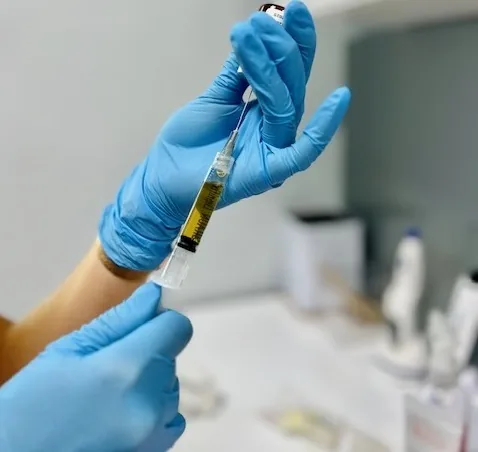
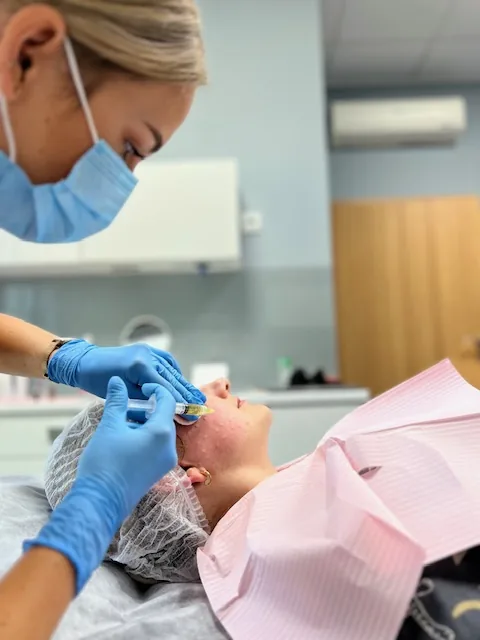
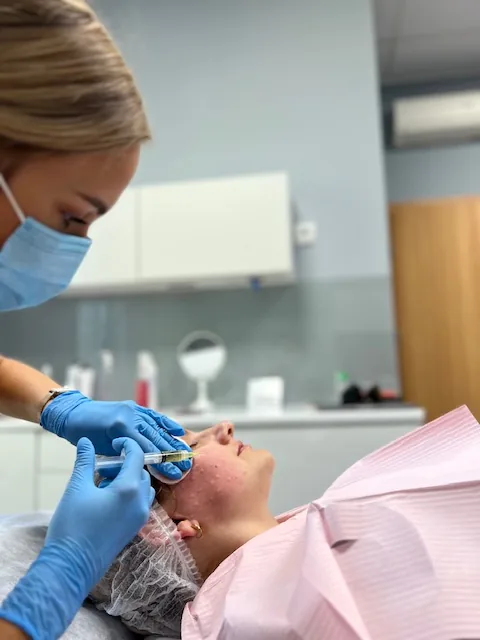
Photos and recordings are from our practice. We do not show before and after material, because without an identical frame, lighting and time interval such a comparison is misleading.
Three methods of administration
They differ in how they cross the epidermal barrier, in depth, and in how much rest the skin needs after the visit. The choice belongs to the person performing the treatment, after assessing the skin.
Who it tends to be chosen for
Mesotherapy is most often chosen by people who are not looking to change their features, only to improve the condition of their skin. Typical situations:
Dehydrated, dull skin
A visible network of fine lines, a feeling of tightness despite regular moisturising.
First fine wrinkles
Lines that do not disappear after rest, but are not yet deep grooves.
Loss of density and elasticity
Thinner skin, less taut, quicker to show tiredness.
Skin after summer and sun exposure
Uneven tone, roughness, a need to recover after the season.
Preparation for other treatments
Improvement of skin quality before laser therapy, a surgical procedure, or as part of a long-term plan.
Men's skin is usually thicker, more vascularised, and has stronger sebaceous gland activity, so the protocol can differ: a different injection depth, a different choice of product, and more often the scalp rather than the eye area. The treatment itself stays the same and is not aimed solely at women.
Mesotherapy is also combined with other treatments, for example peels, laser therapy, or microneedle radiofrequency. The order and intervals are decided by the person conducting the treatment, because the skin needs a break between stimuli.
Mesotherapy versus related methods
Names used in the practice and online often overlap, and the differences between them can be real. Below are three distinctions people ask about most often.
Skin boosters and fillers
Skin booster is a trade name for a moisturising product based on hyaluronic acid, administered using the mesotherapy technique. A filler is a different product with a different purpose: a cross-linked gel that restores volume and shapes contour.
The difference concerns the purpose, not the technique. Mesotherapy and skin boosters work on skin quality, fillers on its shape. With volume loss, mesotherapy alone will not solve the problem, and with dehydrated skin, a filler alone will not improve its condition.
Platelet-rich plasma and fibrin
These are blood-derived preparations, prepared from the patient's blood directly before the treatment. They are administered using a technique similar to mesotherapy, but the procedure includes drawing blood and preparing it, and qualification is carried out by a doctor.
From the patient's perspective, the difference is practical: a different visit process, different qualification, and a different price list. Details are described on the blood-derived preparations page.
Microneedling
Despite the shared name, it works differently: what matters most is the mechanical stimulus, meaning the micro-punctures that trigger healing, with the product penetrating through the resulting channels.
For uneven texture, enlarged pores, and scars, the microneedle technique is used more often. For dehydration and reduced density, the needle technique is used more often.
Treatment order and a year round plan
Mesotherapy is rarely the only treatment. More often it is part of a plan, and then what matters is not only the choice of product but also what happens before and after it.
Mesotherapy versus laser therapy
Usually laser first, then mesotherapy to support regeneration, unless the skin is so dehydrated that it needs preparation before the laser treatment. Always at separate visits and with an interval resulting from the protocol.
Mesotherapy versus peels
Not on the same day. The epidermis is sensitive after exfoliation, and injections into irritated skin increase the risk of a reaction.
Mesotherapy versus aesthetic medicine treatments
With botulinum toxin and fillers, we usually recommend separate visits and keeping intervals. The order depends on the indication and the area, and is decided by the doctor.
Mesotherapy before a surgical procedure
Improving the condition of thin skin before a planned operation can be part of the preparation, after agreement with the surgeon. After the treatment, it is resumed only once healing is complete.
The season does not rule out mesotherapy, but it changes the conditions. In summer, the basis is photoprotection and planning the treatment with a margin before travelling into full sun. In autumn and winter, it is easier to fit in methods that sensitise the skin, so mesotherapy then often sits alongside peels or laser therapy. The calendar itself also matters: a series of several sessions at intervals of two to four weeks usually means two to four months in total, so the first visit is planned well ahead of any event that matters to someone.
What mesotherapy will not do
Mesotherapy concerns skin quality. Below is the scope it does not cover.
It does not restore lost volume. Sunken cheeks, deep folds, and sagging contours are the task of other methods, discussed with the doctor.
It does not tighten lax skin to an extent comparable with a surgical procedure, nor does it replace a lift.
It does not treat skin diseases. Active inflammation, a pigmented lesion of unclear character, or significant hair loss require a medical assessment first.
It does not stop ageing. The effect requires maintenance, and its durability depends on age, skin condition, the product, and lifestyle.
Treatment areas
Beyond the face, mesotherapy is carried out in areas that are easy to forget in daily skincare.
Face
Hydration, tone, and skin density.
Eye area
Gentle products, delicate technique, usually more sessions.
Neck and décolletage
The firmness of the skin and smoothing of fine wrinkles.
Hands
Thin, dry skin, often overlooked in skincare.
Scalp
Support for hair follicles, after establishing the cause of hair loss.
Body
Thighs, buttocks, and abdomen for cellulite and stretch mark therapy.
What the visit looks like
The whole visit usually takes thirty to sixty minutes. After the treatment, the skin can be red and slightly swollen, and small bumps are visible at the injection sites, which usually disappear within a day.
Assessment and contraindications
Every series is preceded by a medical history: medication taken, allergies, chronic conditions, and previous treatments in the same area. Mesotherapy is not carried out during pregnancy and breastfeeding, with an active skin infection at the treatment site, or with a history of severe allergic reactions to the ingredients of the products.
Postponement is required, among other things, by: anticoagulant treatment, an active phase of autoimmune disease, a flare-up of dermatoses in the treatment area, a fresh tan, and fever and acute inflammatory conditions. You will find the full list with justification on the needle mesotherapy page.
Where it comes from
The first treatment in a form close to today's version was performed in 1910 by the Belgian doctor Lemaire. The name and framework of the method were given in the 1950s by the French doctor Michel Pistor, initially for therapeutic use. Mesotherapy entered cosmetology in the 1970s, and since then it is mainly the products that have changed.
The questions we are asked most often
How does mesotherapy differ from good home skincare?
A cosmetic product works on the surface of the epidermis, mesotherapy introduces the product deeper, into the dermis. It does not replace skincare, only complements it. Without daily skincare and sun protection, the effect of the series will last for a shorter time.
Why are treatments planned in a series?
The skin responds to biostimulation gradually, and a single administration of the product mainly gives a hydration effect. The number of sessions and the intervals are set by the person performing the treatment during qualification, because they depend on the product and the condition of the skin.
Is mesotherapy the same as a skin booster?
Skin booster is a trade name for moisturising products based on hyaluronic acid, administered using the mesotherapy technique. Mesotherapy itself is broader, because it also includes vitamin cocktails, amino acids, peptides, and tissue stimulators.
Who will carry out my treatment?
Needle mesotherapy is carried out by a doctor or a cosmetologist. Microneedle and needle-free mesotherapy remain within the cosmetology practice. We state the person and the scope of their qualifications at the time of booking.
Will the effect last after the course ends?
Not permanently. The skin continues to age, and how long the effect lasts depends on age, skin condition, the type of preparation and lifestyle. Maintenance is usually planned at intervals of several months.
I am in my twenties, is that too early?
The timing is decided by the condition of the skin, not by age. In younger people, mesotherapy is sometimes chosen for dehydration or after an intense season of sun exposure, rather than as preventive treatment for later. If the skin does not need a treatment, we will say so at the consultation.
How to prepare for the first visit?
Come without make-up in the treatment area, with a list of the medicines and supplements you take. A week before the treatment, avoid sunbeds and intensive sun exposure, and stop using retinoids and strong acids a few days beforehand. Limit alcohol the day before.
How much does it cost?
The price depends on the preparation and the area, so we keep one current price list for cosmetology treatments instead of scattered amounts on separate pages. We discuss the cost of the whole course at the consultation, before the first treatment.
Before you decide
Consultation with a cosmetologist
The cosmetologist assesses the skin and tells you which mesotherapy approach makes sense in your case, and which does not. The conversation does not commit you to having the treatment, and if the skin needs something else first, you will hear that directly. A consultation with an aesthetic medicine doctor is paid according to the price list.
This material is for information and does not replace a consultation or an assessment of suitability for the treatment.