
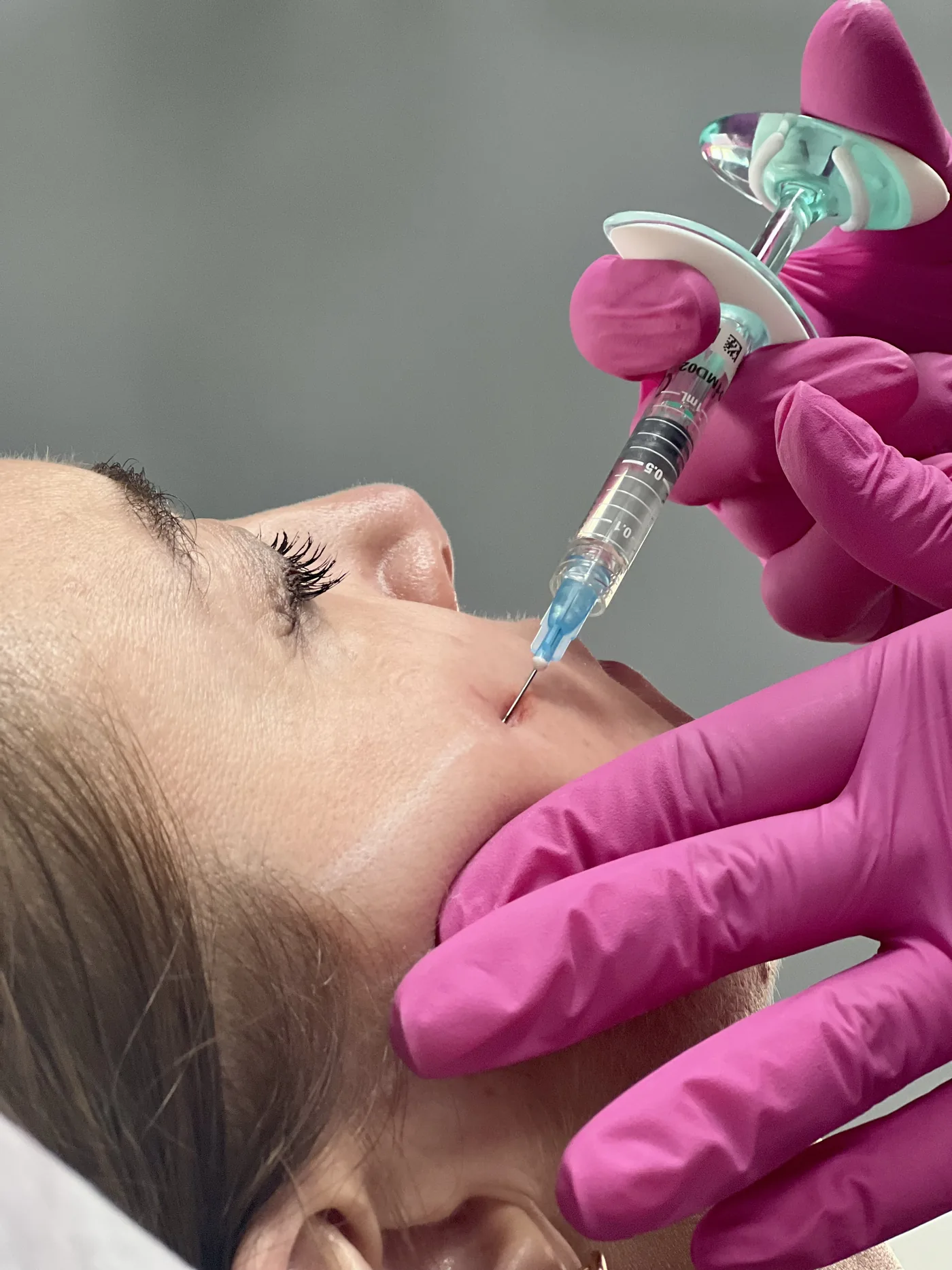
This page describes one application of hyaluronic acid
We cover the types of fillers, the mechanism of the gel, the full list of complications, including management of vascular occlusion, and the contraindications on the fillers and hyaluronic acid page.
The content is for information. It does not replace a consultation, an examination or an individual medical assessment.
On this page
What is facial volumetry
Volumetric lifting, commonly called volumetry, is a volume correction of the facial tissues. The name mentions lifting, but the mechanism differs from skin tightening: the preparation replaces what has been lost from the tissue.
Over time the amount of subcutaneous tissue decreases, and there is less hyaluronic acid in the skin, with different properties. The skin then loses support from underneath, seen as sagging and volume loss around the cheeks, lips and jawline. Injecting filler into deeper layers restores part of the tissue's lost properties.
Besides replacing the loss, a stimulation effect on the skin cells is described, thanks to which, once the preparation has been absorbed, the tissue stays in better condition than before the treatment. This is not, however, a permanent change: we are talking about months, not years.
Volumetry versus filling a single wrinkle
The same substance, the same injection procedure, two different ways of thinking about the face.
Filling a wrinkle
Work on a single line: a furrow or a hollow. The preparation is injected at the spot that is to be made shallower. The goal is local and visible straight away.
Volumetry
Volume correction of a whole area, performed more deeply, to restore support for the tissues lying above. The change concerns the proportions of the face, not a single line.
A practical consequence: the nasolabial fold can be a symptom, not a cause. If the tissue has collapsed higher up, around the cheek, filling the fold alone gives a result disproportionate to the effort.
The most common treatment areas
Cheek volumisation
Replacing the volume that is lost earliest. Support in this area also changes the picture lower down, along the nasolabial folds.
Chin volumisation
Work on the proportion of the lower third of the face and on the profile.
Jaw volumisation
Emphasising the contour and jawline, which loses definition over time.
As volume-replacing treatments, filling the tear trough and treatments around the mouth are also carried out. Both have their own pages, because they follow different anatomy: under-eye shadows and lips.
Indications for volumetric lifting
Correction of other flaws and volume deficits is possible after an individual consultation. The presence of an indication does not replace qualification: what decides is the assessment of the area and determining whether the change results from volume loss.
How the treatment goes
The first treatment takes 60 minutes. We standardly administer local anaesthesia, and the preparations used also contain an anaesthetic in their composition.
The treatment on video
A recording from our treatment room will show how the preparation is injected into the cheek and jaw area and the work with a cannula.
We publish photos of results only with patients’ consent and under comparable conditions: the same framing, light, facial expression and time interval. The result is always individual.
Results and when they are visible
Some effects are visible immediately after the treatment, because the preparation restores volume straight away. Swelling distorts the first picture though, so the result is assessed once it subsides, and the distribution of the preparation after around two weeks.
The extent of the change depends on the initial condition of the tissue and on the amount of preparation the doctor considers appropriate for the given area. The plan is drawn up for the face as a whole, not for a single spot.
How long does the result last
The effect obtained lasts on average 6 to 12 months. This is a range observed in practice, not a forecast of the result in a specific person.
Smoking cigarettes, strong sun exposure and sunbeds shorten how long the preparation lasts. This is one of the few things the patient can influence after the treatment.
Recommendations before the treatment
Do not drink alcohol on the day before the treatment, on the day of the treatment and the day after. It dilates the vessels and increases the risk of bruising.
Stop taking aspirin, vitamin E and preparations containing Japanese ginkgo extract, after agreeing this with your treating doctor.
Do not stop taking any medicine on your own: changes are decided by your treating doctor. You receive detailed recommendations for before and after the treatment during an individual consultation.
Reactions after the treatment
The treatment is an injection, so redness and bruising may appear at the injection sites. They most often disappear within the first three days, and redness and swelling usually subside after one to two days.
The treatment does not require convalescence, so you can return to daily activities quickly. We discuss recommendations for the first days and symptoms requiring urgent contact before the treatment, and we have also described them on the fillers page.
When to call without waiting
Strong, worsening pain, blanching or a bluish discolouration of the skin at the injection site, blotchy pigmentation and any visual disturbances require urgent contact. Contact the clinic immediately, at any time. With these symptoms, time matters.
+48 881 202 202When volumetry is not the right method
It does not remove excess skin. With pronounced sagging, adding volume can deepen the impression of heaviness, rather than remove it.
It does not work on wrinkles caused by muscle movement. There, the method of first choice is botulinum toxin.
It does not improve skin quality, its hydration or its tone. With thin, sallow skin, revitalisation or a biostimulating method is more appropriate.
It is not a method for swelling or pigmentation, so under eye shadows with such a background require a different approach.
An alternative for allergies and autoimmune diseases
Preparations used in volumetry are obtained synthetically, without animal protein. Hypersensitivity to the components of the preparation remains a contraindication though, so the medical history includes questions about reactions after previous treatments.
People with allergies and autoimmune diseases are sometimes qualified for lipotransfer, in which the material is the patient's own fat tissue. The doctor decides on the merits of such an approach after assessing the situation, because lipotransfer is a treatment with a different course and a different scope of risk.
The questions we are asked most often
How does volumetry differ from ordinary wrinkle filling?
By the scope and the layer of work. Wrinkle filling addresses a single line. Volumetry is a correction of volume across whole areas of the face, carried out deeper, to restore support for the tissues lying above. That is why the plan is drawn up for the face as a whole, not for a single fold.
How long does the effect of volumetry last?
On average 6 to 12 months. Durability depends on the area treated, age and lifestyle. Smoking cigarettes, strong sun exposure and sunbeds shorten how long the preparation lasts.
Is the effect visible straight away?
Partly yes, because the preparation restores volume straight away. Swelling distorts the first picture though, so the result is assessed once it subsides, and the distribution of the preparation after around two weeks. When planning the treatment before an important event, leave yourself this margin.
Which areas does volumetry cover?
Most often the cheeks, chin and jawline. As a complement, filling of the tear trough and treatments around the lips are carried out, which have their own pages, because they are governed by different anatomy.
Will volumetry replace a surgical lift?
No. Volumetry restores volume, but does not remove excess skin. With pronounced sagging, adding volume can deepen the impression of heaviness, so qualification begins with assessing the cause of the change, not with choosing the preparation.
What not to do before a volumetry treatment?
Do not drink alcohol on the day before the treatment, on the day of the treatment and the day after, because it dilates the vessels and increases the risk of bruising. Also stop taking aspirin, vitamin E and preparations with Japanese ginkgo extract, after agreeing this with your treating doctor. You will receive detailed recommendations at the consultation.
What instead of volumetry with an autoimmune disease?
People with allergies and autoimmune diseases are sometimes qualified for lipotransfer, in which the material is their own fat tissue. The doctor decides on the merits of such an approach at the consultation, because lipotransfer has a different course and a different scope of risk.
How much does facial volumetry cost?
The cost depends on the area and the number of millilitres of preparation used, so we keep one current price list for aesthetic medicine instead of scattered amounts on subpages. You will learn the price at the consultation, once the plan has been established.
The content is for information. It does not replace a consultation, an examination or an individual medical assessment.