
On this page
Fractional and non-ablative, two different things
These two words describe different properties and are often confused, and understanding the whole treatment depends on telling them apart.
Fractional
The beam is divided into a grid of microscopic points. The tissue between them stays intact and the rebuilding runs from there. This is a feature shared with the CO2 laser.
Non-ablative
The beam does not vaporise the epidermis. The heat acts in the dermis and the skin surface stays closed. This is the difference from the CO2 laser, which works ablatively.
The practical consequence: no scab and no open surface form, so the rebuilding is shorter. The price is that a single session acts more gently, which is why a larger number of them is usually needed.
The absorption window, or what absorbs 1550 nm
The chromophore of this laser is water, the same as with the CO2 laser. The difference lies not in what absorbs, but how strongly. The bar length corresponds to the strength of absorption, and the light background shows the full scale.
1550 nm
the range of this laser
Water
Melanin
Haemoglobin
Moderate absorption by water is an advantage here, not a weakness. The energy is not released immediately at the surface, so it reaches the dermis, where the remodelling takes place. At 10 600 nm absorption is so strong that the beam vaporises the epidermis and has no way of penetrating deeper. Low absorption by melanin additionally means that skin colour matters less here than with pigment lasers.
A schematic comparison, based on the absorption curves of skin chromophores.
What happens to collagen
Heat delivered in microcolumns to the dermis causes a controlled reaction to which the tissue responds by rebuilding: stimulation of fibroblasts and production of new collagen fibres. The effect described for this method is denser skin, improved structure and a smoother surface.
Collagen remodelling takes weeks, not days. What is visible in the first days after the treatment is the skin's reaction, not the final result. The outcome is assessed after the series is complete.
Indications
In our clinic this laser is also used in combination with IPL, where work on pigment is combined with skin remodelling. We describe the choice of technology for pigmented lesions on the laser pigmentation removal page, and the types of scars on the scars and stretch marks page.
When this laser, and when an ablative treatment
This question comes up at consultations, because both lasers work fractionally and both remodel the skin. The difference lies in the strength of the action and the rebuilding time, and the decision belongs to the doctor.
Non-ablative, 1550 nm
A gentler course, a shorter return to everyday activities, no scabs. Usually requires a larger number of treatments to achieve a comparable change.
Ablative, CO2 laser
A stronger effect in one session, at the price of longer healing with peeling and strict sun protection. With a tendency to post-treatment pigmentation it requires a more cautious assessment.
The treatment on video
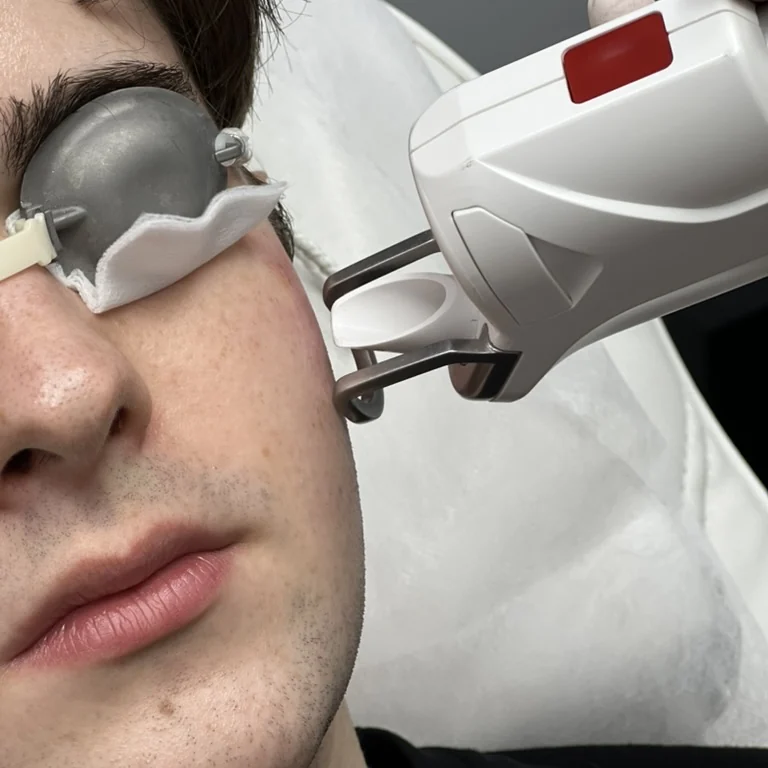
The recording shows the work with the handpiece and what the skin looks like immediately after a pass, that is the difference from an ablative treatment: redness without an open surface and without scabs.
After the treatment
The skin may be red and swollen for a few days, without scabs and without an open surface.
In the following days gentle peeling may appear, which must not be hurried.
Daily sun protection for the whole duration of the series.
Full aftercare recommendations, together with home care, are given by the person performing the treatment.
Contraindications
Tell us about the medication you take, including oral vitamin A derivatives, and about any tendency to post-treatment pigmentation and keloids.
Editorial responsibility
Responsible for the content
NL Clinic, Katowice
How the content is created
Last updated
14 August 2026
We do not give the trade names of devices, because we do not build an advantage on the brand of equipment, and the law restricts advertising of medical devices to the general public. The material is for information and does not replace a consultation or an assessment.
The questions we are asked most often
What does it mean that the laser is fractional but non-ablative?
Fractional means that the beam is divided into a grid of microscopic points, and the tissue between them stays intact. Non-ablative means that the beam does not vaporise the epidermis: the heat acts in the dermis and the skin surface stays closed. This is the main difference from the CO2 laser, which works ablatively.
Why does 1550 nm reach deeper than CO2, despite the shorter wavelength?
Because it is not about the wavelength, but about the strength of absorption. The chromophore of both lasers is water, but at 1550 nm absorption is moderate and at 10 600 nm very strong. So the energy at 1550 nm is not released immediately at the surface and reaches the dermis, where collagen remodelling takes place.
How does healing go after this treatment?
Because the epidermis is not vaporised, no scab and no open surface form. The skin may be red and swollen for a few days, and in the following days gentle peeling may appear. The rebuilding time is shorter than after an ablative treatment, but the aftercare recommendations still apply.
When is this laser chosen, and when CO2?
The decision belongs to the doctor and depends on the aim and on how much time the patient has for the skin to rebuild. A non-ablative treatment means a gentler course and a shorter return, but usually requires a larger number of treatments. An ablative treatment acts more strongly in one session, at the price of longer healing.
Is the effect visible straight away?
No. Collagen remodelling takes weeks, which is why the outcome is assessed after the series is complete, not after the first treatment. What is visible in the first days is the skin's reaction to the treatment, not the final result.
Is this laser combined with other treatments?
Yes. In our clinic it is used, among others, in combination with IPL, where work on pigment is combined with skin remodelling. The order and intervals are set by the person conducting the treatment, because skin after a fractional treatment needs time to rebuild.
The content is for information. It does not replace a consultation, an examination or an individual assessment.