
On this page
Three numbers in descriptions of thulium lasers
Three different values circulate in material about thulium lasers and it is easy to get lost in them, because each concerns something different. It is worth separating them before moving on to the treatment itself.
1927 nm
The typical range of thulium lasers on the market
The value most often given in descriptions of other manufacturers' devices. The affinity for water is slightly lower here than at 1940 nm.
1935 nm
Area of the water absorption peak
This is not the wavelength of a device, but a point on the absorption curve at which water absorbs light most strongly. That is why it appears in technical descriptions.
1940 nm
Our device
A wavelength lying very close to the absorption peak of water, so the energy is absorbed more strongly and closer to the skin surface.
Our device works at 1940 nm. A higher affinity for water than at 1927 nm means the energy is absorbed closer to the surface, so the action is more superficial.
The absorption window, or what absorbs 1940 nm
The skin contains three main chromophores: water, melanin and haemoglobin. With this laser the target is water, and the fact that the other two absorb weakly has a direct practical consequence.
1940 nm
the range of this laser
Water
Melanin
Haemoglobin
Low absorption by melanin matters when working on pigmentation. This laser does not target the pigment directly, as the alexandrite laser does, but works through remodelling of the epidermis and dermis. That is why it is sometimes chosen where strong targeting of melanin would be risky, for example with melasma.
A schematic comparison, based on the absorption curves of skin chromophores.
How the thulium laser works
This laser targets water, not pigment, and yet it lightens pigmentation. That is not a contradiction. The energy reaches the epidermis and the shallow dermis and creates microzones in them, which heal as the epidermis renews itself. The shedding epidermis takes the excess pigment with it, and that is why the skin tone evens out, not because the laser breaks down melanin. The fresh skin is smoother and brighter, hence the baby glow, and the shallow remodelling adds a little collagen.
Added to this is remodelling of the skin structure: micro-injuries in the epidermis and the superficial layer of the dermis trigger repair processes, the effect of which is a smoother surface and a more even tone.
Fractional operation and ablative mode
Fractional technology consists of dividing the beam into microbeams, which create microscopic zones of regeneration in the skin, that is microcolumns. The tissue between them stays intact and the rebuilding runs from there.
Fractionally
Pinpoint zones of regeneration surrounded by healthy tissue. Faster healing, a shorter rebuilding time and more freedom with a darker skin phototype.
Over the whole surface
An even, more intense action at greater depth. The renewal is more extensive, but comes with longer regeneration.
This laser does not work only non-ablatively.
In most treatments it works in a stimulating way, without breaching the epidermis, but with the right settings it can also work in ablative mode, that is deliberately breaching the surface. This is a stronger mode with a longer rebuilding period. Its use is decided by the person conducting the treatment, not by a choice made at booking.
Indications
With melasma it is worth remembering that it is a recurring condition, and the approach reduces its visibility without removing the cause. We describe the choice of technology for a specific pigmented lesion on the laser pigmentation removal page. For mild acne scars this laser is sometimes considered, whereas for deeper scars the CO2 laser, the erbium glass laser or the picosecond laser is chosen more often.
How the treatment goes
The treatment itself takes from 20 to 40 minutes, depending on the area: the face usually 20 to 30 minutes, the face with neck and décolletage 40 to 50 minutes. The first visit is longer, because it includes a consultation and skin preparation. During the treatment you may feel warmth, tingling and slight pricking.
The series, results and planning the date
Usually 3 to 5 sessions at intervals of 4 to 6 weeks are recommended. The first changes may be visible after a few days, but skin remodelling develops over weeks, and the results in a series accumulate.
A practical tip for planning: the last treatment in the series is best done about 4 to 6 weeks before an important event, so the skin has time to regenerate. If you are planning the whole series, it is worth starting about six months earlier.
The treatment on video
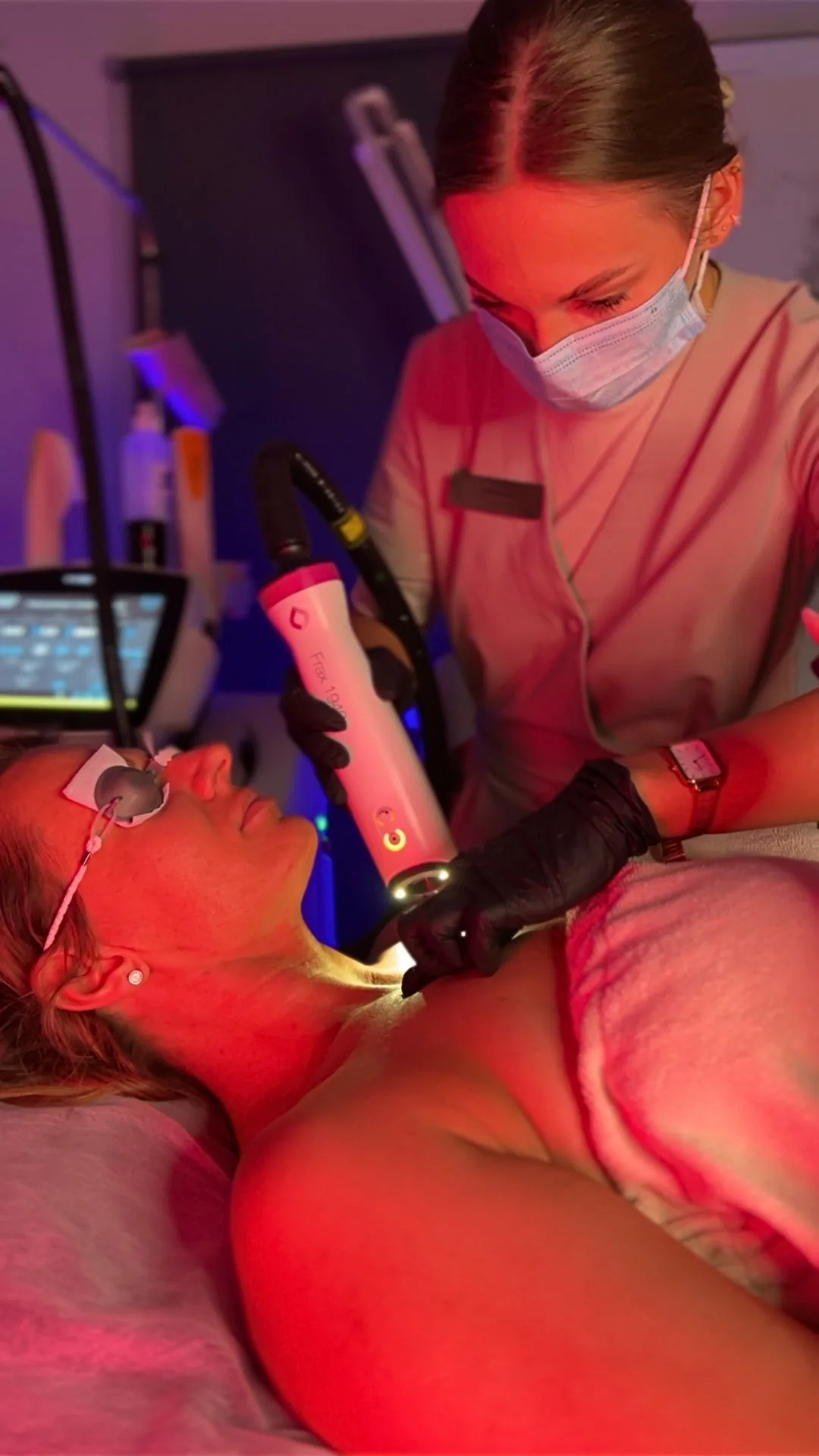
The recording shows work with the handpiece in a therapy combined with IPL, that is in the variant in which work on skin texture is combined with work on pigment and vessels.
A recording from the NL Clinic treatment room. It plays on click, with no background sound and no automatic start. We write about combined therapy on the Laser photorejuvenation page.
Recommendations before and after the treatment
Before the treatment
Protecting the skin from ultraviolet radiation for at least 4 weeks before the treatment, with SPF 50 plus sunscreen.
Stopping retinoids, AHA and BHA acids and other irritating ingredients 7 to 10 days before the treatment.
Skin free of irritation, abrasions and infection in the treatment area.
Reporting photosensitising medication and recurrent herpes.
After the treatment
Redness and slight tightness of the skin usually for 1 to 3 days. This is an expected reaction that resolves on its own.
Possible gentle peeling, most often on the second and third day, depending on the type of treatment and the settings.
Daily SPF 50 plus sunscreen and regenerating, moisturising creams.
For 1 to 2 weeks no chemical peels, microdermabrasion or other treatments that irritate the skin.
Contraindications
Tell us about the medication you take, including oral vitamin A derivatives, and about any tendency to post-treatment pigmentation and keloids.
Editorial responsibility
Responsible for the content
NL Clinic, Katowice
How the content is created
Last updated
16 August 2026
Data confirmed by the clinic's materials: the treatment is carried out by an aesthetic medicine doctor or a certified cosmetologist, the device wavelength is 1940 nm, the series usually includes 3 to 5 sessions at intervals of 4 to 6 weeks. We do not give the trade names of devices, because the law restricts advertising of medical devices to the general public. The material is for information and does not replace a consultation or an assessment.
The questions we are asked most often
What wavelength does the thulium laser in your clinic have?
1940 nm. It is worth explaining, because three different numbers appear in industry material. Thulium lasers on the market mostly work at 1927 nm, the absorption peak of water lies around 1935 nm, and our device emits 1940 nm, a wavelength lying very close to that peak.
Why does closeness to the absorption peak of water matter?
Because the chromophore of this laser is the water contained in the skin. The closer to the absorption peak, the more strongly the energy is absorbed at the surface, so it acts more precisely in the shallow layers of the skin without reaching deeper unnecessarily. That is why this range is sometimes chosen for work on the epidermis and the superficial layer of the dermis.
What does fractional work mean?
The beam is divided into microbeams, which create microscopic zones of regeneration in the skin, so-called microcolumns. The tissue between them stays intact and the rebuilding runs from there, which is why healing is faster than when the whole surface is treated. Fractional work also gives more freedom with a darker skin phototype.
Does this laser work only non-ablatively?
No. In most treatments it works non-ablatively, that is in a stimulating way, but with the right settings it can also work in ablative mode, that is deliberately breaching the epidermis. This is a stronger mode with a longer rebuilding period, and its use is decided by the person conducting the treatment after assessing the skin.
How many treatments does the series include and when are the results visible?
Usually 3 to 5 sessions at intervals of 4 to 6 weeks. The first changes may be visible after a few days, but skin remodelling develops over weeks, and the results in a series accumulate. The full outcome is assessed after the series is complete, not after the first treatment.
Does the skin peel after the treatment?
It may, usually on the second and third day, depending on the type of treatment and the settings. The skin may also be red and slightly tight for 1 to 3 days. A regenerating cream is usually enough, and most people do not need to withdraw from everyday activities.
When should the treatment be planned before an important event?
The last treatment in the series is best done about 4 to 6 weeks before the event, so the skin has time to regenerate. If the whole series is planned, it is worth starting about six months earlier. Dates are agreed at the consultation.
Does the thulium laser help with acne scars?
It is sometimes used for mild acne scars. For deeper scars other solutions are chosen more often: the CO2 laser when a break of a few days is possible, the erbium glass laser when the break has to be short, or the picosecond laser. The choice belongs to the person conducting the treatment.
The content is for information. It does not replace a consultation, an examination or an individual assessment.