
On this page
How laser photorejuvenation works
A chromophore is a substance in the skin that absorbs light. The effectiveness of every light-based treatment depends on which chromophore the beam hits. Here we work with two at once.
IPL, broadband light
Chromophores: melanin and haemoglobin.
It works on what has colour: pigmentation, uneven skin tone, and visible vessels and redness. Filters and wavebands are selected to match the indication.
Fractional laser, 1550 nm
Chromophore: water contained in the skin.
It does not remove the epidermis. It creates microcolumns in the dermis that trigger healing and collagen remodelling, so the improvement affects texture and fine irregularities, not skin tone alone.
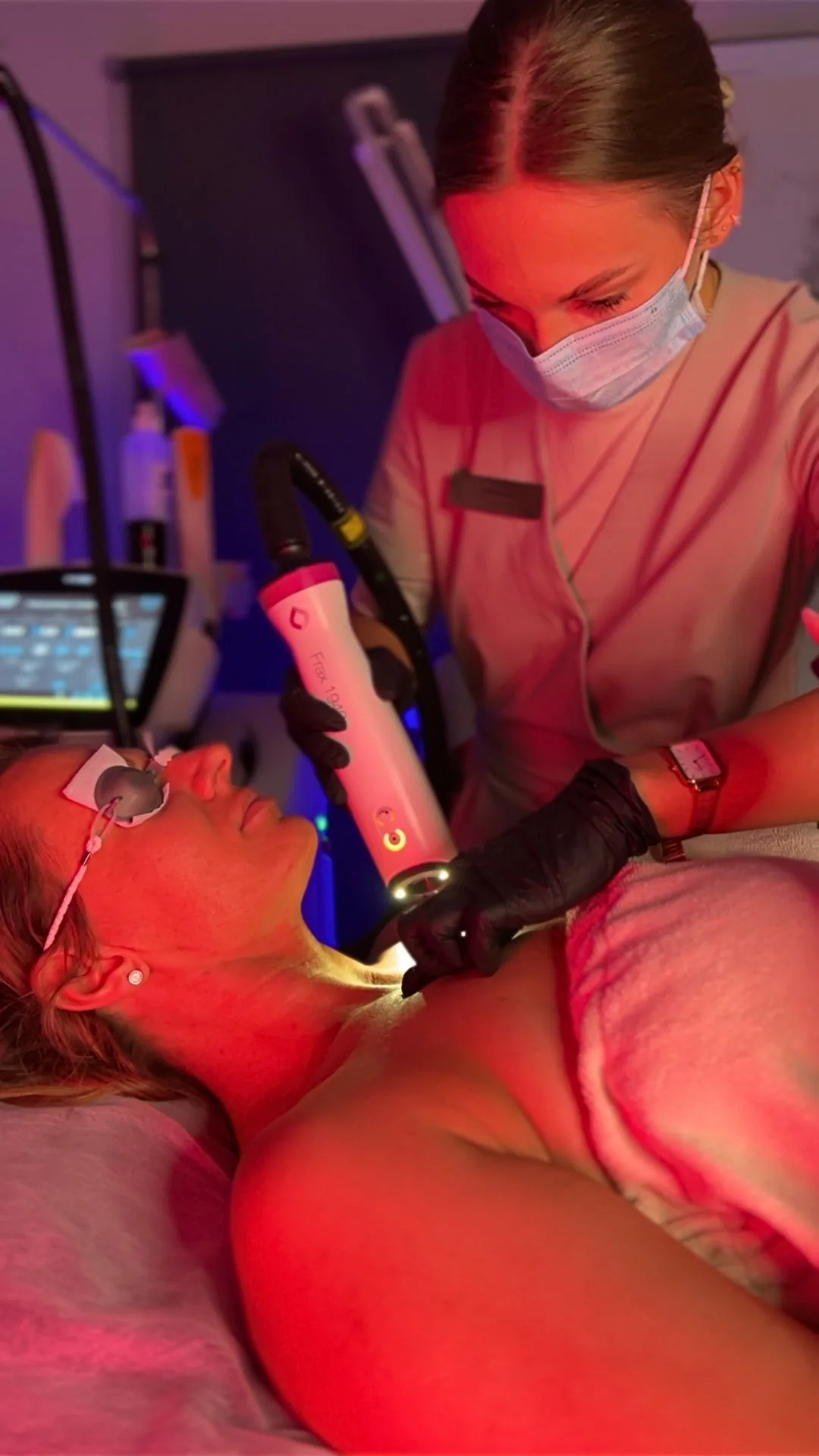
When working on pigmentation, we often add a 1940 nm thulium laser to the session. It works more superficially, on water in the epidermis and in the superficial layer of the dermis, and smooths the surface itself. We describe it separately on the thulium laser page.
Why we combine IPL with a fractional laser
The platform manufacturer describes this combination under the name Light & Bright. It is not a separate device, but a way the manufacturer envisages of combining two technologies in one visit: broadband IPL light with a PR 530 or VL 555 filter and a 1550 nm fractional laser. For pigmentation, we add a 1940 nm handpiece. The manufacturer envisages this protocol for mild pigmentation, diffuse redness, fine vessels and uneven texture on the face and decolletage, in a scheme of three treatments in a series, usually monthly. The number of sessions and the choice of filters is decided by the cosmetologist or doctor after a skin assessment.
It is not about doing more in one visit, but about the fact that skin problems rarely occur on their own. Pigmentation is often accompanied by a decline in skin structure, and visible vessels by uneven skin tone.
A single technology covers a single mechanism. IPL will not rebuild skin structure, because it does not work on water. A fractional laser will not close a vessel, because it does not target haemoglobin. Combining both in one session covers both directions at once.
Combining means a wider range of action, not stronger parameters.
The skin receives two stimuli in one session, so the parameters of each technology are chosen more carefully than for a single treatment. The order, the parameters and whether a combined session is right in a given case are decided by the person carrying out the treatment after a skin assessment.
Who it is for, and when a single technology is better
Combined therapy
Pigmentation and uneven skin tone coexisting with a decline in skin structure.
Visible vessels together with enlarged pores and surface roughness.
Photoaged skin, where the problem is both tone and skin quality at the same time.
Readiness for a series of treatments and for daily photoprotection.
Rather a single technology
One clearly defined problem. In that case, a technology matched to it is more effective.
Fresh suntan or planned intensive sun exposure.
Irritated skin or skin with active inflammation in the treatment area.
Expecting a result after one session.
If a skin assessment shows that a combined session is not the right step, we will say so directly and suggest a single technology. We describe the choice of solutions for pigment changes on the laser pigmentation removal page, and for vessels on the vascular laser page.
Course of the session
A combined session takes longer than a single treatment, because it involves two passes over the same area. The exact time depends on the scope and is established at the consultation.
The treatment on video
The recording shows work with the handpiece in combined therapy, that is exactly the variant this page is about.
A recording from the NL Clinic practice. It plays after clicking, with no background sound and no automatic start.
What the treatment will not do
It will not change facial features or replace volumising treatments. It works on skin quality, not on its support.
It will not remove the cause of pigmentation or the tendency to develop vessels. Without photoprotection, the changes come back.
It will not work after a single session. For pigmentation and skin structure a series is needed, and the effects accumulate.
It is not the right choice for one, clearly defined problem. In that case a single technology can be more effective.
We do not give the number of sessions or the degree of improvement before qualification. They depend on which problems dominate and how the skin responds to the first treatments.
Recommendations before and after the treatment
The recommendations proper to both technologies apply, so the more cautious version is taken into account.
Before the treatment
Protecting the skin from ultraviolet radiation for at least 4 weeks before the treatment.
Stopping retinoids, AHA and BHA acids and other irritating ingredients 7 to 10 days before the treatment.
Skin free of irritation, abrasions and infection in the treatment area.
Reporting photosensitising medication and recurrent herpes.
After the treatment
Redness and mild skin tightness, usually for 1 to 3 days.
Mild flaking is possible, most often on the second and third day.
Daily SPF 50 plus sunscreen and regenerating, moisturising creams.
For 1 to 2 weeks, no chemical peels, microdermabrasion or other irritating treatments.
Contraindications
For a combined treatment, the contraindications of both technologies apply, so the list is wider than for each of them separately. Tell us about the medication you are taking and about any tendency towards post-treatment pigmentation.
Editorial responsibility
Responsible for the content
NL Clinic, Katowice
How the content is created
The composition of the treatment, that is IPL combined with a non-ablative 1550 nm fractional laser, confirmed by the clinic on 31 August 2026 and in the system manufacturer's treatment protocol. A 1940 nm thulium laser is sometimes added to the session when working on pigmentation. This material is for information purposes only and does not replace a consultation or qualification.
How much does laser photorejuvenation cost
The price depends on the area. Discounts: package of three minus 15 percent, package of five minus 20 percent.
| Area | Single | Package of three | Package of five |
|---|---|---|---|
| Face | 1400 PLN | 1190 PLN/treatment, 3570 PLN | 1120 PLN/treatment, 5600 PLN |
| Face and neck | 1600 PLN | 1360 PLN/treatment, 4080 PLN | 1280 PLN/treatment, 6400 PLN |
| Face, neck and décolletage | 2000 PLN | 1700 PLN/treatment, 5100 PLN | 1600 PLN/treatment, 8000 PLN |
| Hands | 1000 PLN | 850 PLN/treatment, 2550 PLN | 800 PLN/treatment, 4000 PLN |
The price list is for information only and does not constitute an offer within the meaning of Article 66 § 1 of the Polish Civil Code.
The questions we are asked most often
What does laser photorejuvenation consist of?
Two technologies carried out in one session: IPL, that is broadband light, and a non-ablative 1550 nm fractional laser. IPL works on whatever has colour, that is on pigment and vessels. The fractional laser creates microcolumns in the dermis, which trigger collagen remodelling, so the improvement also covers texture. When working on pigmentation, the session is often supplemented with a 1940 nm thulium laser.
Why does combining these two technologies make sense?
Because each of them works on a different chromophore, that is a different substance that absorbs light. IPL targets melanin and haemoglobin, and the fractional laser targets the water contained in the skin. The combination therefore covers pigment and vascular problems as well as skin structure at the same time, which a single technology cannot do.
Who is this treatment intended for?
For people who have several problems on the face at the same time: pigmentation, uneven skin tone, visible vessels, and deterioration of skin structure together with enlarged pores. If there is one clearly defined problem, a single technology matched to it is usually more suitable.
Does combining two technologies mean a stronger treatment?
It means a broader range of action, not automatically stronger parameters. For a combined treatment, the parameters of each technology are chosen more carefully precisely because the skin receives two stimuli in one session. The order and the parameters are decided by the person carrying out the treatment after assessing the skin.
Does the skin peel after the treatment?
This can happen, usually mildly, on the second or third day, as it does after the fractional treatment alone. The skin can also be red and slightly tight for 1 to 3 days. SPF 50 plus sunscreen is required for the whole duration of the series.
When should the treatment be planned before an important event?
The last treatment in the series is best carried out around 4 to 6 weeks before the event, so the skin has time to regenerate. If a whole series is planned, it is worth starting earlier and setting the schedule at the consultation.
The content is for information. It does not replace a consultation, an examination or an individual assessment.