
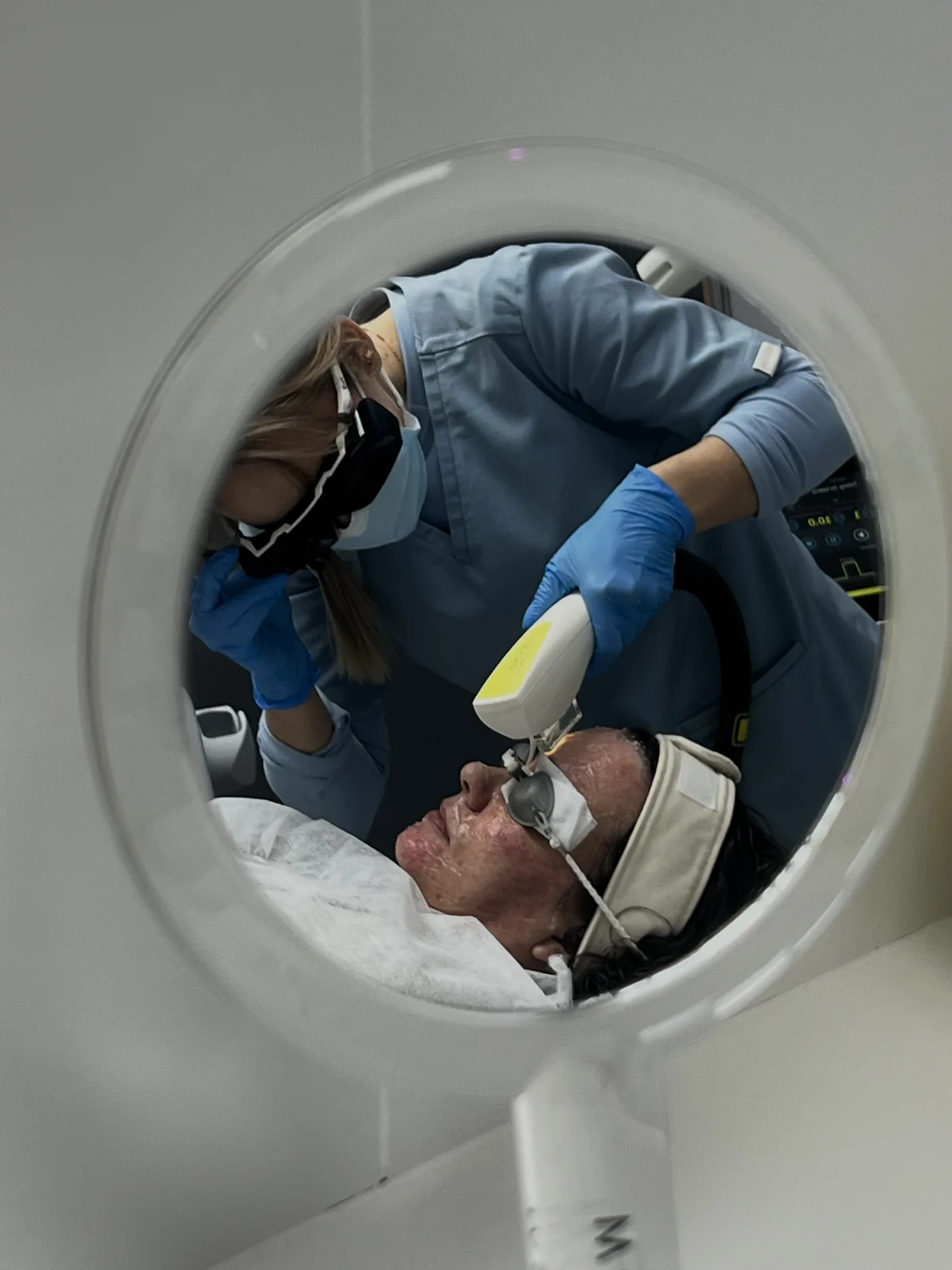
Let us start with the boundary
Rosacea is a medical condition and its treatment is led by a doctor, most often a dermatologist.
Laser treatments can be a supporting measure, targeted at visible vessels and erythema, but they do not replace treatment. Contact a doctor if the redness is accompanied by papules, pustules or eye symptoms. In more difficult cases we refer you to cooperating dermatologists.
On this page
How the laser closes a vessel
The mechanism is based on selective photothermolysis. The chromophore, meaning the substance that absorbs light, is the haemoglobin in the blood filling the vessel. The energy turns into heat inside the vessel lumen and leads to its closure.
The surrounding skin absorbs this wavelength much more weakly, so it remains largely untouched. This is what distinguishes the vascular laser from ablative devices, whose chromophore is the water present in every tissue.
Closing the vessel does not mean it disappears immediately. The vessel still has to be removed by the body, and this takes weeks. That is why the result is assessed after a few weeks, not the next day.
The absorption window, or why haemoglobin
The skin contains three main chromophores: haemoglobin, melanin and water. The effectiveness of a vascular treatment depends on whether the chosen wavelength targets haemoglobin and misses the others. Below is how this looks for the range that works on superficial vessels. The length of the bar corresponds to the strength of absorption, and the light background shows the full scale.
532 nm
range working on superficial vessels
Haemoglobin
Melanin
Water
High absorption by haemoglobin is the goal here, but note the second bar: in this range melanin also absorbs strongly. That is why with a darker phototype and fresh tanning the risk of an adverse reaction increases, and the parameters have to be chosen more carefully.
A schematic comparison, based on the absorption curves of skin chromophores.
Two ranges, two vessel depths
Vessels differ in thickness and depth, so one wavelength range cannot serve them all.
532 nm
Superficial vessels
Absorbed very strongly by haemoglobin, but works shallowly. Chosen for fine, thin vessels, dilated vessels around the nose and cheeks, and for cherry angiomas.
1064 nm
Deeper and thicker vessels
Absorbed by haemoglobin more weakly, but it reaches deeper. Chosen for vessels located deeper and with a larger diameter, including on the legs.
The choice of range belongs to the person performing the treatment and results from the assessment of the vessel, not the patient's preference. For mixed lesions the plan can be combined.
Vessel versus erythema, two different things
Vessel
A single dilated vessel, visible as a thin line. It is treated point by point, vessel by vessel.
Redness
Diffuse redness resulting from a dense network of small vessels. It requires work over a larger area, usually in a series.
We describe the mechanisms behind both changes and the factors that intensify them on the vascular skin page.
Indications
What the treatment will not do
It will not remove the tendency to develop vessels. It closes those that have already formed, and new ones may continue to appear.
It will not cure rosacea, because that is a condition managed by a doctor.
It will not work in a single session for erythema. Diffuse redness requires a series and maintenance.
It will not give an immediate effect. The body clears a closed vessel over weeks.
We do not state the number of treatments before qualification. It depends on the number, thickness and depth of the vessels, and on whether we are working on individual changes or on erythema.
The treatment on video
The recording will show point work on a single vessel and how the area looks immediately after the treatment. This answers the most common concern: whether, after the treatment, there is anything visible that would stop you leaving the house.
After the treatment
Immediately after the treatment, the area can be red and slightly swollen, and the vessel may look darker than before the treatment.
No sauna, swimming pool, hot baths or intense exercise for the period indicated by the person carrying out the treatment.
Daily photoprotection, because ultraviolet radiation intensifies vascular changes.
The effect builds up over weeks, as the body clears the closed vessel.
Contraindications
Tell us about any medicines you are taking, because some of them increase the skin's sensitivity to light, and about medicines affecting clotting.
Editorial responsibility
Responsible for the content
NL Clinic, Katowice
How the content is created
Last updated
14 August 2026
We do not give equipment brand names, because we do not build an advantage on equipment branding, and regulations restrict advertising of medical devices directed at the public. The material is informational in nature and does not replace a consultation, examination or treatment carried out by a doctor.
The questions we are asked most often
How does the laser close a vessel without damaging the skin?
The chromophore, that is, the substance that absorbs the light, is here the haemoglobin contained in the blood filling the vessel. The energy converts into heat inside the vessel and leads to its closure, while the surrounding skin, which absorbs this wavelength much more weakly, remains largely untouched. This is the mechanism of selective photothermolysis.
Why are two different wavelength ranges used for vessels?
Because vessels lie at different depths. The 532 nm range is absorbed very strongly by haemoglobin, but works superficially, so it suits fine, thin vessels. The 1064 nm range is absorbed more weakly, but reaches deeper, so it is chosen for thicker vessels that lie deeper.
Does the vessel disappear immediately after the treatment?
Some vessels fade during the treatment, but a closed vessel still has to be cleared by the body, and that takes time. In the first few days, the area can be red, and the vessel may look darker than before the treatment. The effect is assessed after a few weeks.
Does the treatment remove the cause of vessels forming?
No. It closes vessels that have already formed, but it does not change the tendency to develop them. With vascular skin and with rosacea, we are talking about ongoing management with maintenance, not a one off treatment. New vessels may continue to appear.
Are erythema and vessels the same thing?
No. A vessel is a single dilated vessel, visible as a thin line. Erythema is diffuse redness resulting from a dense network of small vessels. They are treated differently: individual vessels point by point, erythema over a larger area, often in a series.
When is a medical assessment needed first?
When the redness is intensifying, covers a growing area, and is accompanied by papules and pustules or eye symptoms. Rosacea is a disease and its treatment is managed by a doctor, most often a dermatologist. In more difficult cases, we refer to cooperating dermatologists instead of carrying out a series of treatments on our own.
The content is informational in nature. It does not replace a consultation, examination or treatment carried out by a doctor.