
Before you start reading
Not every redness is a vessel, and not every vessel needs a treatment. If you are not sure what you are dealing with, start with the page about vascular skin, where we describe the symptoms and causes.
This page answers the question of what to do about a vessel or redness that is already there. We describe the technical details of the devices separately: vascular laser and IPL, broadband light.
On this page
How a vessel is closed
Both lasers and IPL are based on selective photothermolysis. Light energy is absorbed by a specific chromophore, in this case haemoglobin and oxyhaemoglobin in the blood vessel, and converted into heat.
1
Absorption of energy
Light of the selected wavelength is absorbed by the haemoglobin and oxyhaemoglobin in the vessel, not by the surrounding tissue.
2
Conversion into heat
Light energy converts into heat and raises the temperature of the vessel wall to about 70 to 75 degrees Celsius.
3
Denaturation and closure
Proteins in the vessel wall undergo denaturation, so the vessel is controllably damaged and closed.
4
Resorption
The body removes the closed vessel gradually, through the lymphatic system. That is why the effect develops over weeks, not hours.
Temperature is what matters, not power. Around 70 to 75 degrees Celsius is enough to denature the proteins of the vessel wall. Above that, the risk to surrounding tissue starts to rise, so parameters are escalated carefully, not by shortcuts.
Why four different wavelength ranges
Haemoglobin does not absorb light evenly. It absorbs most strongly in the range from 400 to 600 nm, above 600 nm absorption drops noticeably, and beyond 800 nm it levels off at a lower level. A shorter wavelength therefore releases energy close to the surface, while a longer one reaches deeper, though it needs more of it.
Haemoglobin absorption and device ranges
532
755
1064
Vascular IPL applicator, 555 to 950 nm
From 400 to 600 nm: the strongest absorption by haemoglobin. Hence the effectiveness of the 532 nm range and IPL filters in this band for shallow lesions.
From 600 to 800 nm: absorption drops noticeably.
Above 800 nm: absorption levels off at a lower level. The wavelength reaches deeper, but needs more energy to work.
Vascular IPL applicator on our platform: 555 to 950 nm. The band starts at the range well absorbed by haemoglobin and extends further, which means it also covers vessels located deeper.
Schematic summary. The absorption profile is given after the literature listed in the Sources section, device ranges after the clinic's own materials.
Four methods and when we choose which one
Four ranges, one goal. They differ in the depth at which they release energy, and in who carries out the treatment.
Vessel-closing methods by depth of the lesion
| Method (wavelength range) | For which lesions | Depth and vessel diameter | Who performs it |
|---|---|---|---|
| KTP laser, 532 nm | Superficial vascular lesions, small vessels on the face | superficial | cosmetologist |
| Nd:YAG laser, 1064 nm | Deeper vessels, mainly on the legs | deeper, vessels up to 2 to 3 mm in diameter | doctor |
| Nd:YAG and alexandrite, 1064 + 755 nm | Lesions of varying depth in one area | two ranges in one protocol | doctor |
| IPL, filtered light 555 to 950 nm | Extensive redness and scattered telangiectasia | wider field, less precision than a laser | cosmetologist |
Scattered erythema and a single vessel are two different tasks. For erythema and widespread telangiectasia, a wider field works better, meaning IPL. For a single, clearly visible vessel, the precision of a laser wins.
Indications
The treatment is indicated when permanently dilated vessels have appeared in the dermis and are visible through the epidermis. Such lesions do not disappear on their own and may deepen over time, so it is easier to work at an early stage.
Face
Visible vessels, telangiectasia and erythema around the nose, cheeks and chin.
Neck and décolletage
Vascular lesions, including poikiloderma.
Legs
Superficial vessels and spider veins. Deeper lesions require the 1064 nm range and a treatment carried out by a doctor.
Vascular lesions can also be a symptom of vascular disease, not only an aesthetic issue. That is why qualification includes a medical history, and in the case of an atypical presentation we refer to a doctor before the treatment, not after it. Rosacea is managed by a dermatologist; the treatment is then a supporting measure, not a cure.
How the treatment goes
We do not use anaesthesia, and it is not a matter of saving time. Numbing cream reduces the effectiveness of the treatment because it limits vessel constriction. Comfort is provided by cooling the skin before and after the treatment. Sensations are described as a burning feeling or brief stinging.
1
Consultation and assessment
Assessment of skin condition, the type and extent of lesions, a medical history and exclusion of contraindications. At this stage we determine the wavelength range and who will carry out the treatment.
2
Preparation
Thorough cleansing of the treatment area, cooling the skin if needed, selecting the device parameters and protective goggles.
3
Treatment
Pulses applied over the treatment area, with monitoring of the skin's reaction. Time depends on the technology chosen and the size of the area.
4
Finishing
Cooling the skin with the working tip or a chiller to limit redness and swelling, along with soothing and regenerating preparations.
The treatment on video
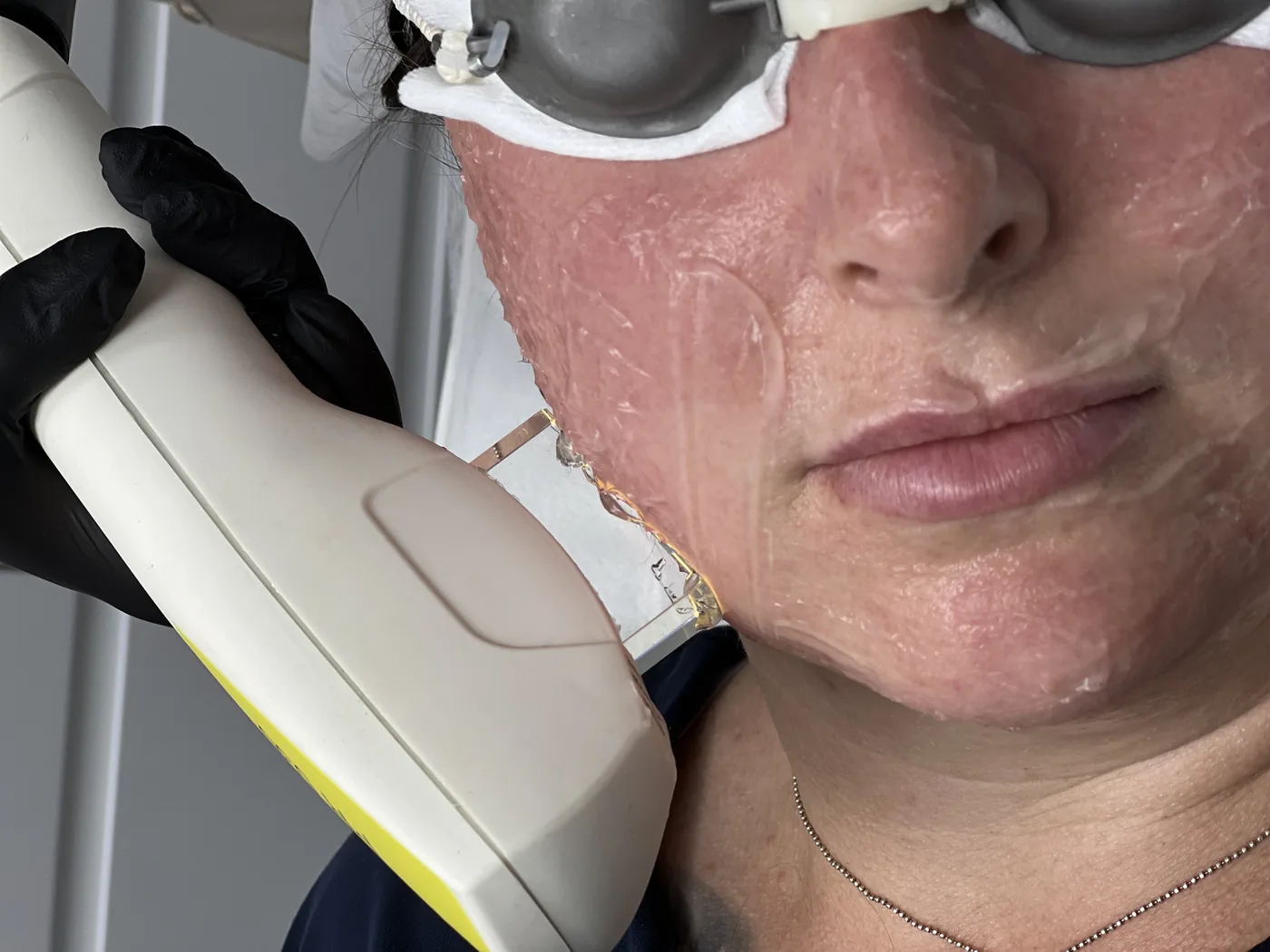
The recording shows the handpiece being guided over the area with vascular lesions, and the skin being cooled, which is what replaces anaesthesia in this treatment.
Recording from the NL Clinic practice in Katowice. Treatment for vascular lesions.
What to expect and after how many treatments
The greatest improvement is often visible after the first treatment, and some people do not need another visit. For more extensive lesions a series is needed, usually 2 to 3 sessions. Effectiveness depends on the width and depth of the vessel, on skin phototype and on systemic conditions, so the number of treatments cannot be promised in advance.
First changes
The greatest improvement is often visible after the first treatment.
Number of sessions
Some lesions require a series, usually 2 to 3 sessions.
Skin regeneration
From 14 to 21 days after the treatment.
What affects the result
The width and depth of the vessel, skin phototype, systemic conditions.
A good time of year
Autumn and winter, when the skin is not exposed to strong sun.
What a "lasting effect" means
The closed vessel is absorbed and does not return. New lesions may still appear, however, especially with further sun exposure or hormonal changes. The treatment therefore addresses a specific vessel, not the tendency to develop them.
We publish photos of results only with patients’ consent and under comparable conditions: the same framing, light, facial expression and time interval. The result is always individual.
What to do after the treatment
The treatment does not require recovery time, and you can return to your daily activities straight away. Full skin regeneration, however, takes 14 to 21 days, and a few rules apply during this time.
Use compresses and cosmetics as recommended at your appointment.
Treat the skin gently for a few days, without rubbing and without irritating products.
Stop using products containing alcohol, tretinoin, retinol, benzoyl peroxide, salicylic acid and glycolic acid, and astringents.
Do not drink alcohol for at least two days.
Limit physical activity that raises blood pressure.
Avoid extreme temperatures: hot baths, saunas and frost.
Protect the skin from UV radiation and use a high factor sun cream for four weeks.
Take the recommended supplements.
If the changes recur or you have any doubts, contact your doctor.
Why physical activity matters
Activity that raises blood pressure can cause the vessel to reopen before the body absorbs it. This is the only recommendation on this list that affects the actual result of the treatment, not just healing comfort.
In very rare cases, an antibiotic ointment is needed, and for severe irritation, a mild steroid ointment. Medicines are prescribed by the aesthetic medicine doctor at a follow-up visit.
Contraindications
Some contraindications are absolute, some are only temporary. Which of them apply to a specific person is determined by the interview at the consultation.
A fresh tan, abrasions at the treatment site and photosensitising cosmetics postpone the treatment rather than rule it out. This is why the most convenient time for vessel therapy is autumn and winter, when the skin is not exposed to strong sunlight.
Editorial responsibility
Responsible for the content
NL Clinic, Katowice
How the content is created
Last updated
14 August 2026
Data confirmed by the clinic's materials: four wavelength ranges used for vascular lesions, temperature 70 to 75 degrees Celsius and denaturation of the vessel wall proteins, 1064 nm penetration of 2 to 3 mm, IPL filter range, no anaesthesia along with the justification, a series of 2 to 3 sessions, regeneration 14 to 21 days, post treatment recommendations and contraindications. Trade names of devices are not given. This material is informational in nature and does not replace a consultation or qualification.
The questions we are asked most often
What does closing vessels involve?
Light energy is absorbed by the haemoglobin in the vessel and converted into heat. The vessel wall heats up to around 70 to 75 degrees Celsius, the proteins in it undergo denaturation, and the vessel is closed. The body gradually removes the closed vessel through the process of resorption.
Why is anaesthesia not used?
Because anaesthesia reduces the effectiveness of the treatment: numbing cream limits the constriction of the vessels, which is the reaction the patient comes for. Comfort is provided by cooling the skin before and after the treatment. The sensations are described as a burning feeling or brief stinging, well tolerated by most people.
How many treatments will be needed?
The number depends on the extent and depth of the lesions. Most people notice an improvement after the first treatment, and for some lesions a series is needed, usually 2 to 3 sessions. The final plan is made after an assessment of the skin at the consultation, not by phone.
Is the result permanent?
The closed vessel is absorbed by the body and does not return. New vascular lesions can, however, appear, particularly with further sun exposure or hormonal changes. This is why we talk about treating a specific vessel, not curing the tendency for them to form.
Are vessels on the legs removed the same way as on the face?
No. Vessels on the legs lie deeper, so they require a wavelength with greater penetration, that is the 1064 nm range, and the treatment is then carried out by a doctor. Small vessels on the face respond well to the 532 nm range and to IPL, and these treatments are carried out by a cosmetologist.
What are the possible side effects?
The skin at the treatment site may be red or swollen, usually for a few hours to a few days. Small scabs rarely form and heal on their own. In very rare cases, an antibiotic ointment or a mild steroid ointment is needed; medicines are prescribed by the doctor.
How should I prepare for the treatment?
Avoid sun exposure and tanning for 4 weeks before the treatment. Do not use self-tanning products or chemical peels for a week before the appointment. Report any skin infections at the planned treatment site and all medicines and supplements you are taking.
When is the best time to plan the treatment?
In autumn and winter, when the skin is not exposed to strong sunlight. A fresh, deep tan is a contraindication, and after the treatment the skin must be protected with sun cream for four weeks.
Can you return to your usual activities after the treatment?
Yes, the treatment does not require recovery time. For about two weeks, however, you should avoid intense exercise, hot baths and sun exposure. Exercise that raises blood pressure can cause the vessel to reopen before the body absorbs it.
Is this the same as IPL for erythema?
IPL is one of the methods described on this page, alongside three laser ranges. If you are interested in the technology itself, its physics and safety, we describe it separately on the page about broadband light. The choice of method belongs to the qualification, not to the patient.
Sources
A Comparative Study of Intense Pulsed Light with Two Different Filters in Meibomian Gland Dysfunction. Description of the light absorption profile in haemoglobin: the highest coefficient in the 400 to 600 nm range, a clear decrease between 600 and 800 nm, stabilisation above 800 nm, and the mechanism of vessel coagulation after energy absorption.
Comparative Efficacy Between Intense Pulsed Light Narrow Spectrum and Broad Spectrum in the Treatment of Post-Acne Erythema. Description of the bands used for vascular lesions and the role of filters in directing energy to haemoglobin.
The description of the treatment process, the device parameters used in the practice and the post-treatment recommendations come from the clinic's own materials. We base the light absorption profile for haemoglobin on the literature above.
The content is for information. It does not replace a consultation, an examination or an individual assessment.