
A simple test before you read on
Tilt your head back slightly and look in the mirror from the side. If the area under the chin clearly smooths out, the cause is largely the skin and its tension. If the outline stays almost unchanged, fatty tissue or bone structure is likely involved.
This is not a diagnosis, but a clue worth starting the conversation with. At the consultation, this is assessed by examination, not in the mirror.
On this page
Four causes, four different paths
The term "double chin" describes the appearance, not the cause. Different structures lie behind the same picture, and each of them responds to a different approach.
Excess fatty tissue
Tissue accumulates in the submandibular area, creating fullness visible in profile. Distribution is largely genetically determined, which is why a double chin also occurs in slim people.
The contour does not change noticeably when the head is tilted back. The tissue can be pinched between the fingers.
Skin laxity
The skin loses elasticity and stops following the line of the jaw. Common after weight loss and with age, as collagen and elastin decrease.
The contour smooths out when the head is tilted back. The skin is thin and can be gently lifted.
Platysma muscle tension
The broad neck muscle loses tension over time and separates along the midline. This shows as vertical bands on the neck and a blurred angle between the neck and chin, despite no excess tissue.
The bands become visible when the neck is tensed, for example when clenching the teeth.
Bone structure
A recessed or small jaw shortens the distance between the chin and the neck, which makes the area look fuller regardless of the amount of tissue. This is an anatomical feature, not a change.
The contour does not change either when the head is tilted back or after weight loss.
In practice, several causes are usually present at once, in different proportions. This is why the plan is often staged: first volume reduction, then work on skin tension, or the other way round. The order matters and is set after assessment, not in advance.
Why diet sometimes does not help
This is the most common question and deserves an honest answer. With excess fatty tissue, weight loss usually improves the neck contour, though not always proportionally, because tissue distribution is genetically determined and you cannot lose weight selectively in one area.
With the other three causes, diet will not change anything or may make the appearance worse. Lax skin becomes more visible after weight loss, because it loses fullness. Muscle tension and bone structure are not related to body weight.
What this means in practice
If you are planning to lose weight, it is worth doing so before the treatment, not after it. Otherwise the result of the treatment may be distorted by the change in volume, and with a larger weight loss, laxity that was not there before may appear.
Methods, and what each one targets
Each of the methods below addresses a different cause. The list shows which one, so you can rule out those that will not work in your situation.
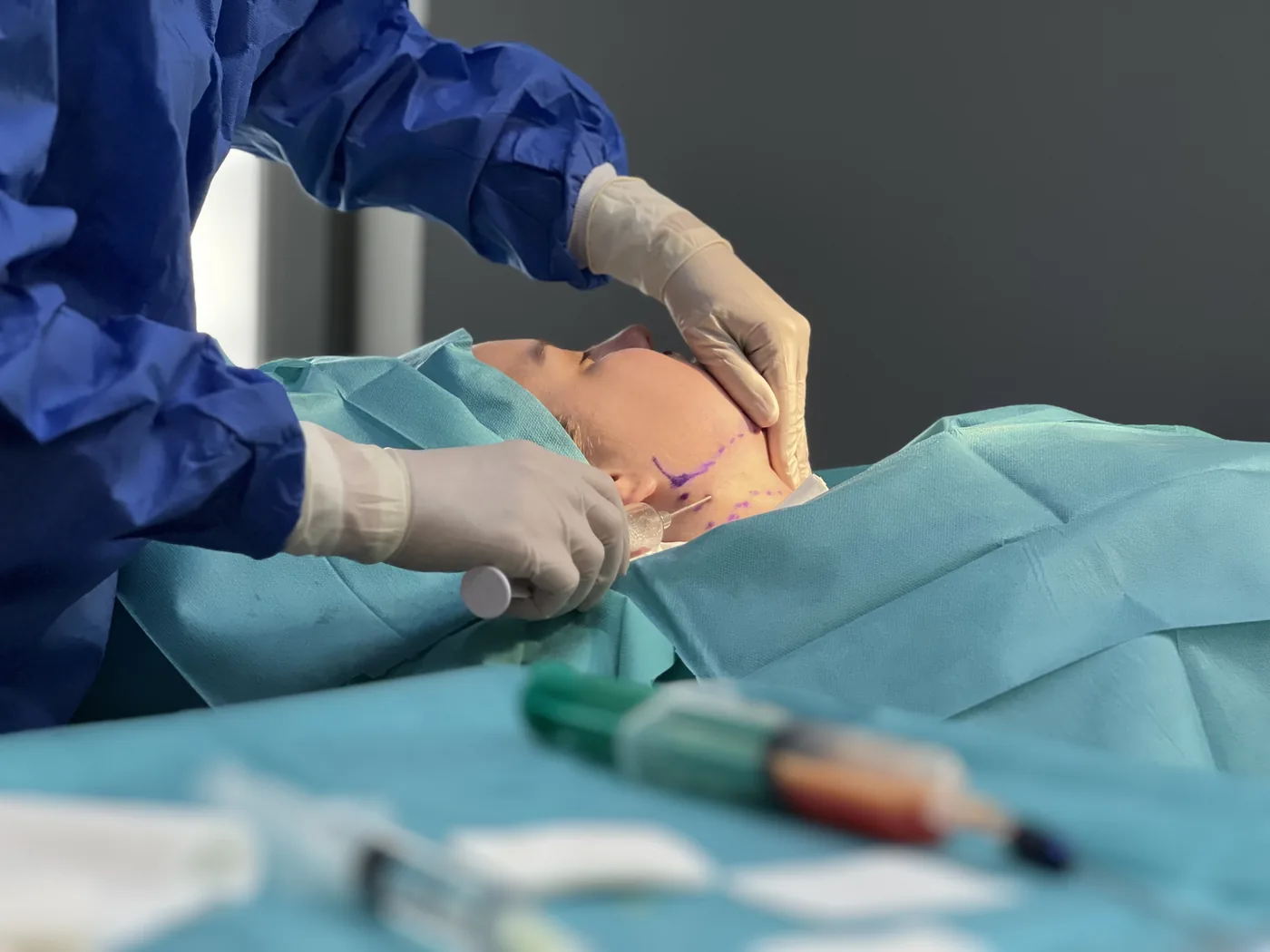
Removal of excess fatty tissue with a syringe method. The most direct approach to excess volume, performed by a doctor. Requires preserved skin elasticity, so the contour settles after volume reduction.
Fat tissue
Fat-dissolving injections (injection lipolysis)
The injected product, administered with a fine needle, destroys fat cells, which the body removes over the following weeks. A course of treatments after a doctor's qualification, considered for a small, localised excess of tissue.
Fat tissue
Cavitation with drainage, a non-invasive method carried out in a series. Gentler than liposuction and with a smaller scope of action, considered for a small excess of tissue.
Fat tissue
Lifting and supporting the tissues along the jawline. A method for skin laxity, not for excess fatty tissue, with a large excess of volume the result can be unsatisfying.
Skin laxity
Energy delivered to the dermis, aimed at tightening and remodelling. Work on skin tension carried out in a series, without breaking the surface. The effect builds up over months.
Skin laxity
Nd:YAG laser, micropulse technique
Gradual heating of the dermis with a 1064 nm wavelength, aimed at firmness and skin quality. A gentle approach, requiring a series, for mild laxity.
Skin laxity
Botulinum toxin for platysma bands
Reduction of tension in the bands of the broad neck muscle, allowing the blurred angle between the neck and chin to be regained. Considered when the muscle is the problem, not the tissue.
Platysma muscle
With a recessed jaw, rebuilding the proportions of the chin changes the profile contour without intervening in the submandibular area. It does not remove tissue, but changes the relationship between the chin and the neck.
Bone structure
Methods are sometimes combined, and this is common in this area, because a single clear cause is rare. We describe the principle of staged planning under combined therapies.
How we choose the method
1
Assessment of the contribution of each cause
Examination of the area: how much fatty tissue there is, what the skin elasticity is like, whether platysma bands are visible, what the relationship between the chin and neck is. Usually several causes emerge in different proportions.
2
Determining what dominates
The method is chosen to match the dominant cause, because acting on one with a smaller share will not change the contour visibly.
3
Checking the conditions
With volume reduction, skin elasticity matters: without it, the contour may not settle smoothly after the tissue is removed. This is the most common reason we suggest a sequence rather than a single treatment.
4
A staged plan or a single procedure
With one clear cause, a single method is enough. With several, the plan includes stages, with gaps to assess the effect of the previous one.
What can realistically be achieved
What is achievable
Improved contour and a more defined jawline.
Reduced volume of the submandibular area, when the cause is fatty tissue.
Improved skin tension and its alignment along the jawline.
Regaining the angle between the neck and chin, when it has been blurred by muscle tension.
What we do not promise
Changes to bone structure. A recessed jaw will not be moved by an aesthetic treatment.
The same effect in every person, because the contribution of the four causes is individual.
A result without maintaining body weight. When it increases, tissue is deposited in this area too.
Stopping the ageing process. Skin laxity continues to progress and requires the effect to be maintained.
The chin area is demanding, because the neck contour depends on several structures at once, and one of them, the bone, is unchangeable. This is why we talk about improving the contour, not achieving a specific shape.
When a medical assessment is needed
The contour changed quickly, within weeks, without a change in body weight.
You notice a firm, well-defined mass or an enlarged node in the neck area.
This is accompanied by a feeling of pressure, difficulty swallowing, hoarseness or a change in voice.
The area is painful, red or warm.
You are planning to reduce your body weight: in that case, a conversation about the treatment makes sense after it, not before.
Separately, it is worth mentioning something that is not about aesthetics: an increase in neck circumference with a feeling of pressure, difficulty swallowing or a change in voice requires a medical assessment regardless of appearance. The chin and neck area contains structures that cannot be assessed by eye.
Editorial responsibility
Responsible for the content
NL Clinic, Katowice
How the content is created
Last updated
15 August 2026
This material is informational in nature and does not replace a consultation or qualification.
The questions we are asked most often
Will a double chin disappear if I lose weight?
It depends on the cause. With excess fatty tissue, reducing body weight usually improves the contour, although not always proportionally, because the distribution of tissue is genetically determined. With skin laxity, muscle tension and bone structure, diet will not change anything, and with greater weight loss, the laxity will become more visible.
I have a double chin even though I am slim. Why?
Because the distribution of fatty tissue depends on genetics, not only on body weight. Besides, the cause may be skin laxity, tension in the broad neck muscle or a receded jaw, and none of these are related to weight. This is a common situation and does not mean you are doing anything wrong.
Which method is best?
There is no best method, only one that is right for a given cause. With excess fatty tissue, volume-reducing methods work; with skin laxity, tightening methods; with the muscle, reducing its tension; and with bone structure, changing the proportions of the chin. Applying a method to the wrong cause gives disappointment, not results.
How do I know if it is skin or fat?
A simple test can offer a clue: tilt your head slightly back and look from the side. If the area clearly smooths out, skin and its tension are the dominant factor. If the contour stays unchanged, fatty tissue or bone structure may be involved. This is a pointer for the conversation, not a diagnosis; it is assessed by examination at the consultation.
Is chin liposuction enough?
Usually yes, when excess fatty tissue is dominant and the skin still has good elasticity. If the skin is already lax, removing the volume alone may not be enough, because the contour will not settle smoothly. In that case, the plan includes two stages: volume reduction and work on skin tension.
Are there methods without surgical intervention?
Yes, and for some causes they are sufficient. Ultrasonic cavitation for a small excess of tissue, micro-needle radiofrequency and the micro-impulse technique for skin laxity, botulinum toxin for muscle bands. All of them require a series of sessions and give a gradual result, not an immediate one.
What about vertical bands on the neck?
This is usually the broad neck muscle, known as the platysma, which loses tension over time and separates along the midline. It is not excess tissue or skin laxity, so volume-reducing methods or skin-tightening methods will not solve the problem. The right approach is to reduce the tension of the bands.
How long do you have to wait for results?
With volume-reducing methods, the change becomes visible once the swelling subsides, within a few weeks. With methods that work on skin tension, the result builds up over months, alongside collagen remodelling, and is assessed once the series is complete. The exact course depends on the chosen method and we discuss it during the qualification.
Is the result permanent?
Removed fatty tissue does not return in the same place, but if body weight increases, it is deposited there again as well. The tension of the skin and muscle continues to change with age, so for these causes we talk about maintaining the result, not a one-off solution.
The content is for information. It does not replace a consultation, an examination or an individual assessment.