
Aesthetic medicine
Exosomes and platelet-rich plasma, how they differ
Both methods are described as regenerative and both work on skin quality rather than its volume. That is where the similarities end. The difference starts with where the material comes from, and carries through to the course of the visit, the method of administration and how predictable the result is.
Published 2 August 2023. Last reviewed 24 August 2026.
Where the material comes from
Platelet-rich plasma, or PRP for short, from the English platelet rich plasma, is plasma with an increased platelet content. The material comes from the patient: blood is drawn on site, during the same visit. Plasma belongs to the group of blood-derived preparations, alongside fibrin.
Exosomes are membrane vesicles with a diameter of 30 to 150 nanometres, secreted by the cells of many organisms, including humans. The preparations used in the practice are obtained non-invasively, through ultracentrifugation of a body fluid, for example plasma, followed by purification and concentration by filtration. They arrive at the practice as a ready-made preparation.
This one difference brings all the others with it. With plasma, the material is the patient's own and prepared on the spot, with exosomes it is external and standardised by the manufacturer.
What the visit looks like
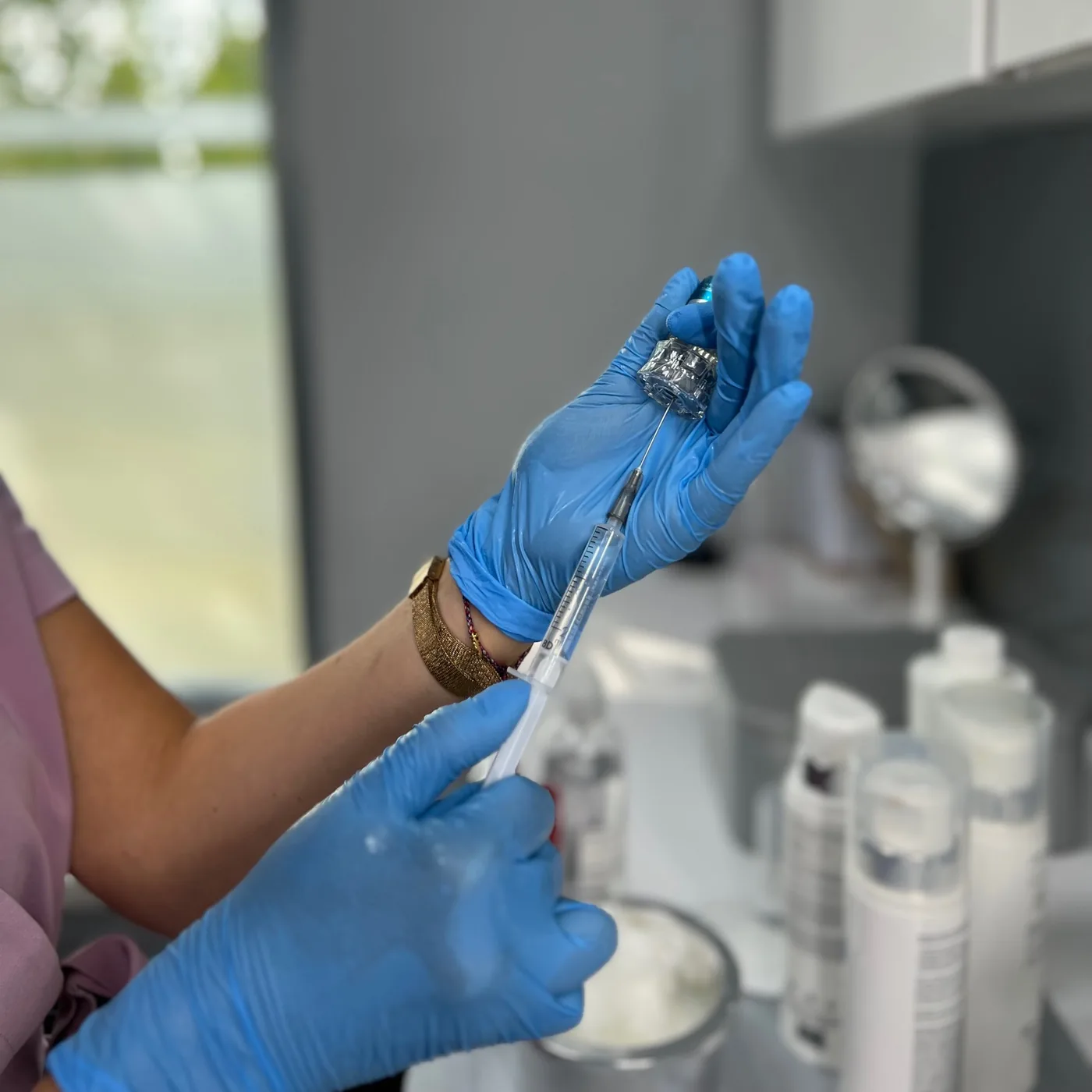
With plasma, the treatment starts with drawing blood, most often from a vein in the crook of the elbow, as with a routine blood test. The prepared material is administered during the same visit, by micro-injections or the linear technique, depending on the area. The whole visit usually takes 30 to 60 minutes.
With exosomes there is no drawing stage. There is, however, a stage that plasma does not need: a base treatment, after which the preparation is applied. For some patients this settles the choice, and in both directions, because some do not want blood drawn, while others do not want an additional procedure.
How the preparation reaches the skin
Plasma is administered by injection, so it reaches where it was injected. Exosomes are applied directly after a treatment that creates micro-injuries in the skin. The resulting channels are a route through which the preparation can penetrate deeper, instead of remaining on the surface of the epidermis.
This has a practical consequence worth knowing before booking: booking a treatment with exosomes actually means booking a base treatment with an addition. The contraindications and the course of healing then follow from both procedures at once. The base treatments are most often microneedling mesotherapy, microneedle radiofrequency and fractional laser.
Comparison of differences
Criterion
Platelet-rich plasma
Exosomes
Origin of the material
Patient's blood, drawn during the visit
Ready-made preparation, obtained by ultracentrifugation and filtration
Method of administration
Micro-injections or the linear technique
Application after a treatment that creates micro-injuries
Whether a base treatment is needed
No, plasma is a standalone treatment
Yes, an addition to microneedling mesotherapy, microneedle RF or laser
Blood draw
Yes, from a vein in the crook of the elbow
No
Risk of a reaction to the preparation
Own material, so no risk of an allergic reaction to the preparation
External preparation, qualification includes hypersensitivity to the ingredients
Assessment
Clotting disorders, anticoagulant treatment, blood diseases
Contraindications to the product and to the base treatment, together
Evidence base
Longer clinical history
Young method, standards not yet established
What neither of them does
- It does not restore volume. For sunken cheeks or temples, other methods are used, described on the volumetry page.
- It does not remove excess skin. With advanced skin laxity, the scope of possible change is established at the consultation, before the series.
- It does not stop the cause of the changes. If unprotected exposure continues, the effect of the work on skin quality does not last.
- It does not work after a single treatment. Both approaches are carried out in a series, and the assessment is made after a few weeks.
Difference in the evidence base
Platelet-rich plasma has been present in aesthetic medicine for years and has a longer clinical history. Exosomes are a young method. Research into their use in dermatology and tissue regeneration is ongoing and promising, but it does not yet have the same evidence base as mesotherapy, laser therapy or acid peels. There are also no established standards for concentrations, the source of the preparation or series schedules.
We say this openly, because some marketing materials in the industry present exosomes as a breakthrough with guaranteed results. If someone is looking for a method with a predictable course and well-described effects, a treatment with a longer history will be the more suitable choice. If, on the other hand, they want to enhance a procedure they are having anyway, exosomes are a reasonable addition.
What determines the choice
Whether the base treatment is already planned. If so, exosomes are an addition to something that is happening anyway. If not, adding the base treatment changes the calculation: time, healing and cost.
Health status and medication. With plasma, clotting disorders, anticoagulant treatment and blood conditions matter. With exosomes, qualification covers contraindications to the preparation and to the base treatment. This is decided by the doctor at the consultation, not by preference.
Attitude to having blood drawn. A technical element, but it genuinely affects the decision, and there is no reason to leave it out of the conversation.
Expected predictability. Anyone who needs a well-described method will choose the one with a longer history. Anyone who wants to enhance a planned treatment has a reason to consider the addition.
Further on the site
- Course and qualification: platelet-rich plasma and exosomes.
- Where the informal name comes from: vampire facelift.
- The whole group of preparations: blood-derived preparations.
- Prices: aesthetic medicine price list.
- Booking a visit: doctor's consultation or online booking.
The questions we are asked most often
How do exosomes differ from platelet-rich plasma
Above all, in the origin of the material. Platelet-rich plasma is prepared from the patient's blood, drawn on site, while exosomes are a ready-made preparation obtained by ultracentrifugation of a bodily fluid. The rest of the differences follow from this: the course of the visit, the method of application and the risk profile.
Are exosomes administered by injection
No. Exosomes are applied directly after a treatment that creates microdamage in the skin. The resulting channels are a route through which the preparation can penetrate deeper, instead of remaining on the surface of the epidermis. Plasma, on the other hand, is administered by micro-injections or by the linear technique.
Which method is better documented
Platelet-rich plasma has a longer clinical history. Exosomes are a young method: research into their use in dermatology is ongoing and promising, but it does not yet have the same evidence base, and standards for concentrations, the source of the preparation and series schedules are not established.
Does blood need to be drawn for exosomes
No. This is one of the practical differences: with plasma, the visit begins with drawing blood, most often from a vein in the crook of the elbow, while with exosomes the preparation is ready-made. For some patients, this one element decides the choice.
Does either of these methods add volume
Neither. Both work on skin quality, not on its volume. For sunken cheeks or temples, other methods are used, described on the volumetry page.
Can the two methods be combined
Combining them is decided by the doctor at the consultation, after assessing the indications and contraindications. It is worth remembering that both approaches involve a base treatment or injections anyway, so the sum of the procedures, not the sum of the preparations, determines the course of healing.
What the research says
Below is a paper that describes the state of documentation for exosomes. References for platelet-rich plasma will be added here after verification, so as not to place items of different reliability next to each other.
A literature review covering 2010 to 2023. Of 246 papers found, 34 were qualified for full-text analysis, and four of them were clinical studies. The authors point to the lack of uniform protocols and the small number of clinical trials as the main limitations of the method. This is the basis for the statement that exosomes have a shorter clinical history than plasma.
Bai G, Truong TM, Pathak GN, Benoit L, Rao B. Clinical applications of exosomes in cosmetic dermatology. Skin Health and Disease. 2024;4(6):e348.
Sources
References for the state of documentation on exosomes are given in the section What the research says. The vesicle size, the method of obtaining the preparation and the description of administration have been carried over from the NL Clinic treatment pages. The duration of the visit for plasma is given in line with the clinic's practice.
About this text
The text was prepared by the NL Clinic team. Published 2 August 2023, verified 24 August 2026.
The content is for information and does not replace a consultation.
Doctor's consultation
At the consultation, we establish whether the appropriate approach is plasma, an addition to the base treatment, or neither. If the scope of expectations goes beyond what both methods can achieve, we say so before the series.