
On this page
What exosomes are
Exosomes are membrane vesicles with a diameter of 30 to 150 nanometres, secreted by the cells of many organisms, including humans. They were discovered in the 1980s, but their use in dermatology and aesthetic medicine is a topic of recent years.
Their role in the body is to carry biomolecules: proteins, lipids and nucleic acids. They are sometimes described as information packets, because they pass messages between cells. It is this function, not the composition alone, that accounts for the interest in them.
The preparations used in the practice are obtained non-invasively, through ultracentrifugation of a body fluid, for example plasma, followed by purification and concentration by filtration.
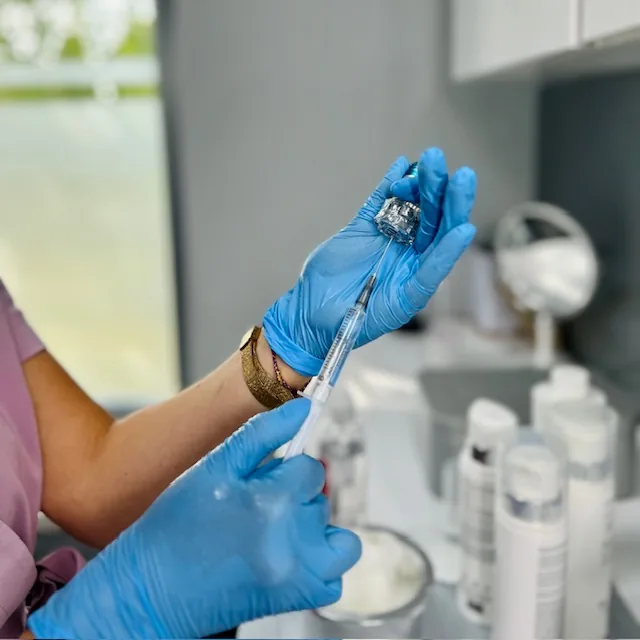
The treatment on video
A recording from our treatment room, without editing to speed the work up.
How they work in the skin
Exosomes contain growth factors, cytokines, proteins and lipids, substances involved in natural repair processes. The described directions of action include:
Transmission of intercellular signals
Exosomes carry growth factors, cytokines, proteins and lipids, passing cells information involved in repair processes.
Effect on the production of collagen, elastin and hyaluronic acid
Stimulation of the synthesis of three components responsible for skin firmness, elasticity and hydration has been described.
Anti inflammatory effect
Limiting inflammatory processes in the skin, which in themselves accelerate its ageing.
Inhibition of enzymes that break down collagen
Limiting the activity of enzymes that degrade existing collagen fibres.
This is a description of mechanisms observed in research on exosomes, not a promise of what will happen to your skin. In this method, the distance between the mechanism and a predictable clinical effect is greater than with treatments of established standing.
What they are combined with
Exosomes are applied immediately after a treatment that creates microdamage in the skin. The resulting microchannels are a route through which the preparation can penetrate deeper, instead of remaining on the surface of the epidermis.
This has a practical consequence: when booking a treatment with exosomes, you are in fact booking the base treatment with an addition. The contraindications and the course of healing then follow from both procedures at once.
What the state of knowledge is
This is a young method. Research into the use of exosomes in dermatology and tissue regeneration is ongoing and promising, but it does not yet have the same evidence base as mesotherapy, laser therapy or acid peels. There are also no established standards for concentrations, the source of the preparation or the schedule of a course.
We say this plainly, because some marketing materials in the industry present exosomes as a breakthrough with guaranteed action. If you are looking for a method with a predictable course and well described effects, a treatment with a longer history will be the more suitable choice. If, on the other hand, you want to reinforce a procedure you are already having, exosomes are a reasonable addition.
Indications, meaning when they may be considered
With hair loss and with pigmented lesions of unclear character, the starting point is establishing the cause, not choosing a preparation. Atopic dermatitis and other skin diseases require management by a doctor, and a cosmetology treatment does not treat them or replace therapy.
What exosomes will not do
They are applied after a treatment that creates microdamage, because it is this that opens a route for the preparation into the depth of the skin. Applied to intact skin, they remain on the surface.
They do not treat skin diseases or hair loss. They are an addition supporting regeneration, not a therapy, and they do not replace management established by a doctor.
They do not restore volume and do not tighten lax skin. Other methods work on that.
They do not stop ageing. The skin continues to age, and the effect of every treatment requires maintenance.
Contraindications to the exosome treatment
The qualification covers contraindications both to the exosomes themselves and to the treatment they will be combined with.
Report anticoagulant medication and cardiovascular disease before your visit. Do not stop taking anything on your own, because any change is decided solely by the doctor in charge of your treatment.
The questions we are asked most often
Can exosomes be given as a standalone treatment?
No. A preparation applied to intact skin will not overcome the epidermal barrier and will remain on the surface. Exosomes are applied immediately after a treatment that creates microdamage, and it is this treatment that determines the course of the visit.
What exactly are exosomes?
They are vesicles with a diameter of 30 to 150 nanometres, secreted naturally by cells. They carry proteins, lipids and nucleic acids, acting as a carrier of information between cells. They were discovered in the 1980s.
Is this a method with confirmed effectiveness?
Research is ongoing and promising, but this is a young method, without established standards comparable to mesotherapy or laser therapy. We say this plainly, because some materials in the industry present exosomes as a certain breakthrough, and that is an overinterpretation.
Is it worth paying extra for exosomes?
It depends on whether you are having the base treatment anyway. As an addition to a planned procedure, they can be a reasonable enhancement. As a reason to come in for a treatment on their own, no. We will discuss this at the consultation, rather than adding the extra automatically.
Do exosomes help with hair loss?
They may be considered as a supporting element, but they do not replace finding the cause. With pronounced hair loss, the starting point is tests and a medical assessment, because without addressing the cause, the effect of any therapy is short-lived.
Do exosomes treat atopic dermatitis?
No. Atopic dermatitis is a condition that requires medical supervision, and a cosmetology treatment does not treat it. For atopic skin, the decision about any treatment should be made after a dermatological consultation.
What does the day after the treatment look like?
It depends on the base treatment. Temporary swelling, tenderness and redness are possible, usually resolving within one to a few days. Aftercare recommendations follow from the base procedure, not from the addition itself.
Where do the preparations come from?
Exosomes are obtained non-invasively, through ultracentrifugation of a body fluid, followed by purification and concentration by filtration. We will tell you which preparation will be used for your treatment before it is carried out.
How many treatments do I need?
The number of sessions follows from the plan for the base treatment, not from the exosomes alone. We set this at the consultation, after assessing the skin and the aim of the therapy.
Before you decide
Consultation with a cosmetologist
With exosomes, the conversation starts with the question of which base treatment makes sense in your situation, because that is what determines the course and the contraindications. We will also tell you honestly when the extra charge for exosomes is not justified. The conversation does not commit you to having the treatment.
This material is for information only and does not replace a consultation or qualification for treatment. The preparations described on this page are cosmetics, not medicinal products.