
Legal note
The content is for information. It does not replace a consultation, an examination or an individual medical assessment.
The mechanisms described below come from the literature on platelet-rich plasma. The mechanism of action is not the same as a predictable effect in a specific person, and the extent of the change depends on the condition of the tissue and on the composition of the preparation obtained from a given blood draw.
On this page
What platelet-rich plasma contains
PRP stands for platelet-rich plasma. The name describes exactly what is in the syringe: plasma with an increased platelet concentration, obtained by centrifuging the patient's blood.
Platelets in the body are responsible for clotting and for triggering the repair of damaged tissue. They contain growth factors, proteins that signal cells to divide and rebuild. Besides these, plasma also contains cytokines, fibrinogen, vitamins and mineral components that are naturally present there.
The composition of the preparation is not fixed. It depends on what is in the blood on a given day, on the centrifugation parameters and on the medication being taken. This is what sets plasma apart from preparations with a repeatable composition and explains why the effect can vary between two people.
How PRP acts in the skin
Growth factors delivered into the tissue stimulate fibroblasts, the cells that produce collagen and elastin. Collagen is responsible for the density and firmness of the skin, elastin for its elasticity. New fibres form over weeks, not days.
An effect on angiogenesis is also described, that is, the formation of new blood vessels within the treatment area. Better blood supply means better nourishment and oxygenation of the tissue, which supports the repair processes.
Plasma does not fill or tighten. Everything visible after the treatment is the result of the tissue's own work, so the extent of the change cannot be set by dose, as with a filler.
How the treatment with plasma proceeds
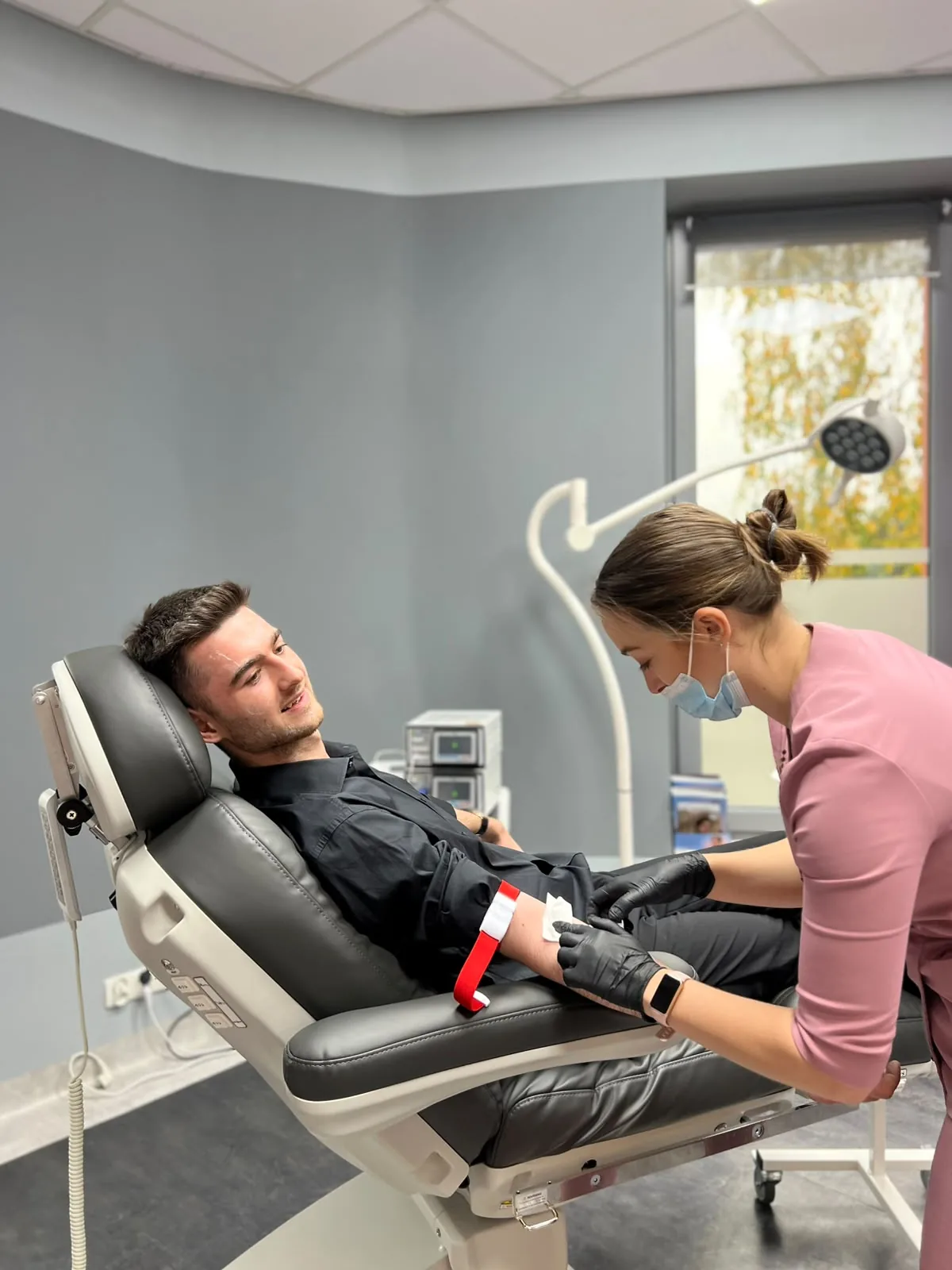
The first treatment takes from 45 minutes. We describe the details of the blood draw and preparation of the product, common to the whole group, on the page about blood-derived preparations.
Indications, meaning when it may be considered
An indication does not mean qualification. With scars, stretch marks and changes after injuries, plasma is usually one element of the therapy rather than the whole therapy, and in that case the method it is combined with matters more than the preparation itself.
What plasma will not do
It will not restore lost volume. For a sunken cheek or a deep fold, a different method is needed.
It will not tighten the skin or change the shape of the face, even though the common name for the treatment refers to a lift.
It will not stop hair loss without establishing the cause. The diagnosis determines whether plasma is appropriate here.
It will not remove pigmentation or vessels, because it does not act on pigment or on blood vessels.
Plasma versus fibrin
Both preparations come from the same blood and the same draw. The difference lies in what remains in the syringe and how it behaves in the tissue.
Platelet-rich plasma
A liquid preparation with a high content of platelets and growth factors. It works mainly by stimulating cells into action, which is why it is used to improve skin quality and to support healing.
Fibrin
The same blood also produces a network of fibrin fibres with a denser consistency. It stays longer at the site of administration and acts as a scaffold for tissue rebuilding, which is why it is sometimes chosen for scars and defects.
The choice is decided by the doctor after assessing the area and the aim of the treatment. You will find a description of fibrin on the fibrin page.
What plasma is combined with
Plasma is rarely the only element of the plan. Below are the combinations used most often, with a note on what is the main treatment in each one and what is the addition.
Microneedling
Micro-punctures open a path for the preparation deeper into the skin. The main treatment is microneedling, plasma is the addition that supports healing after it.
Laser and IPL treatments
Plasma applied after the treatment supports healing and shortens the redness. Here the goal is different from rejuvenation and a single application is enough.
Hyaluronic acid fillers
Plasma works on tissue quality, a filler works on volume. They can be part of one plan, in a set order and with intervals, but they address different problems.
Needle-based therapies
Plasma is sometimes administered together with other substances, as part of a cocktail matched to the condition of the skin.
When methods are combined, contraindications and the course of healing result mainly from the base treatment, not from the plasma itself. The doctor sets the order and the intervals when planning the whole therapy.
The results and when they are visible
The first changes in hydration and skin tone are reported after a few days. Improvement in density and elasticity builds up over weeks, because it depends on new collagen fibres, and it is assessed once the series is complete.
How long the effect lasts is given in months, but the range is wide and depends on age, the condition of the skin, smoking, sun exposure and on what preparation could be obtained from that particular draw. We do not give a single figure, because it would be made up.
We publish photos of results only with patients’ consent and under comparable conditions: the same framing, light, facial expression and time interval. The result is always individual.
How many treatments are needed
When working on skin quality, a series of several treatments is planned at intervals set by the doctor. When supporting healing after a laser treatment, it is sometimes a single application, because the goal is different: shortening the time of redness, not rejuvenation.
We set the number of treatments before the first one, together with the price of the whole series. A single treatment from the series is not a basis for judging the method.
Reactions after the treatment and recommendations
Expected reactions
Redness, swelling and tenderness at the injection sites, sometimes small bruises, also at the site of the blood draw. These are temporary, and we will discuss how long they take to resolve individually after the treatment.
No make-up for 24 hours
For the first 24 hours, do not apply make-up to the treatment area and do not touch the injection sites.
No high temperatures
Sauna, steam baths, swimming pool and sunbeds only after two weeks.
No exercise or alcohol for a day
For at least 24 hours no alcohol and no intense physical exercise.
Sun protection
Sun protection on the treatment area for a few days, especially with bruising and skin prone to pigmentation.
The treatment does not require recovery time, so you can usually return to daily activities the same day. Increasing pain, warmth and redness of the area after a few days require contact with the clinic.
Contraindications to the plasma treatment
Report medications affecting blood clotting before your appointment, as they matter both for the blood draw itself and for the quality of the preparation obtained. Do not stop taking anything on your own: any change is decided by your treating doctor.
The questions we are asked most often
What does the abbreviation PRP stand for?
It stands for platelet-rich plasma. The name describes the contents of the syringe: plasma with an increased concentration of platelets, obtained by centrifuging the patient's blood. This treatment is also commonly known as a vampire lift.
How long does it take to see the effect after plasma treatment?
The first changes in hydration and skin tone are reported after a few days. Improvement in skin density and elasticity builds up over weeks, as it depends on new collagen fibres, and is assessed after the series is completed.
How many plasma treatments are needed?
When working on skin quality, a series of several treatments is planned at intervals set by the doctor. When supporting healing after a laser treatment, this can be a single application. The number and price of the whole series are established before the first treatment.
Does plasma help with hair loss?
It is sometimes used on the scalp as part of therapy, but the process starts with establishing the cause of hair loss. The diagnosis determines whether plasma is the right method and whether it is sufficient on its own. You can find a description of the diagnostics on the hair loss page.
Will plasma remove under-eye shadows?
It depends on the cause of the shadow. For thin, grey skin in the under-eye area, plasma is sometimes considered. A shadow resulting from volume loss or pigmentation requires a different approach, so qualification starts with an assessment of the area, not the choice of preparation.
How does plasma differ from fibrin?
Plasma is liquid and contains a large number of platelets with growth factors, so it works mainly by stimulating cells. Fibrin forms a denser network of fibres that remains at the injection site for longer and acts as a scaffold for healing. Both preparations are obtained from the same blood draw.
How much does a platelet-rich plasma treatment cost?
The cost depends on the area and the number of treatments in the series, so we keep one current aesthetic medicine price list instead of scattered amounts on individual pages. You will learn the valuation of the whole plan at the consultation.
Does a plasma treatment hurt?
Sensations include the needle prick when blood is drawn and punctures in the treatment area. We use anaesthetic cream for comfort, although it is not required. After the treatment, the area can be temporarily tender.
The content is for information. It does not replace a consultation, an examination or an individual medical assessment.