
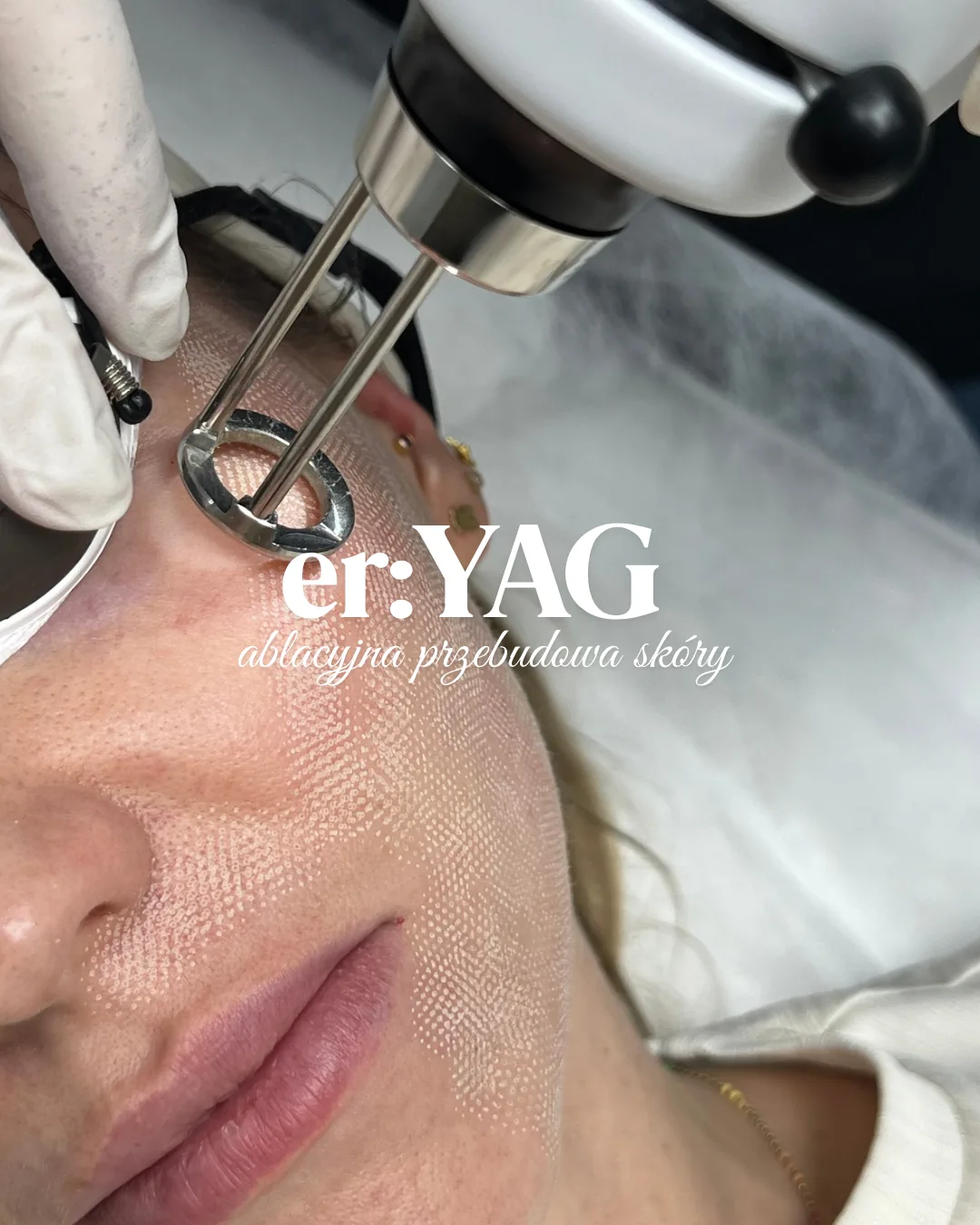
The treatment is carried out by a doctor
This is an ablative laser: it removes layers of tissue. The manufacturer's instructions list among the indications incision, excision, vaporisation and haemostasis of soft tissue, and among the uses the removal of benign skin lesions.
The assessment and the treatment are carried out by a doctor. With skin lesions of an atypical appearance the right first step is a dermatological assessment and a histopathological examination, not removing the lesion.
On this page
The peak of absorption by water
The chromophore for this wavelength is water, present in every cell of the skin. The 2940 nm range lies exactly at the point where water absorbs radiation most strongly in the whole band used in aesthetic medicine. Not „strongly”, but most strongly.
The consequence is immediate and measurable. The energy is absorbed in a very thin layer, so the tissue vaporises rather than heating up. The zone of thermal damage around the site of ablation is narrow: in the literature described as limited to around 20 to 50 µm.
It is the same feature seen from two sides. A narrow thermal zone means fast healing and a lower risk of scarring, but also weak coagulation. A laser that does not heat the surroundings does not close vessels either, so with bleeding it calls for a different approach.
Four wavelengths, one chromophore
In our range four wavelengths work with water as the target. They differ in the strength of absorption, and that translates directly into the proportion between vaporising and heating the tissue.
The strength of absorption by water, a schematic comparison
2940 nm
Er:YAG. The strongest absorption: clean ablation, minimal heat beyond the site of vaporisation, the shortest healing, the weakest coagulation.
10 600 nm
CO2. Weaker absorption, so alongside the ablation a wider zone of heating forms. Better coagulation and a stronger stimulus for the tissue to contract, a longer rebuilding.
1940 nm
Thulium. The energy is deposited shallowly, in the epidermis and just below it. Work on tone and superficial sun damage.
1550 nm
Erbium glass. The weakest absorption of the four, which is why the energy penetrates deeper and heats without vaporising. The epidermis stays closed.
The length of the bar corresponds to the strength of absorption on an ordinal rather than a linear scale. The differences between the ranges are in reality orders of magnitude, not percentages; the comparison serves to show the order and the character of the treatment that follows from it.
Three working modes
The same handpiece works in three modes, and the difference between them decides the character of the treatment more than the energy alone.
Normal mode
Work with a full spot, from 2 to 9 mm, with an energy density reaching 95 J per square centimetre. Ablation, vaporisation and coagulation of soft tissue, and full resurfacing.
Skin lesions, resurfacing of the whole surface
Fractional mode
The beam divided by a microlens array into a grid of microzones 300 to 600 µm across, with a 9 mm spot. The tissue between them stays intact.
Wrinkles, scars, discolouration, texture
Stacking and a thermal pulse
Laying successive layers of pulses in the same place, optionally with a thermal pass. The energy of a microbeam reaches 160 mJ.
Deeper changes, when a greater stimulus is needed
The thermal pulse is a separate decision, not a default setting. The manufacturer's instructions put it plainly: without thermal pulses the return to everyday activities is shorter, with them the effectiveness is higher. We discuss this trade-off before the treatment, because it concerns the patient's plans, not only the settings of the device.
How fractional microablation works
The fractional tip divides the beam with a microlens array into a grid of microscopic zones 300 to 600 µm across. Each of them vaporises the epidermis and reaches with heat into the papillary layer of the dermis. The tissue between them stays intact and it is the source of the rebuilding.
1
Microablation
Each microbeam vaporises the epidermis at its point and causes limited thermal damage in the papillary layer of the dermis.
2
A cell reservoir
The intact tissue between the microzones supplies the cells for rebuilding. It is responsible for the short healing time compared with full resurfacing.
3
Re-epithelialisation
The surface closes quickly: the literature describes the epidermis rebuilding in the microzones within the first 24 to 48 hours.
4
Collagen remodelling
Fibroblasts stay active considerably longer than the healing itself. New collagen forms over the next 3 to 6 months, which is why the result matures over months rather than days.
The thin layer of scabs covering the microzones after the treatment is not a complication. The manufacturer's instructions describe it as helpful for healing. The sensation after the treatment is compared to mild sunburn, with possible slight swelling.
Three levels of depth and the healing time
This is the most practical table on this page. The depth of ablation is set by the doctor, but the choice has a direct consequence for the patient: the deeper it goes, the longer the skin needs to be left alone.
Shallow
3 to 4 days
The skin's response ranges from redness to small scabs. Used with dyschromia, texture and refreshing, on the neck and hands as well.
Medium
4 to 7 days
Small scabs and swelling. The typical level for fine wrinkles, post-acne scars and wrinkles around the eyes.
Deep
7 to 10 days
Small scabs and swelling of greater intensity. Reserved for set wrinkles and for atrophic and hypertrophic scars.
The ranges come from the manufacturer's instructions and concern the fractional mode. With full resurfacing, covering the whole surface, the skin's response is clearer and the rebuilding takes longer. For comparison: with traditional full resurfacing using other lasers, one speaks of weeks rather than days.
Aesthetic indications
Below are the indications given in the manufacturer's instructions for the fractional mode, together with the areas listed in them. The order follows increasing depth of work.
Dyschromia and sun-related pigmentation
The shallowest work, aimed at evening out the tone. The instructions also mention reducing age spots.
Refreshing the skin and texture
Smoothing the surface and improving the quality of the skin, with the shortest rebuilding time.
Fine wrinkles and expression lines
Shallow to medium level. Separate settings for the eye area, where the skin is thinner.
Established wrinkles
A deeper correction, usually with a thermal pulse and more layers. The longest rebuilding time.
Atrophic and post-acne scars
The best documented indication for this wavelength. It usually requires a course and a medium or deep level.
Hypertrophic and post-traumatic scars
Separate settings. The literature also describes work on injury scars in the early period after the injury.
The instructions also list areas beyond the face: the neck, chest and hands. The skin there is thinner or heals differently, which is why the settings and the depth level are chosen separately for each area rather than carried over from the face.
Skin lesions
In normal mode, with a tip of a smaller spot, this laser serves to remove benign skin lesions. The manufacturer's instructions give separate settings for each type of lesion, across a very wide range of energy density.
The line we do not cross
The indication is the removal of benign lesions. We do not diagnose malignant lesions and we do not treat them. Any lesion that grows, changes shape or colour, bleeds or looks atypical requires a dermatological assessment and a histopathological examination before any treatment. Removing a lesion with a laser destroys the material that could serve for a diagnosis. We support the assessment with digital dermoscopy, but that supports a decision; it is not a diagnosis.
What the research says
The literature for this wavelength is extensive, especially in post-acne scars. Below are four papers, including two comparing it directly with methods we also work with.
The method is effective and safe in the short term, with a clearer reaction than non-ablative methods.
A systematic review covered 17 papers and 453 people, comparing the fractional ablative 2940 nm laser with fractional non-ablative 1540 and 1550 nm lasers in rejuvenation, pigmented lesions and atrophic scars. Both kinds were judged effective and safe in the short term. The most common adverse effects were redness and swelling, lasting from 24 hours to 7 days, more frequently with the ablative wavelength. Three papers described post-inflammatory pigmentation. None recorded lasting adverse events.
Type of examination
A systematic review, 17 papers, 453 people
What does not follow from it
Short follow-up: in some papers from one day to six months. It does not allow the durability of the result or rare events to be judged.
Improvement in scars builds up with the number of sessions, and after the first one it is small.
In an analysis of 35 people with post-acne scars, treated with one to four sessions at four-week intervals, improvement of 1 to 25 per cent was recorded in 34 people after the first session. After the fourth session improvement of 26 to 50 per cent was found in 14 of 24 people, and of 51 to 75 per cent in 10.
Type of examination
A retrospective analysis, 35 people, no control group
What does not follow from it
A retrospective assessment and not blinded. The value of this paper lies in showing the course over time rather than the size of the effect: after one session the change is small.
Compared with a picosecond laser the effectiveness was similar, and the course less comfortable.
A split-face study in 31 people, four sessions at four-week intervals. The reduction of scars on the ECCA scale was 43.73 per cent for the ablative wavelength and 39.11 per cent for the picosecond laser, with no statistically significant difference. Patient satisfaction was slightly higher on the ablative side. The picosecond laser, on the other hand, gave less pain, a shorter time of scabbing and swelling and less frequent post-inflammatory pigmentation.
Type of examination
A randomised split-face study, 31 people
What does not follow from it
A pilot study on Asian skin, with a higher tendency to post-inflammatory pigmentation. Conclusions about the safety profile do not carry over directly to lighter phototypes.
Compared with microneedling radiofrequency the effectiveness was comparable, the tolerance worse.
A split-face study on atrophic scars, with imaging assessment by optical coherence tomography. Both methods were judged effective. Microneedling radiofrequency was better tolerated, with a shorter return to activity and fewer adverse effects.
Type of examination
A split-face study, imaging assessment
What does not follow from it
The comparison concerns atrophic scars. It does not mean that radiofrequency replaces ablation in all indications, or the other way round.
The conclusion from these papers is consistent and worth saying plainly: this method works, but it is not the gentlest available. In two direct comparisons it came out just as effective as non-ablative methods, and worse in terms of discomfort and healing time. The choice between them is therefore not a choice between better and worse, but between a faster result and a gentler course.
Preparation and what to do after the treatment
The manufacturer's protocol is specific here, and some of its elements require a prescription, so they are settled at the assessment appointment rather than on the day of the treatment.
Antiviral cover
An antiviral medicine for 3 days before the treatment and 3 days after it. Recommended with a history of cold sores and when working on deep wrinkles and post-acne scars.
Anaesthesia
If needed, a local one applied about 30 minutes before the treatment. It depends on the depth level.
After the treatment, first days
A topical antibiotic for 3 days, as recommended by the doctor. The manufacturer also points to considering antibacterial cover because of the risk of infection.
After the treatment, later on
Moisturising preparations with a high filter in the final phase of the therapy. Sun protection applies throughout the whole rebuilding of the skin.
Follow-up
Assessment of healing after 48 hours, after 7 days and after 3 months. The last date is not a formality: that is when the result of collagen remodelling shows.
Antiviral cover is worth noting separately. The instructions recommend it with a history of cold sores and when working on deep wrinkles and post-acne scars, that is where the treatment goes deepest. This is not a formality: a broken epidermis is a way in for the virus.
Contraindications
The list comes from the manufacturer's instructions. Two entries differ from those we give for other lasers and call for attention.
Two requirements stricter than with the other lasers
Isotretinoin taken orally rules out the treatment for twelve months from the end of the therapy. With another platform in our clinic that interval is six months. The stricter requirement applies, because it concerns the device the treatment will be carried out with.
Very dry skin is a contraindication here, although with other treatments it is sometimes only a reason to prepare the skin. The reason follows from the physics: the chromophore is water, so a shortage of it changes the way the tissue responds to the pulse.
The manufacturer describes serious complications as rare and lists them in order from the most frequent: redness, swelling, scabbing, pain during the treatment, prolonged redness and swelling beyond seven days, pigmentation and loss of pigment, bacterial and viral infections, scars or keloids.
When this wavelength and when another
In our range we have four wavelengths working on water, and that is not excess but the ability to match the proportion between vaporising and heating to a particular task.
When short healing is the priority
This wavelength. The narrowest thermal zone means the fastest rebuilding among ablative lasers, with the strength of the ablation kept.
When deeper remodelling and coagulation are needed
The CO2 laser. Weaker absorption gives a wider zone of heating, better haemostasis and a stronger stimulus for the tissue to contract. The price is a longer rebuilding.
When we want both in one pulse
The hybrid platform: an ablative and a non-ablative wavelength in the same point, with an adjustable proportion between ablation and coagulation.
When the epidermis is to stay intact
The erbium glass laser. Work under a closed epidermis, more gently, usually over a greater number of sessions. The choice when tolerance for healing time is low.
When the problem is mainly one of tone
The thulium laser. The energy is deposited shallowly, aimed at dyschromia and superficial sun damage.
Editorial responsibility
Responsible for the content
NL Clinic, Katowice
How the content is created
Last updated
14 August 2026
This material is informational in nature and does not replace a consultation or qualification.
The questions we are asked most often
How does Er:YAG differ from a CO2 laser?
In the strength of absorption by water, and that is enough to change the character of the treatment. Water absorbs 2940 nm considerably more strongly than 10 600 nm, so the energy vaporises tissue rather than heating it. The zone of thermal damage is narrow, healing shorter, but coagulation and tissue contraction weaker. CO2 gives the opposite: more heat, better haemostasis, a longer rebuilding.
How long does the return to everyday activities take?
In the fractional mode the manufacturer's instructions give three levels: 3 to 4 days at the shallow level, 4 to 7 days at the medium one and 7 to 10 days at the deep one. The level follows from the indication, so with atrophic scars a longer range has to be reckoned with than with refreshing the skin. With full resurfacing the time is longer.
How many sessions do I need for post-acne scars?
In the studies four sessions at four-week intervals were usually used. It is worth knowing the course: after the first session the improvement is small, of the order of ten to twenty-odd per cent, and it builds up with the following ones. The doctor sets the number of sessions in a particular case after assessing the scars, because it depends on their type and depth.
Does the treatment hurt?
At deeper levels local anaesthesia is used, applied about 30 minutes before the treatment. Pain during the treatment is listed by the manufacturer among the more frequent adverse effects, so we do not present this treatment as painless. Afterwards the sensation is compared to mild sunburn.
Where do the scabs after the treatment come from and is that a complication?
No. After a fractional treatment the microzones are covered by a thin layer of scabs of clotted tissue, and the manufacturer's instructions describe it as helpful for healing. It should not be removed mechanically. What is a complication is redness and swelling lasting longer than seven days, and that is the moment to contact the clinic.
Why is very dry skin a contraindication?
Because the chromophore for this wavelength is the water contained in the tissue. A shortage of it changes the way the skin responds to the pulse, so the predictability of the treatment falls. This contraindication appears in the instructions of this device and has no equivalent with lasers targeting melanin or haemoglobin.
I have taken isotretinoin; when can I have the treatment?
The instructions of this device give an interval of twelve months from the end of the therapy. With another platform in our clinic the interval is six months; the stricter requirement applies for the device the treatment will be carried out with. It is worth taking into account when planning acne treatment, if work on scars is being considered afterwards.
Are moles removed with this laser?
The indication is the removal of benign lesions, such as seborrhoeic keratosis, fibromas or warts. We do not diagnose malignant lesions. Any pigmented lesion of an atypical appearance requires a dermatological assessment and a histopathological examination first, because removal with a laser destroys the material needed for a diagnosis.
When will I see the result?
The result comes in two stages. Improvement in the surface of the skin is visible once it has healed, within a few days to two weeks. Collagen remodelling, on the other hand, goes on for 3 to 6 months, which is why the manufacturer recommends a check-up after three months and assessing the full result only then.
Is there a gentler alternative?
Yes, and we say so plainly. In two direct comparisons a picosecond laser and microneedling radiofrequency gave effectiveness on atrophic scars with no statistically significant difference, with less pain and a shorter healing time. The choice depends on how much time for the skin to rebuild you have available and how quickly you want to see a change.
Sources
Modena DAO, Miranda ACG, Grecco C et al. Efficacy, safety, and guidelines of application of the fractional ablative laser erbium YAG 2940 nm and non-ablative laser erbium glass in rejuvenation, skin spots, and acne in different skin phototypes: a systematic review. Lasers in Medical Science, 2020;35(9):1877 to 1888.
Cenk H et al. Effectiveness and safety of 2940-nm multifractional Er:YAG laser on acne scars. Dermatologic Therapy, 2020. The course of improvement after each of the four sessions.
Comparison of 1064-nm Nd:YAG picosecond laser using fractional micro-lens array vs. ablative fractional 2940-nm Er:YAG laser for the treatment of atrophic acne scar in Asians. A split-face study, 31 people, 20 weeks.
Split-face comparative study of fractional Er:YAG laser versus microneedling radiofrequency in treatment of atrophic acne scars, using optical coherence tomography for assessment.
Efficacy and safety comparison between 1927 nm thulium laser and 2940 nm Er:YAG laser in the treatment of facial atrophic acne scarring. The source of the data on thermal damage being limited to around 20 to 50 µm and on the epidermis rebuilding in the microzones in the first 24 hours and new collagen forming over 3 to 6 months.
The instructions for use of the 2940 nm laser handpiece, the manufacturer's edition. Technical parameters, indications, contraindications, complications, working modes, depth levels with the return to activity and the peri-treatment protocol.
Device documentation, in the clinic archive
The content is for information. It does not replace a consultation, an examination or an individual assessment.