
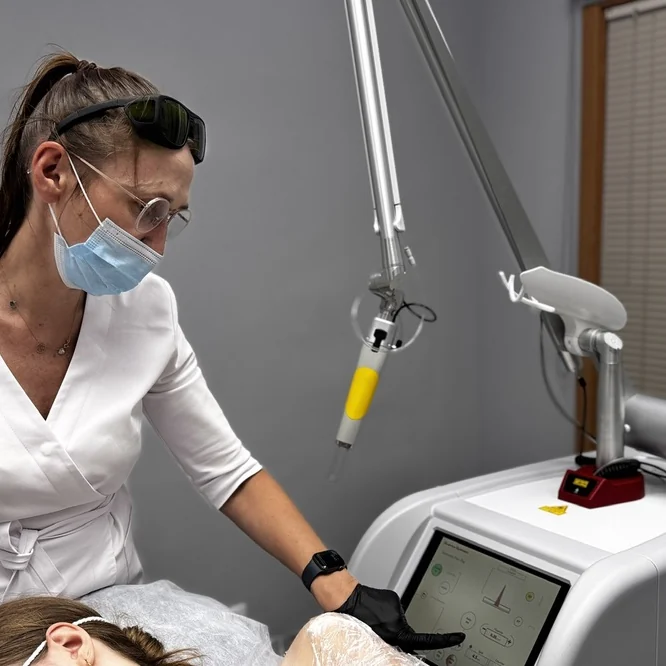
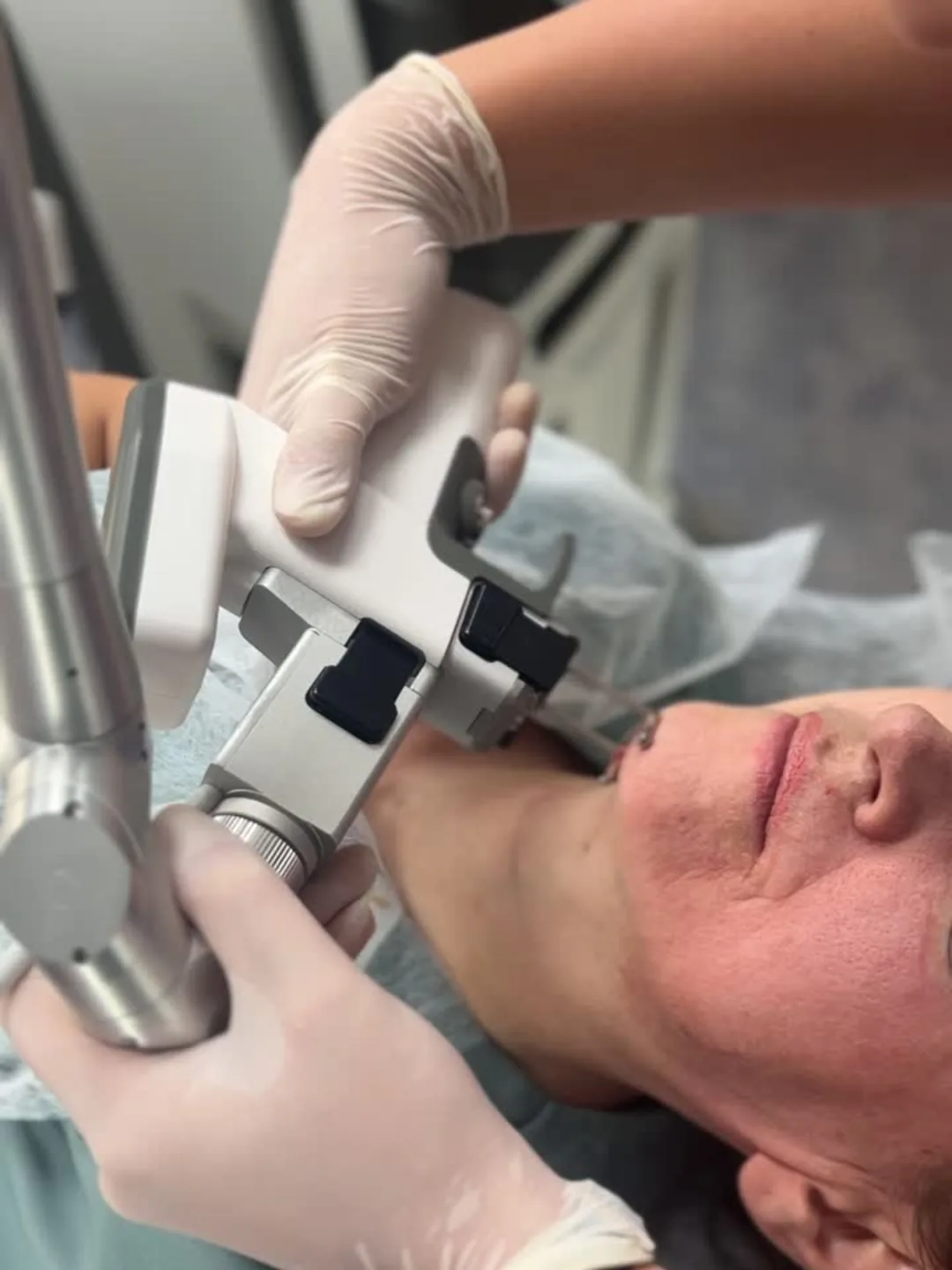
The treatment is carried out by a doctor
The manufacturer's instructions limit the operation of this device to people practising a medical profession, with experience in surgery, dermatology or gynaecology, and expressly exclude the staff of beauty salons.
That is why the assessment and the treatment are carried out here by a doctor, including for purely aesthetic indications. It is not a matter of how work is organised but a condition of the device being approved for use.
On this page
Two wavelengths, two different tasks
The chromophore for both wavelengths is water, but absorbed with very different strength. That settles everything: a strongly absorbed wavelength gives up its energy at once at the surface and vaporises tissue, while a wavelength absorbed more weakly penetrates deeper and heats without breaking the epidermis.
10 600 nm
The ablative wavelength, far infrared
Water absorbs it very strongly, so the energy is given up right at the surface. The tissue at the point of impact vaporises and a microscopic channel forms. That is the part of the treatment which afterwards requires the epidermis to rebuild.
The source is a sealed gas tube excited by a radio wave. It works in continuous, pulsed and hyperpulsed modes.
1550 nm
The non-ablative wavelength, near infrared
Water absorbs it much more weakly, so the energy penetrates deeper and spreads through the tissue as heat, without vaporising the surface. No open wound forms; a stimulus to remodel collagen does.
The source is a fibre laser. It works in continuous and pulsed modes.
Both wavelengths are invisible to the eye. The first lies in the far infrared, the second in the near infrared. The visible aiming beam serves only for guidance and does not act on tissue.
What the second wavelength changes in the tissue
A fractional treatment does not cover the whole surface. The beam is divided into a grid of microscopic points, and the tissue between them stays intact, and that is where the material for rebuilding comes from. The question is what happens around each single channel.
A histological study answers it unambiguously: adding the second wavelength does not deepen the ablation channel, but it widens the zone of coagulation around it. What changes is therefore not the reach in depth but the volume of tissue covered by the heat stimulus.
The column of action, a diagram
The ablative wavelength alone
A narrow zone of coagulation around the channel. The volume of tissue covered by the heat stimulus is smaller.
Both wavelengths in the same point
A channel of the same depth, but a clearly wider zone of coagulation. A greater reach of action with the same degree of disturbance to the surface.
The ablation channel: tissue vaporised by the 10 600 nm wavelength. Its depth is the same in both variants.
The zone of coagulation: tissue heated but not vaporised. This is where the stimulus to remodel collagen arises, and this is where the second wavelength makes the difference.
The dashed line: the depth of ablation. Identical in both variants, and that is the heart of this comparison.
An illustrative diagram; the proportions do not match real dimensions. The direction of the change, that is a constant depth and a wider zone of coagulation, follows the histological study given in the Sources section.
What the research says
A reservation that has to be made at the outset
The available work was carried out with a non-ablative wavelength of 1540 nm, and in part 1570 nm. Our device emits 1550 nm. All these values lie in the same window of absorption by water and the mechanism is the same, but they are not identical wavelengths. We give the results with their actual parameters, without ascribing them to our equipment.
The second wavelength does not deepen the ablation, but it widens the zone of coagulation around the channel.
A histological study on animal tissue compared working with the ablative wavelength alone against a sequential emission of both. With the same pulse shape the depth of damage did not change, while the width of the zone of thermal action increased. The greatest thermal coverage was obtained when the ablative wavelength went first: an open channel lets the second wavelength spread heat deeper.
Type of examination
An ex vivo study, animal tissue, 1540 nm wavelength
What does not follow from it
Harvested tissue does not respond to a treatment the way living skin does, because no healing or inflammatory response takes place in it. This explains the mechanism; it does not prove a clinical result.
In a clinical comparison, hybrid emission gave a better result and a shorter return to form than the ablative wavelength alone.
One group received a single pass with the ablative wavelength, the other a simultaneous emission of both, at the same energy settings and with the same scanner. Assessed after three months with three-dimensional imaging: a reduction of fine wrinkles of 32.3 per cent against 20.7 per cent, a return to everyday activities of 3.7 against 5.9 days, and a higher satisfaction rating. Redness after the treatment settled faster in the hybrid group, with no significant adverse events.
Type of examination
A clinical study with a comparison group, 1540 nm wavelength
What does not follow from it
The result concerns fine wrinkles in the group studied, at particular settings. It does not carry over automatically to scars, stretch marks or other settings, and it is not a forecast of the result in any one person.
The non-ablative wavelength on its own prompts fibroblasts to produce collagen.
In a study on cultured human skin fibroblasts, the non-ablative wavelength increased the activity of the genes responsible for producing collagen and the activity of the mitochondria, with a significant rise in the expression of type III collagen. This explains why the second wavelength brings something beyond merely widening the thermal zone.
Type of examination
An in vitro study, cells in culture
What does not follow from it
Cells in a dish are not a patient's skin. The result describes a mechanism at cell level, not an effect visible in the mirror.
Emission modes
The device works with one wavelength on its own or with both together. When working with both, the doctor decides whether the pulses fall at the same time or one after the other, and with sequential emission also sets the order of the sources and the interval between them.
One wavelength
Working only with the ablative or only with the non-ablative wavelength.
When the aim is uniform: either vaporising the surface, or stimulation alone without breaking the epidermis.
Simultaneous emission
Both pulses start at the same moment, in the same point.
The mode studied in the clinical comparison described above. It shortens the treatment compared with two separate passes.
Sequential emission
The pulses fall one after the other, with an adjustable interval and a chosen order of sources.
When the doctor wants to steer how the heat is distributed. The order changes the reach of the action, which the histological study confirms.
The order is not a technical detail. In the histological study the greatest reach of thermal action was obtained when the ablative wavelength went first: an open channel lets the second wavelength spread heat deeper.
Comfort and healing: observations from our treatment room
These are our own observations, not study results
The observations below come from the work of our team and from a comparison with the CO2 laser we have been working with for years on the same group of indications. The experience of one clinic carries a different weight than a study with a control group, which is why we separate it from the data in the publications.
Comfort during the treatment
Patients tolerate it better than a treatment with the CO2 laser alone. With a comparable aim, the sensations are gentler.
Higher energies
Better tolerance makes it possible to set a higher energy than with CO2 alone, that is to achieve more in one session without crossing the line of comfort.
Faster healing
The skin rebuilds faster than after a treatment with CO2 alone at comparable settings.
These three things are connected. Better comfort makes it possible to set a higher energy without crossing the patient's line of tolerance, and a higher energy means more result in one session. Faster rebuilding of the skin goes in the same direction as the clinical comparison described above, where the return to everyday activities was 3.7 days against 5.9 days with the ablative wavelength alone.
When to plan the visit
Thursday or Friday is most convenient. The weekend then falls on the days when the skin is most red and needs to be left alone, and on Monday it is usually possible to go back to work.
A reservation
That is a guide, not a guarantee. The time depends on the settings chosen, the size of the area and on what your work looks like: with patient contact or work in front of a camera it is worth planning a longer buffer. We set the realistic range at the consultation, before choosing the settings.
Aesthetic indications
Below are the indications given in the manufacturer's instructions as non-medical uses, carried out with the dermatological scanner. With each group we note whether one wavelength or the hybrid mode is used.
Scars
Post-acne, post-surgical, after burns, hypertrophic and atrophic. The widest group of indications for this technology, because a scar requires work on the surface and remodelling deeper at the same time.
One wavelength or the hybrid mode
Resurfacing and wrinkles
Rejuvenation of the surface of the skin, with wrinkles around the eyes named expressly in the instructions. Here the clinical comparison showed an advantage of hybrid emission over a single pass with the ablative wavelength.
One wavelength or the hybrid mode
Mild pigmented lesions
Lentigines, sun spots, melasma, dyschromia and uneven tone. Note: the chromophore is water, so work on pigment happens through the exchange and remodelling of tissue, not through breaking up the pigment.
One wavelength or the hybrid mode
Actinic keratosis
Benign lesions within the skin. In the instructions they are listed as a non-medical indication; with us they require a dermatological assessment first.
One wavelength or the hybrid mode
Melasma is on this list, but it remains a chronic and recurrent condition. We treat it as an indication for a staged approach, described under combined therapies, not as a one-off treatment. Areas of actinic keratosis require a dermatological assessment first, because they sit on the border between aesthetics and skin oncology.
Medical and surgical indications
This platform is not solely an aesthetic device. With surgical handpieces it serves for cutting, excising, vaporising, coagulating and achieving haemostasis in soft tissue, and the instructions expressly list the removal of skin lesions, including cancerous and precancerous ones.
The line we do not cross in our content
The presence of oncological indications in the device's instructions does not mean that we carry out cancer treatment or that we diagnose malignant lesions. Every lesion that raises doubt requires a dermatological assessment and a histopathological examination before any treatment. We support the assessment with digital dermoscopy, but that supports a decision; it is not a diagnosis.
The instructions also list gynaecological uses, available with a separate scanner: vaginal atrophy, genitourinary syndrome of the menopause and urinary incontinence. That is a separate area, described under aesthetic gynaecology, with its own assessment and its own list of contraindications.
Phototypes and tanned skin
This is one of the few technologies in our range for which the instructions allow all phototypes on the Fitzpatrick scale, I to VI, and tanned skin. The reason is physical: the chromophore is water rather than melanin, so a tan does not compete with the target for energy.
Being allowed, however, does not mean no caution. With higher phototypes the risk of post-inflammatory pigmentation rises after any treatment that breaks the skin, which is why the settings are chosen conservatively and sun protection applies just the same. With lasers that target melanin, for example in hair removal, a tan is still a contraindication.
The settings the doctor chooses
A patient does not have to know them, but it is worth understanding that it is these, rather than the power of the device alone, that decide the depth, the time the skin takes to rebuild and the risk.
Output power
From 0.5 to 50 W for the ablative wave, from 1 to 18 W for the non-ablative one. Each source is set separately.
Hyperpulsed mode
Peak power up to 150 W at a pulse energy of 3 to 90 mJ. This allows the energy to be delivered very briefly, limiting heating of the surrounding area.
Interval between sources
Switched off with simultaneous emission, adjustable with sequential emission. It decides how the heat is distributed in the tissue.
Spot and shape of the field
A scanner spot of 250 µm. A treatment field from 3 to 18 mm, in more than a dozen shapes matched to the area.
Density of points
From 25 to 500 points per square centimetre. A higher density means a greater proportion of the surface disturbed and a longer rebuilding.
Surgical handpieces
Spots from 150 to 2000 µm, for surgical rather than fractional uses.
The instructions also set out a principle we apply across all laser therapy: the treatment starts with conservative doses, because inflammation rises along with effectiveness. The settings are escalated between sessions, after assessing how the skin responded, and not within a single visit.
Contraindications
The list comes from the manufacturer's instructions. Some entries rule out the treatment, some put it off, and which of them apply to a given person is settled by the medical history taken at the consultation.
Two intervals that are easy to forget
Isotretinoin taken orally rules out the treatment for six months from the end of the therapy. That is longer than for most treatments and it is worth taking into account when planning acne treatment and later work on scars.
Earlier resurfacing reaching the papillary layer of the skin requires an interval of two to three months. This is why treatments in a staged plan are spread out in time rather than packed together.
A tendency to keloids does not always rule out the treatment, but it changes the assessment: any damage to the skin, including a laser treatment, carries a greater risk of a scar in such people. The instructions also advise considering antibacterial cover because of the risk of infection.
Possible reactions and complications
The manufacturer describes serious complications as uncommon, and gives the list in order from the most frequent. We quote it in full, because a patient has the right to know it before the treatment, not after it.
More frequent, temporary
Redness
Temporary pinpoint bleeding and petechiae
Itching and a burning sensation after the treatment
Exfoliation
Small scabs
Pain during and after the treatment
Purpura, redness and swelling immediately after the treatment, settling within hours to a few days
Rarer, requiring follow-up
Blisters
Prolonged redness and swelling, over 10 days
Hyperpigmentation and hypopigmentation
Superficial erosions, bruising and burns, usually healing without a scar
Bacterial and viral infections
Scars or keloids
Redness and swelling lasting longer than ten days are treated by the instructions as a complication, not as a normal course. That is a good point of reference: if the reaction goes beyond that time, there is reason to contact the clinic.
Where this laser sits alongside the others
In our range we already have a separate ablative 10 600 nm laser and a separate fractional non-ablative one with a similar wavelength. The new device does not replace them. It brings one thing that cannot be obtained by working with them one after the other: both wavelengths in the same point, in one pulse.
When the depth and strength of resurfacing count
The ablative 10 600 nm laser on its own remains the choice for changes requiring the deepest remodelling, including in surgical mode.
When the epidermis is to stay intact
A fractional non-ablative laser works under an intact epidermis, more gently, usually over a greater number of sessions.
When the problem is complex
With several kinds of change at once, what counts is the order of procedures and the intervals, not a single device.
Editorial responsibility
Responsible for the content
NL Clinic, Katowice
How the content is created
Last updated
24 August 2026
This material is informational in nature and does not replace a consultation or qualification.
The questions we are asked most often
How does a hybrid laser differ from an ordinary fractional CO2 laser?
A CO2 laser works with one wavelength, strongly absorbed by water, which vaporises tissue at the point of impact. A hybrid device adds a second wavelength, 1550 nm, absorbed much more weakly, so it penetrates deeper and heats tissue without vaporising it. Both can reach the same point in one pulse, and the doctor sets the proportion between vaporising and heating before the treatment.
Is the treatment deeper than with CO2 alone?
No, and that often comes as a surprise. A histological study showed that adding the second wavelength does not deepen the ablation channel. What changes is the width of the zone of heated tissue around the channel, that is the volume of the area covered by the stimulus to remodel, with the same degree of disturbance to the surface.
Who performs this treatment?
A doctor. The manufacturer's instructions limit the operation of the device to people practising a medical profession with experience in surgery, dermatology or gynaecology, and expressly exclude beauty salon staff. This applies to purely aesthetic indications as well.
Can I have the treatment with tanned skin?
The instructions allow all phototypes on the Fitzpatrick scale, I to VI, and tanned skin, because the chromophore for both wavelengths is water rather than melanin. That does not mean no caution, however: with darker phototypes the risk of post-inflammatory pigmentation rises after any treatment that breaks the skin, so we choose the settings conservatively. With lasers that target melanin, for example in hair removal, a tan still rules the treatment out.
How long does the return to everyday activities take?
It depends on the settings, above all on the density of points and the depth. In the clinical comparison, with hybrid emission this time averaged 3.7 days, and with a single pass using the ablative wavelength alone 5.9 days. That is data from a study at particular settings, not a promise for any one person; we discuss the realistic time at the consultation, because it depends on how aggressively we set the treatment.
When is the best time to plan the treatment so as to get back to work?
Thursday or Friday is most convenient. The weekend then falls on the days when the skin is most red and needs to be left alone, and on Monday it is usually possible to go back to work. That is a guide, not a guarantee: the time depends on the settings chosen, the size of the area and the kind of work you do. With patient contact or work in front of a camera it is worth planning a longer buffer.
Is the treatment more comfortable than with the CO2 laser alone?
From our team's observations, yes: patients tolerate it better than a treatment with CO2 alone with a comparable aim. This has a practical consequence, because better tolerance makes it possible to set a higher energy, that is to achieve more in one session. That is, however, the experience of one clinic rather than the result of a study with a control group, and that is how we mark it on this page.
Does taking isotretinoin rule out the treatment?
Yes, for six months from the end of the therapy. That is a longer interval than for most treatments, so it is worth taking into account when planning acne treatment, if work on scars is being considered afterwards.
Are skin lesions removed with this device?
The instructions provide for such a use with surgical handpieces, including for cancerous and precancerous lesions. That does not mean that we diagnose malignant lesions. Every lesion that raises doubt requires a dermatological assessment and a histopathological examination before the treatment; we support the assessment with digital dermoscopy, but that supports a decision; it is not a diagnosis.
Does this device replace the other lasers in the clinic?
No. The ablative laser on its own remains the choice where the deepest remodelling is needed, and the fractional non-ablative one where the epidermis is to stay intact. The hybrid device brings one thing that cannot be obtained by working with them one after the other: both wavelengths in the same point, in one pulse.
Why do you not give the name of the device?
Because the regulations limit advertising of medical devices addressed to the public. We give the technical parameters, that is the wavelengths, powers, working modes and the characteristics of the scanner, because it is these that settle what the treatment can do. You will learn the name of the device at the consultation.
Sources
Cannarozzo G, Bennardo L, Zingoni T et al. Synergistic Sequential Emission of Fractional 10.600 and 1540 nm Lasers for Skin Resurfacing: An Ex Vivo Histological Evaluation. Journal of Clinical Medicine, 2022. The depth of ablation unchanged, the width of the thermal zone greater than with the ablative wavelength alone, the greatest coverage with the ablative emission going first.
Sequential Fractional CO2 and 1540/1570 nm Lasers: A Narrative Review of Preclinical and Clinical Evidence. Journal of Clinical Medicine, 2025;14(11):3867. A review of preclinical and clinical data, including a comparison of hybrid emission with a single pass using the ablative wavelength and the results on fibroblasts.
The instructions for use of the laser platform, the manufacturer's edition. Technical parameters, medical and non-medical indications, the target population, contraindications, complications and the restriction of operation to people practising a medical profession.
Device documentation, in the clinic archive
The parameters of the device, the indications, contraindications and list of complications come from the manufacturer's instructions for use. The statements about the depth of ablation being maintained, the widening of the zone of coagulation, the importance of the order of emission and the clinical results rest on the publications above.
The content is for information. It does not replace a consultation, an examination or an individual assessment.