
Technologies and equipment
RF microneedling and thulium laser in one plan
Both technologies work at different levels of the skin: microneedle radiofrequency in the deeper layers, the thulium laser at the surface. This is what combining them is based on, as long as it follows from qualification.
Published 1 June 2025. Last reviewed 26 September 2026.
Category
Technologies and equipment
Applies to treatments
Author
NL Clinic team
Why the technologies are combined
Combined treatments are based on a simple premise: two methods working at different depths of the skin can address different elements of the same problem. Combining microneedle radiofrequency with the diode-thulium laser is an example of this approach, in which one technology works at the surface and the other in the deeper layers.
Combining them is not, however, a routine applied to everyone. Whether it makes sense in a given case is decided by an assessment of the skin, the aim of the treatment and tolerance of the procedures.
What microneedle radiofrequency is
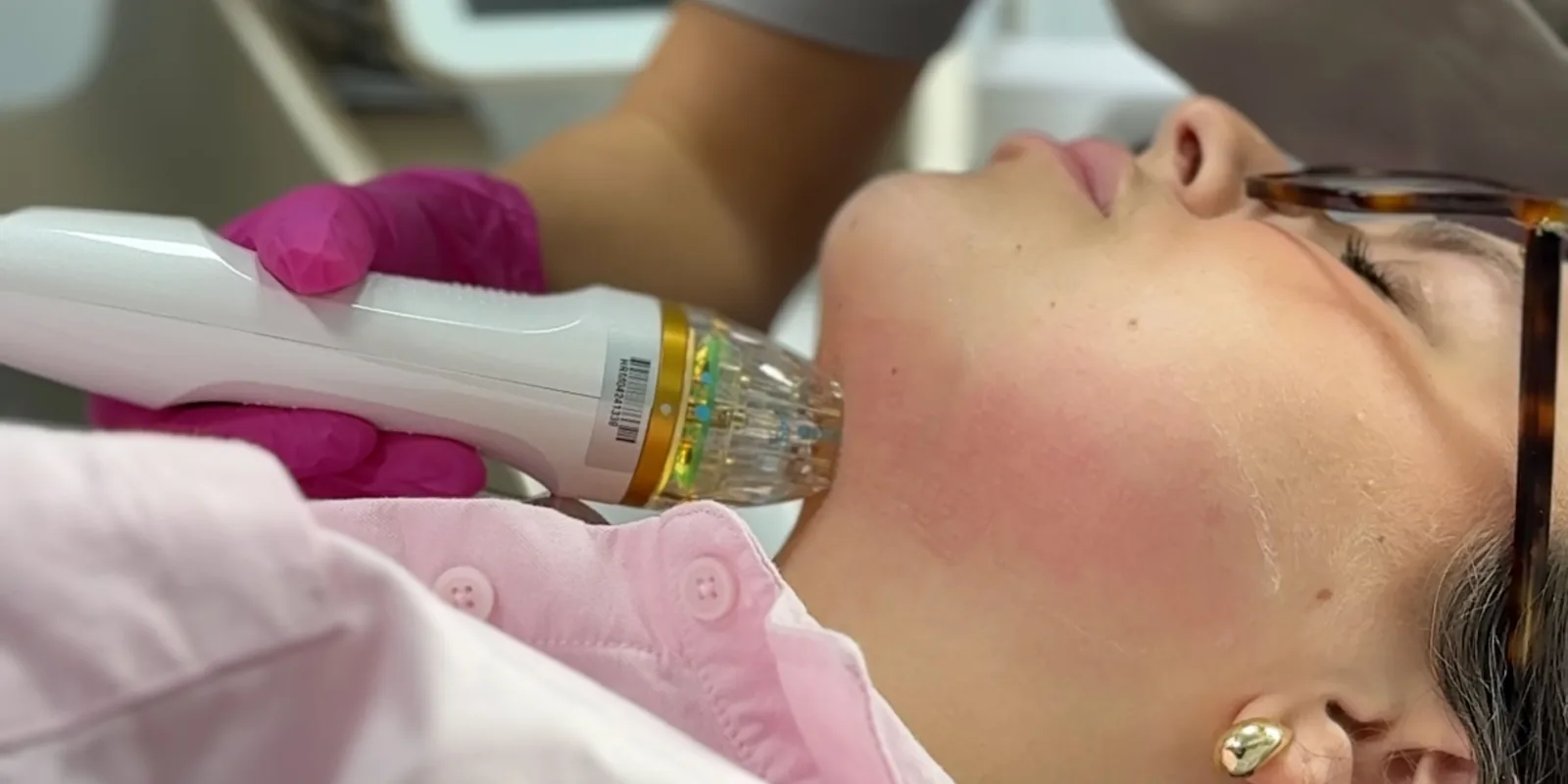
Microneedle radiofrequency combines mechanical micro-puncturing of the skin with delivering radiofrequency energy to its deeper layers. The depth the needles work at is adjustable, in our device within a range of 0.5 to 3.5 mm, depending on the treatment area and individual needs.
During the treatment the needles emit radio waves, which heat the tissue, leading to denaturation of collagen and elastin, and then to their rebuilding. The treatment is aimed at the firmness, elasticity and structure of the skin.
How the diode-thulium laser works
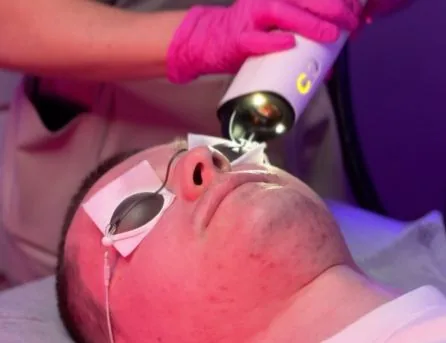
The diode-thulium laser, emitting light with a wavelength of 1940 nm, works mainly in the epidermis and the upper part of the dermis. Depending on the settings, it can work in ablative, subablative or non-ablative mode, which allows the depth and intensity of its action to be adjusted.
This technology is sometimes used to work with pigmentation, skin tone and fine wrinkles.
Two skin levels in one plan
The division of tasks between the technologies is as follows:
- the thulium laser works superficially, so it is responsible for skin tone, pigmentation and fine wrinkles,
- RF microneedling works deeper, so it stimulates the production of collagen and elastin, working on firmness and elasticity.
Combining both methods makes it possible to cover both these levels with one treatment plan. The scope, order and intervals between treatments are set by the person conducting the treatment after qualification.
What the treatment is aimed at
- firmness of the skin and smoothing of its surface,
- skin tone and texture, including a reduction in pigmentation,
- firmness and elasticity through stimulation of collagen and elastin,
- work with acne scars and stretch marks,
- the visibility of enlarged pores.
The skin's response is individual, so the extent of improvement cannot be determined before an assessment. We do not give the number of treatments before qualification.
When a combined treatment is sometimes considered
A combined treatment is sometimes considered for signs of skin ageing, such as wrinkles and a loss of firmness and elasticity, for pigmentation and an uneven skin tone, for acne scars or stretch marks, and also when the aim is to work on the overall condition of the skin.
We assess contraindications, skin condition and previous treatments before every decision. The fact that both devices are available does not mean both should be used in every case.
Qualification decides on combining them
Two stimuli in a short space of time mean a greater load on the skin. That is why the scope of the treatment, the settings and the interval between the technologies are set by the person conducting the treatment after assessing skin condition, phototype and the course of previous treatments. In some cases, treatment with a single method is more appropriate.
What the research says
Papers that describe each of the two technologies separately. They do not assess the combined treatment, so this entry does not claim that the combination is better than a single method.
A systematic review of 41 studies on radiofrequency microneedling, 15 of them randomised. Radiofrequency energy delivered through needles disrupts bonds in the collagen of the dermis and triggers healing, and histological studies describe an increase in collagen and elastin. The most common reactions are transient redness, swelling and pain; the authors also cite an October 2025 safety communication from the US Food and Drug Administration (FDA) about rare but serious complications. The review was prepared with the involvement of a manufacturer of such devices.
Kumar N, Kim HM, Nishikawa A, Heo CY, Wu WTL. Effectiveness of radiofrequency microneedling in the treatment of dermatological conditions: a systematic review. Aesthetic Plastic Surgery. 2026;50(13):5282–5317.
An imaging study of forearm skin, carried out with optical coherence tomography immediately after treatment with a 1927 nm thulium laser. At low pulse energy the changes were limited to the epidermis, while at higher energy ablation appeared, reaching the superficial dermis to a depth of about 0.1 mm. The 1927 nm wavelength lies close to 1940 nm and has the same target, water; the study shows that the settings determine the mode of operation.
Wenande E, Jacobsen K, Grove GL, Paasch U, Haedersdal M. Imaging 1927 nm fractional thulium laser-tissue interactions: a spectrum of nonablative to ablative effects. Journal of Cosmetic Dermatology. 2025;24(7):e70304.
A clinical study of a 1940 nm fractional laser in 11 people with photoageing of the facial skin, after three treatments 4 to 6 weeks apart. Three months after the course, pigmentation and wrinkles decreased to a statistically significant degree, while skin laxity and texture did not change significantly. This is the basis for the division of roles in this entry: the thulium laser addresses skin tone and fine lines, not skin tightening.
Miller L, Mishra V, Alsaad S, Winstanley D, Blalock T, Tingey C, Qiu J, Romine S, Ross EV. Clinical evaluation of a non-ablative 1940 nm fractional laser. Journal of Drugs in Dermatology. 2014;13(11):1324–1329.
A systematic review of 16 studies involving 481 people in which radiofrequency microneedling was used on its own for acne scars. The authors assess it as probably effective and point to the need for further randomised trials to establish treatment parameters.
Niaz G, Ajeebi Y, Alshamrani HM, Khalmurad M, Lee K. Fractional radiofrequency microneedling as a monotherapy in acne scar management: a systematic review of current evidence. Clinical, Cosmetic and Investigational Dermatology. 2025;18:19–29.
A systematic review and meta-analysis of 11 studies, 6 of them randomised, on microneedling for stretch marks. In the subgroup of studies using radiofrequency microneedling, clinical improvement was statistically significant. The authors regard the result as preliminary evidence of the method's efficacy and safety.
Sun X, Jia X, Huang L. Microneedling therapy for striae distensae: systematic review and meta-analysis. Aesthetic Plastic Surgery. 2024;48(15):2915–2926.
About this text
Prepared by the NL Clinic team. Published 1 June 2025, reviewed 16 August 2026.
The content is for information and does not replace a consultation.
Qualification for the combined treatment
During the consultation we assess the condition of the skin and determine whether treatment with a single method or a combined plan is appropriate.