
Technologies and equipment
Thulium laser 1940 nm: subablation, meaning work without vaporising the epidermis
The energy of this laser is absorbed by water, the main chromophore in the skin. This determines how deeply it reaches and why the healing process differs from ablative treatments.
Published 1 June 2025. Last reviewed 26 September 2026.
Category
Technologies and equipment
Full device description
Author
NL Clinic team
Water as the target, not melanin
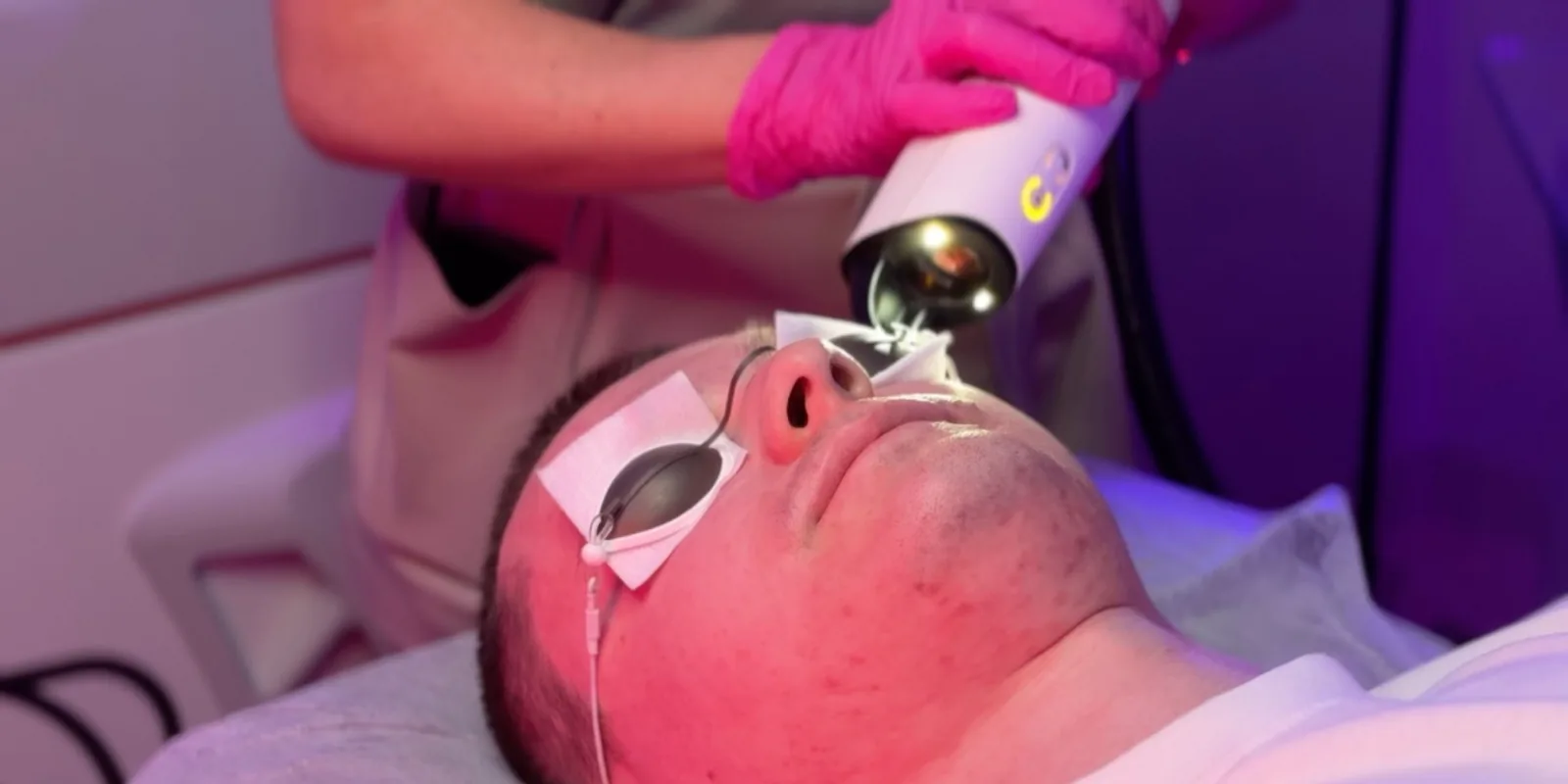
The thulium laser belongs to the near-infrared lasers, and its energy is strongly absorbed by water contained in the skin. Because of this, the action concentrates in the epidermis and upper part of the dermis. Precise microdamage is created without deep destruction of tissue, and the body responds by initiating the healing process and stimulating fibroblasts.
Because the target is water, not melanin or haemoglobin, the work takes place in the layers responsible for skin colour and structure. Energy is absorbed by water contained in keratinocytes and fibroblasts.
Ablation and subablation, what the difference is
Ablative lasers, such as CO2 or Er:YAG, work by vaporising layers of the epidermis, and sometimes the dermis as well. They give a pronounced resurfacing effect, but their invasiveness carries a risk of longer recovery, post-inflammatory pigmentation, and even permanent scarring, particularly with higher skin phototypes.
Subablation is controlled, superficial heating of the skin, which leads to thermal microdamage without fully breaching the epidermis. In practice, this means:
- stimulating cell renewal and collagen production,
- no significant peeling or bleeding,
- shorter recovery time, usually 1 to 3 days of mild redness,
- greater safety with phototypes III to V.
The subablative mode therefore allows for more delicate work than ablative methods, which does not mean it replaces them in every indication. The choice of method is decided by qualification.
When this technology may be considered
A thulium laser may be considered for uneven pigmentation, including sun spots, for work on skin texture and tone, for fine lines, and for enlarged pores and an uneven skin surface. It may also form part of treatment for surface irregularities left by post-acne changes.
In clinical practice it is combined with other therapies: with needle mesotherapy, with medical peels, or with micro-needle radiofrequency and erbium glass laser, which work in deeper layers.
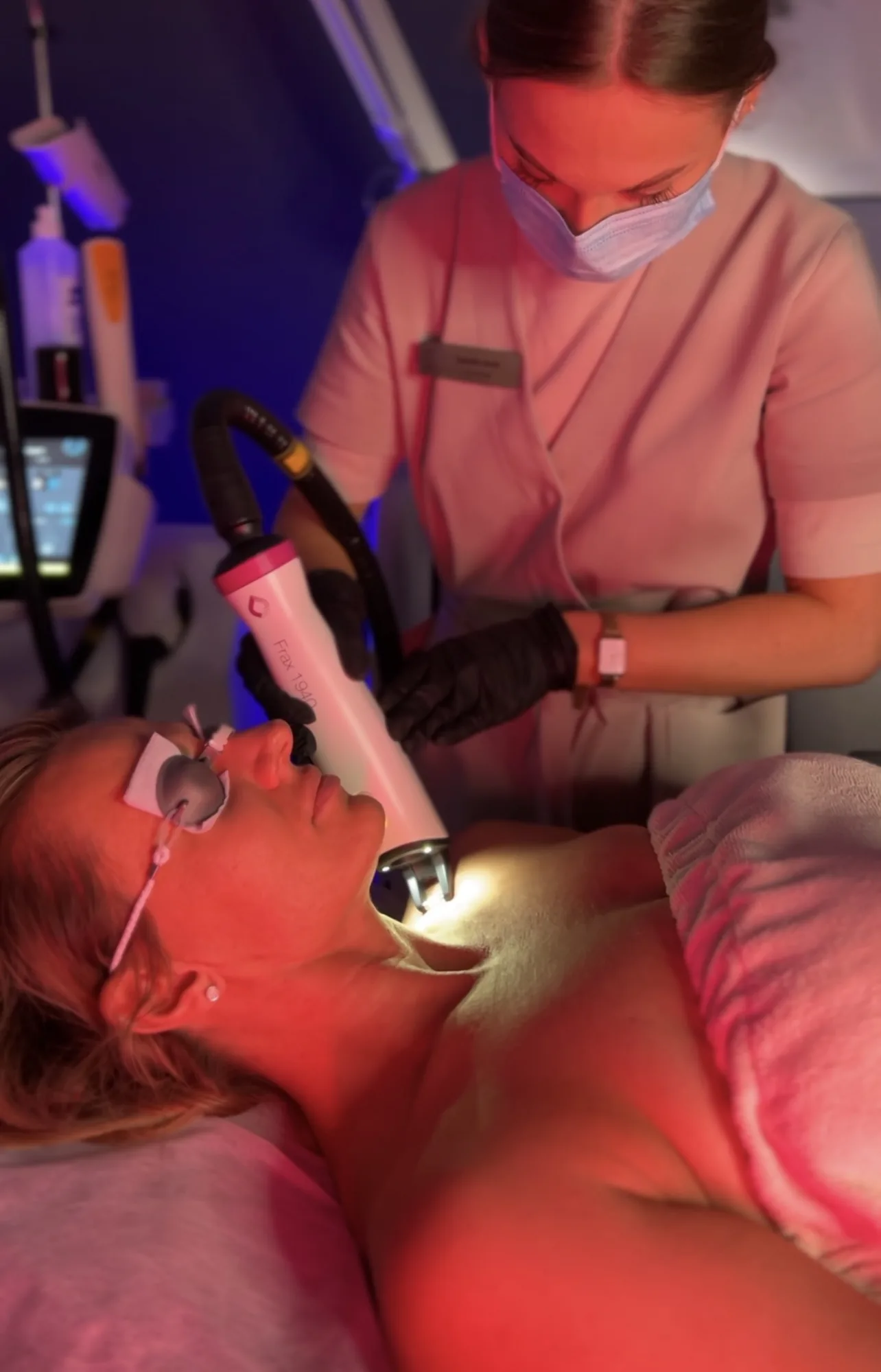
The treatment is preceded by a consultation assessing indications and contraindications, followed by skin preparation, work with the handpiece, and aftercare focused on sun protection and barrier repair. Temporary redness or mild swelling usually resolves within 1 to 3 days.
Three numbers that circulate in descriptions of thulium lasers
Materials about this technology mention different wavelength values, and each refers to something different. Our device operates at 1940 nm. Higher affinity for water than at 1927 nm means the energy is absorbed closer to the surface, so the effect is more superficial.
A breakdown of these numbers, a description of the absorption window, indications, the treatment course and contraindications can be found on the technology page: thulium laser in Katowice.
What the research says
Studies and reviews on thulium lasers. Most clinical data concern the 1927 nm wavelength; one study addresses 1940 nm directly.
A clinical study of a 1940 nm fractional laser in 11 people with photoageing of the facial skin, after three treatments. The authors describe this wavelength as absorbed by water more strongly than the wavelengths of non-ablative lasers from 1410 to 1550 nm and more weakly than those of ablative lasers; the damage reached about 0.2 mm into the skin. Pigmentation and wrinkles decreased to a statistically significant degree, laxity and texture did not change significantly, and recovery at the study settings took 3 to 5 days.
Miller L, Mishra V, Alsaad S, Winstanley D, Blalock T, Tingey C, Qiu J, Romine S, Ross EV. Clinical evaluation of a non-ablative 1940 nm fractional laser. Journal of Drugs in Dermatology. 2014;13(11):1324–1329.
An imaging study of forearm skin, carried out with optical coherence tomography immediately after treatment with a 1927 nm thulium laser. At low pulse energy the changes were limited to the epidermis beneath an intact stratum corneum, while at higher energy ablation appeared, reaching the superficial dermis to a depth of about 0.1 mm. This illustrates what the entry calls subablation: controlled thermal injury without breaking the continuity of the skin surface at low settings.
Wenande E, Jacobsen K, Grove GL, Paasch U, Haedersdal M. Imaging 1927 nm fractional thulium laser-tissue interactions: a spectrum of nonablative to ablative effects. Journal of Cosmetic Dermatology. 2025;24(7):e70304.
A review of studies on the safety of a non-ablative fractional laser with 1440 and 1927 nm wavelengths. The authors point out that ablative lasers carry a higher risk of adverse effects, such as scarring and post-inflammatory hyperpigmentation, especially in darker skin. After non-ablative treatments, redness, swelling and crusting were mild or moderate and resolved on their own, including in people with darker skin. The review was prepared with the involvement of the system's manufacturer.
Geronemus RG, Wang JV, Jacobson AA, Marmur ES, Polder KD. Safety and tolerability of the 1440- and 1927-nm non-ablative fractional diode laser system for skin resurfacing: a review of current literature. Journal of Cosmetic Dermatology. 2025;24(11):e70523.
A review of 15 clinical studies of a dual-wavelength 1550 and 1927 nm non-ablative laser in people with skin phototypes III to VI. The 1927 nm wavelength was used with improvement in melasma and photoageing, and the 1550 nm wavelength also for scars; lower energy and density were associated with less frequent post-inflammatory hyperpigmentation. The review was prepared with the involvement of the system's manufacturer.
Goldman MP, Wu DC, Khetarpal S, Jacobson A, Wang JV, Geronemus RG. Dual 1550-nm erbium glass fiber and 1927-nm thulium fiber non-ablative fractional laser system treatment in patients with skin of color: a review of clinical studies and unmet needs. Lasers in Surgery and Medicine. 2026;58(3):169–179.
About this text
Prepared by the NL Clinic team. Published 1 June 2025, reviewed 16 August 2026.
The content is for information and does not replace a consultation.
Consultation before a laser treatment
The choice of technology follows from an assessment of the skin, phototype and treatment goal. The fact that a device is available does not mean it is right for every indication.