
On this page
What does azelaic acid target
Azelaic acid is a dicarboxylic acid and belongs to neither the AHA nor the BHA group. Hence its unusual profile: it exfoliates less than glycolic or salicylic acid, but has several effects that they do not.
Post-inflammatory pigmentation
It affects the formation of new pigment, which is why it is sometimes used for marks left by inflammatory changes.
Imperfections
It has an antibacterial effect and limits the conditions that favour the formation of blemishes.
Seborrhoea
It reduces the activity of the sebaceous glands, so the skin becomes oily more slowly.
Tendency to redness
It has an anti-inflammatory effect, which is why it is sometimes chosen for reactive skin, after assessment by a cosmetologist.
Uneven skin tone
It evens out skin tone in dyschromia and marks left by imperfections.
Keratinisation of follicle openings
It affects the keratinisation process, so gland openings become blocked less often.
Rosacea and severe papulopustular acne are medical conditions, and their diagnosis and treatment are the responsibility of a doctor. A cosmetology treatment can be part of supportive care for a person who has an established diagnosis and is in a stable phase, never during a flare-up.
Pharmacy cream versus a practice treatment
This is the most common misunderstanding around this acid. Three different things hide under the same name, and they differ in more than just concentration.
Cosmetic product with azelaic acid
A serum, cream or gel available without a prescription, in a low concentration, intended for everyday skincare.
You buy it and use it yourself. It works slowly and requires months of regular use.
In-clinic treatment
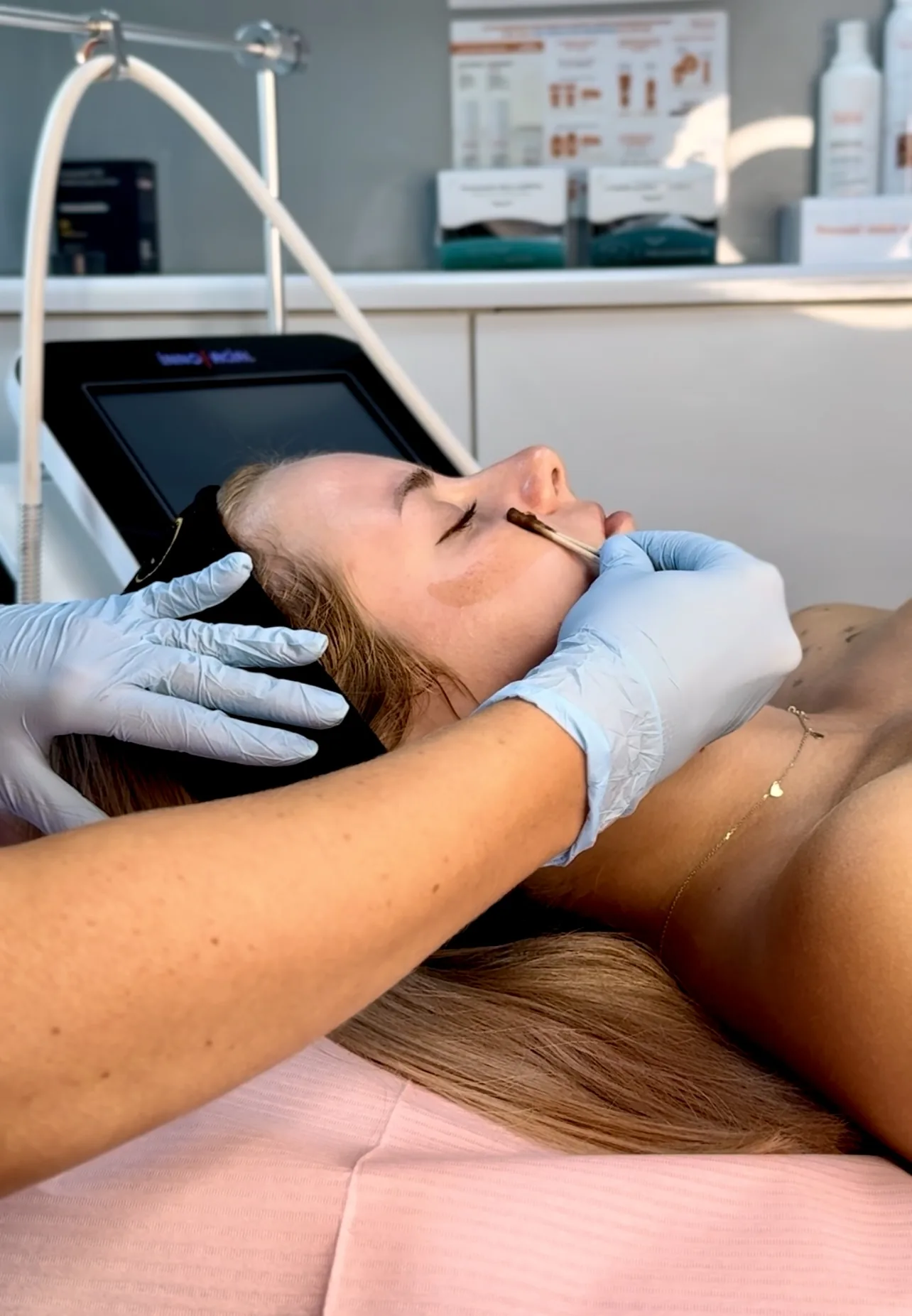
A professional preparation with a different concentration and pH, applied for a measured time, with observation of the skin's reaction and neutralisation.
It is carried out by a cosmetologist, after a skin assessment and consultation. It is conducted as a series, not as a single session.
Medicinal product
Preparations with a high concentration, used for diagnosed medical conditions. They are sometimes dispensed on a doctor's prescription.
It is managed by a doctor, who determines the dosage and duration of therapy. Cosmetology does not replace it.
One does not replace the other. The home cosmetic works daily and slowly, the practice treatment works locally and more strongly, and the medicinal product is managed by a doctor. Most often, the best results come from combining home skincare with a series at the practice, planned so that the two stimuli do not overlap.
Who it tends to be chosen for
Skin with imperfections and the marks they leave
When the problem is not only active blemishes, but also the pigmentation they leave behind.
Oily and combination skin with enlarged pores
A tendency towards oiliness and blocked gland openings, without significant inflammation.
Reactive skin, with a tendency to redness
Where strong exfoliation tends to be poorly tolerated, and an anti-inflammatory effect is needed. Qualification is then more cautious.
Uneven skin tone after summer
Work on evening out skin tone, carried out in the season with less sun exposure.
Continuation after a series with a different acid
It is sometimes the next stage of the plan, when the skin is already prepared and requires a different kind of action.
For skin with no experience of acids, a gentler starting point is sometimes mandelic acid, while for pronounced seborrhoea and blackheads, salicylic acid works more strongly. These three acids are also sometimes used alternately within one series.
What to combine it with, and what to avoid
This question comes up at every consultation, because home skincare can undo the effect of a series or cause irritation. Below are the general rules, which we adapt to the specific skin at the practice.
Retinoids
We stop these a few days before the treatment and return to them once any irritation has settled, after agreeing this with the cosmetologist. Two strong stimuli at once mean irritation, not a doubled effect.
Strong exfoliating acids
We do not combine these at the same time. Glycolic or salicylic acid in home skincare is set aside for the duration of the series.
Niacinamide
It usually does not conflict and is sometimes used alongside the acid, but for very reactive skin we introduce them one after another, to know what caused a reaction.
Vitamin C
This is not an either-or choice. Both substances work on skin tone, just differently. They are usually separated by time of day, and the schedule is set by the cosmetologist.
Sunscreen
It is not simply allowed, it is required. Without consistent photoprotection, working on pigmentation has no point.
Hydration and barrier repair
Emollients and barrier preparations are an ally, not an obstacle. Well hydrated skin tolerates further sessions better.
Course of the treatment and the series
A typical series is four to six treatments at intervals of two to four weeks, carried out alongside home skincare. With post-inflammatory pigmentation it can be longer, because the pigment fades gradually and requires consistent photoprotection between sessions.
After the treatment and temporary reactions
Immediately after the treatment the skin can be red and slightly stinging. Dryness, a feeling of tightness and mild flaking can last several days. These are typical reactions that resolve on their own.
If your skin looks worse in the first few days, do not increase the frequency or strength of your home products. This is the most common mistake, and it turns temporary irritation into lasting inflammation.
A high factor sunscreen is essential for the success of the whole series, especially when working on pigmentation. Without it, the pigment returns faster than it can be lightened.
If burning, swelling, blisters or oozing become severe, call +48 881 202 202 instead of waiting for your next visit.
Contraindications
The full list for all acids, together with photosensitising medicines and the break needed after oral vitamin A derivative therapy, is on the acid peels page.
The questions we are asked most often
What is azelaic acid good for?
For skin with several problems at once: blemishes, the marks they leave, a tendency to oiliness and to redness. It works as an antibacterial and anti-inflammatory, affects the activity of the sebaceous glands and the formation of post-inflammatory pigmentation, with relatively mild exfoliation.
How long before you see results?
A change in skin tone and in the number of blemishes usually appears after several weeks of consistent work, not after the first visit. With post-inflammatory pigmentation you should expect a longer time, because the pigment fades gradually. The first thing patients usually notice is calmer skin, not lighter marks.
How does the treatment differ from a pharmacy cream?
In concentration, pH, exposure time and control. A home cosmetic works daily and slowly, while an in-practice treatment is a stronger, targeted stimulus, removed at a measured moment. Preparations with therapeutic concentrations are a separate category, managed by a doctor. These three things complement each other, but do not replace one another.
What should azelaic acid not be combined with?
For the duration of the series we pause retinoids and strong exfoliating acids, because stacking stimuli ends in irritation. Niacinamide usually does not clash, vitamin C is separated by time of day. The cosmetologist sets the exact combination after reviewing your skincare routine.
Can azelaic acid be used every day?
The home cosmetic, yes, once the frequency has been agreed, usually starting every other day. The in-practice treatment is not carried out every day. A series is usually four to six sessions at intervals of two to four weeks.
Will it help with rosacea?
Rosacea is a medical condition diagnosed and treated by a doctor. Cosmetology care can be a supporting element for someone with an established diagnosis, in a stable phase. During a flare-up we do not carry out the treatment and refer you to a doctor.
Is it safe during pregnancy?
We do not carry out acid treatments during pregnancy or breastfeeding. The use of any preparations during this time is decided solely by the doctor managing the pregnancy, even when the cosmetic is available without a prescription.
Why does skin look worse after azelaic acid?
Temporary redness, burning and dryness in the first few days are typical. The problem starts when, in response, someone increases the frequency or adds further active cosmetics. If symptoms increase or last longer than a few days, stop using the products and call the practice.
How long can azelaic acid be used for?
In home skincare it can be used for a long time, also as part of a regular routine, once the frequency has been agreed. In-practice series are planned in cycles, with breaks, and repeating them depends on the condition of the skin and the goal, not the calendar.
How much does the treatment cost?
The price depends on the area and the number of sessions, so we keep one current price list of cosmetology treatments. We discuss the cost of the whole series at the consultation, before the first treatment.
Before you decide
Consultation with a cosmetologist
Bring a list of the cosmetics you use to your visit. With azelaic acid this is not a formality, because it is precisely your home skincare routine that determines tolerance and results. The conversation does not commit you to having the treatment. A consultation with an aesthetic medicine doctor is charged according to the price list, as is the preparation of a home skincare plan.
This material is for information and does not replace a consultation or an assessment of suitability for the treatment.