
Let us say it up front
The aim of the therapy is the maximum clinically possible lightening of the pigment, not a guarantee of complete removal of the tattoo. Some pigments lighten to a point where they are barely visible, but do not disappear without a trace.
On this page
How laser tattoo removal works
Tattoo ink is an exogenous pigment, that is a colouring foreign to the body, placed in the dermis and enclosed in cells: fibroblasts and macrophages. The body cannot remove it, because the pigment grains are too large for the phagocytic cells. The laser's task is to make those grains smaller.
Classic pigment lasers work on the principle of selective photothermolysis: the energy absorbed by the pigment turns into heat, which destroys it. With a picosecond pulse a different, photoacoustic mechanism dominates. The energy is delivered in a time shorter than the thermal relaxation time of the pigment grain, so a pressure wave is created that tears it apart mechanically before the heat has time to pass into the surrounding tissue.
The last stage explains why the therapy requires intervals. The lightening is not the work of the pulse itself but of lymphatic clearance, which takes place over weeks after the session.
What we work on the pigment with
We use a picosecond-pulse laser platform. We do not give the trade names of devices, because we do not build an advantage on the brand of equipment, and the law restricts advertising of medical devices to the general public. The outcome is decided by three technical features, which translate into the choice of protocol.
Three wavelengths
1064 and 532 nm, and 694 nm in the ruby range, which in this platform is a separate laser path. This allows work on pigments with different absorption spectra without changing the device.
High peak power
Energy delivered in a very short time gives high peak power, on which the photoacoustic effect depends. It is this, not the amount of energy alone, that tears the pigment grains apart.
Large spot size
A spot of the order of 6 to 10 mm limits scattering of the beam and allows the pigment located deeper in the dermis to be reached.
The parameters controlled by the person conducting the treatment are the wavelength, the fluence expressed in joules per square centimetre and the spot size. They are chosen to suit the colour of the pigment, the depth at which it was placed and the skin phototype on the Fitzpatrick scale.
Tattoo colours and the laser wavelength
The laser does not remove the tattoo as an image. It targets the pigment, and every colour has its own absorption spectrum. That is why the platform works in three ranges, including the ruby range delivered by a separate laser path. The range is chosen to match the colour, not the other way round.
1064 nm
Black and very dark navy blues
The most commonly used range, which also reaches pigment located deeper. A black tattoo usually responds best of all colours.
532 nm
Reds and some warm shades
The visible green range, strongly absorbed by red pigment. Acts more superficially than 1064 nm.
694 nm
Greens, turquoises and some blues
The ruby range, delivered in the platform by a separate laser path. Needed for pigments that remain resistant to the other two wavelengths.
The most difficult are mixed pigments and those lightened with white, because they absorb light weakly in each of these ranges. A multicoloured tattoo usually requires work in several ranges, and therefore more treatments than a black one.
A laser test patch at the start of the treatment
A tattoo studio rarely documents the composition of the pigment used, and even the same colour may be mixed from different ingredients. What a tattoo was made with cannot be read from its appearance.
That is why we start the first session with a test patch on a small area, done with the device already switched on, not at a separate visit. The person conducting the treatment delivers a few pulses to the chosen field and watches the reaction: whether the pigment lightens, how the skin behaves and whether the chosen settings are right. On that basis they continue the same session or change the wavelength range and fluence.
A separate test patch at an earlier visit is done rarely, in special situations: with a darker phototype, with tattoos that have previously been removed unsuccessfully and with permanent make-up, where the risk of paradoxical darkening of the pigment is real.
The consequence is that the number of treatments cannot be established before the first one. If someone gives it together with a final price over the phone, based on a photo, that is an estimate, not a finding. We prefer to say „we will check at the first session" rather than give a number that cannot be kept to later.
How many tattoo removal treatments are needed
The colour of the pigment and its composition, including the presence of white and mixed pigments.
The depth at which the pigment was placed in the skin.
The age of the tattoo. Older tattoos often react differently from fresh ones.
The density and surface area of the design.
The location on the body, because it affects how efficiently the pigment is carried away.
Previous removal attempts, including non-medical methods.
An interval is needed between sessions, because the fragmented pigment is removed by the lymphatic system, and that takes time. Shortening the intervals does not speed up the therapy, it increases the load on the skin.
Permanent make-up removal, a separate protocol
The principle of action is the same, but we proceed more cautiously, for two reasons.
Area
The eyebrows, lips and lash line are anatomically sensitive areas, close to the eye and mucous membranes. They require conservative settings and separate protection.
Pigment
Pigments used in permanent make-up often contain iron oxides and white, which can react unpredictably, including darkening after the first pulse. The test patch is particularly important here.
More about the problem of failed permanent make-up itself, and about when it is worth waiting rather than acting straight away, is on the failed permanent make-up page.
The course of the treatment and aftercare recommendations
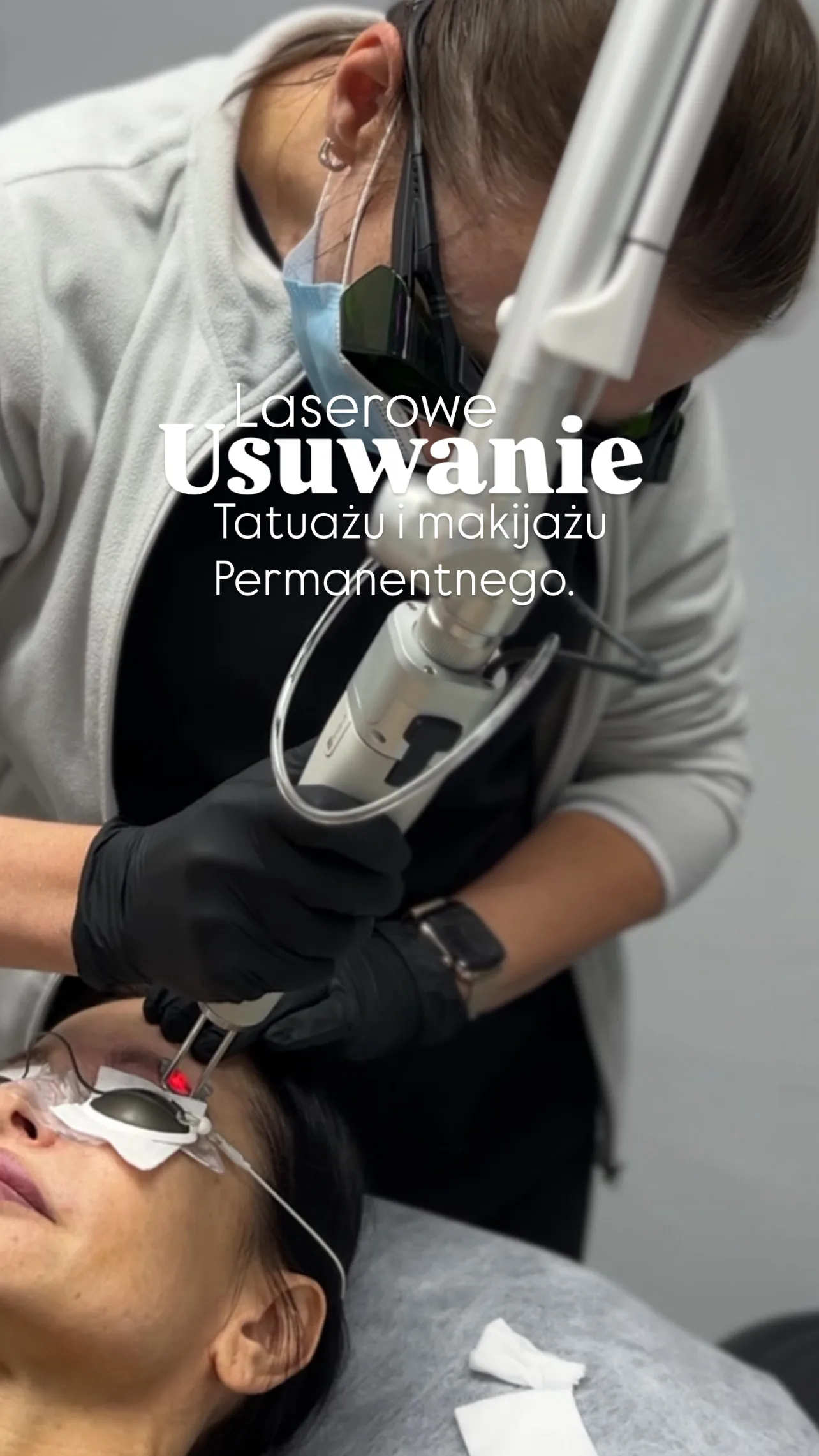
The treatment is preceded by a consultation and a skin assessment. We use a picosecond platform whose pulse breaks the pigment up mechanically instead of burning it out with heat, and for green and turquoise pigments we use its ruby path. A description of the picosecond technology itself is on the picosecond laser page.
Immediately after the treatment, redness, swelling and transient whitening at the pulse site may appear.
In the following days a scab may form. It must not be picked off, because that increases the risk of a scar and pigmentation.
Sun protection applies for the whole duration of the therapy, including between sessions.
The lightening becomes visible gradually, in the weeks after the session, because the pigment is removed by the lymphatic system.
Results of tattoo removal and the limits of the method
We do not promise the complete disappearance of the tattoo or a specific number of treatments before the first session.
We do not promise the absence of a scar. What matters is the technique in which the tattoo was made, previous attempts to remove it and the individual tendency to scarring.
We do not promise even lightening of all colours. Sections in difficult colours usually fade more slowly than black.
We do not conduct the therapy without intervals. The pace is set by the body, which has to clear the fragmented pigment.
Contraindications to laser tattoo removal
Also tell us if the tattoo has already been removed by another method, including non-medical methods. This affects both the expected course and the risk.
Editorial responsibility
Responsible for the content
NL Clinic, Katowice
How the content is created
Last updated
15 August 2026
The assignment of ranges confirmed by the clinic: all three wavelengths, including ruby 694 nm, come from one platform, in which the ruby path is a separate laser path within the same device. We do not give the trade names of devices, because the law restricts advertising of medical devices to the general public. The material is for information and does not replace a consultation or an assessment.
The questions we are asked most often
Will the tattoo disappear completely?
The aim of the therapy is the maximum clinically possible lightening of the pigment, not a guarantee of complete removal. The outcome depends on the composition and colour of the pigment, the depth at which it was placed, the age of the tattoo, its location on the body and whether the tattoo has been treated before. Some pigments lighten to a point where they are barely visible, but do not disappear without a trace.
Why do some colours come off with more difficulty?
Because every colour absorbs a different wavelength. Black and very dark navy blues absorb 1064 nm well, reds and some warm shades respond to 532 nm, and greens, turquoises and some blues require the ruby range of 694 nm. Pigments of unusual composition, mixed and lightened with white, are often the most difficult, because they absorb light weakly in each of these ranges.
When do you do the laser test patch?
Usually at the start of the first treatment, not at a separate visit. The person conducting the treatment delivers a few pulses to a small area, watches the reaction of the pigment and the skin, and then continues the same session or changes the settings. A separate test patch at an earlier visit is done rarely, with a darker phototype, with tattoos previously removed unsuccessfully and with permanent make-up.
How many treatments will be needed?
We do not give a number before the first session, because without checking the pigment's reaction it would be a number pulled out of thin air. An interval is needed between treatments, because the fragmented pigment is removed by the lymphatic system, and that takes time. A multicoloured tattoo usually requires more treatments than a black one, because work in several wavelength ranges is needed.
Does permanent make-up removal go the same way?
The principle is the same, but the protocols are more conservative. The eyebrow, lip and lash line areas are anatomically sensitive, and the pigments used in permanent make-up often contain iron oxides and white, which can react unpredictably, including darkening after the first pulse. That is why the test patch is particularly important here.
Will there be a scar after the treatment?
A picosecond pulse acts mechanically on the pigment and delivers less heat to the surrounding tissue than lasers with a longer pulse, which limits the risk of skin damage. It is not, however, an assurance that there will be no scar: what matters is the technique in which the tattoo was made, any previous attempts to remove it and the individual tendency to scarring, which we assess before the treatment.
The content is for information. It does not replace a consultation, an examination or an individual assessment.