
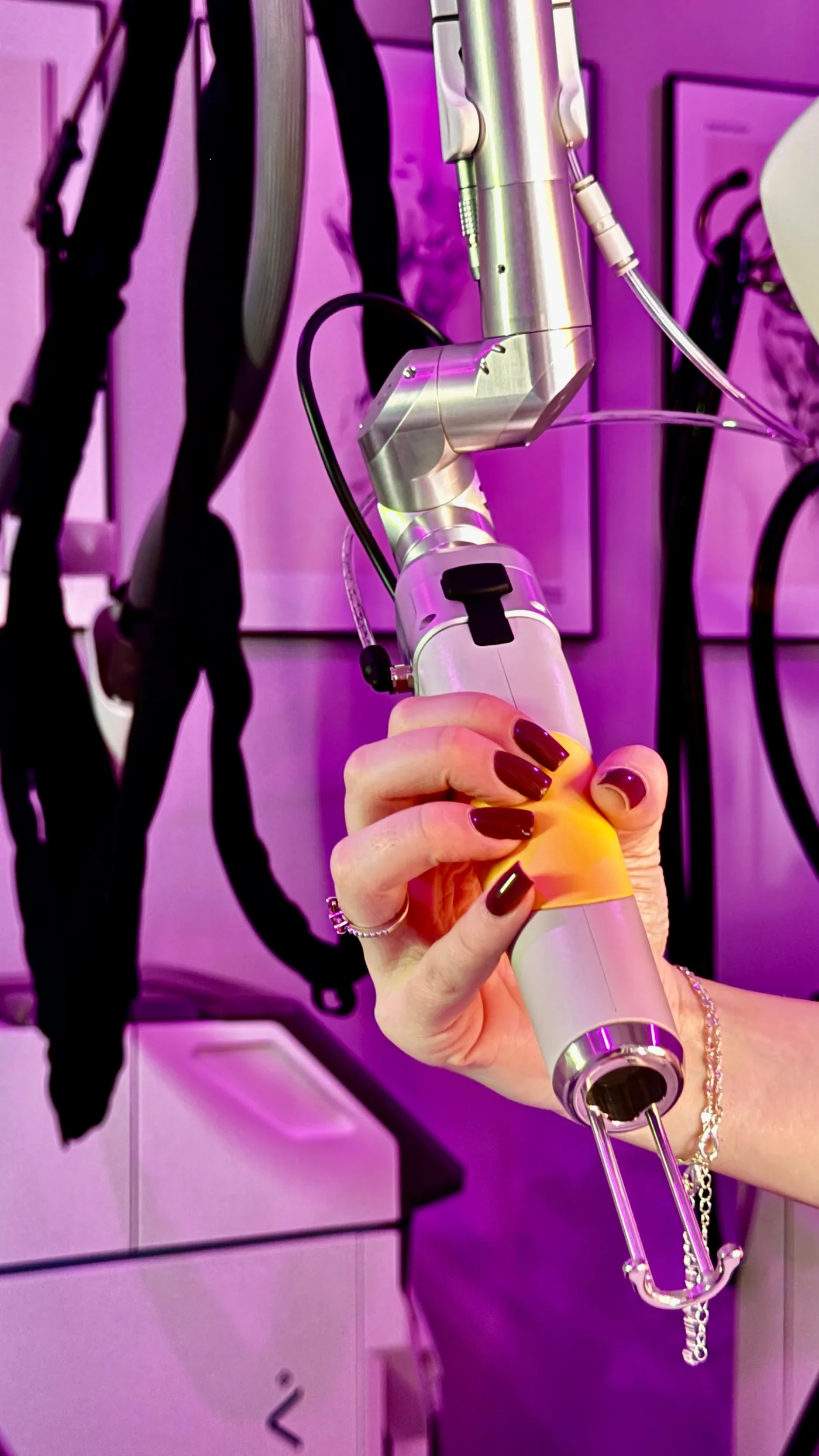
Decisive criterion: skin phototype
We use this range only for phototypes I to III on the Fitzpatrick scale, that is for light skin.
For phototypes IV to VI the risk of adverse reactions is unacceptable, so we use other technologies instead, in particular Nd:YAG 1064 nm. Not sure of your phototype? We will assess your skin at a consultation and present the safest option.
On this page
Why this range is needed
The ruby laser was built by Theodore Maiman in 1960, and it was the first working laser device in history. The active medium is a synthetic ruby crystal, and the emitted wave has a length of 694.3 nm, which falls within the deep red range.
The laser does not remove the tattoo as an image, it targets the pigment. Each colour absorbs a different range of light, so effectiveness is determined by matching the wavelength to the pigment, not the power of the device. This range provides support where standard KTP 532 nm and Nd:YAG 1064 nm systems do not bring satisfactory results.
1064 nm
Black and very dark navy blues
The range used most often, also reaching pigment located deeper. Greens and turquoises absorb it weakly.
532 nm
Reds and some warm shades
The visible green range, strongly absorbed by red pigment. Acts more superficially.
694 nm
Greens, turquoises and some blues
The ruby range. It comes into use for pigments that remain resistant to the other two ranges.
Without the ruby range, sections of the tattoo in green and turquoise remain practically untouched, regardless of the number of treatments. This is why a multicoloured tattoo requires work across several ranges, and so more sessions than a black tattoo.
Absorption window, that is what absorbs 694 nm
The skin contains three main chromophores: melanin, haemoglobin and water. With this range, two things matter at the same time: what absorbs the tattoo pigment, and what the skin itself absorbs.
694 nm
ruby range
Melanin
Haemoglobin
Water
High absorption by melanin is here both an advantage and a limitation. An advantage for pigmented lesions, because the energy hits the pigment precisely. A limitation for darker skin, because the melanin in the epidermis then competes with the target for the same energy.
A schematic comparison, based on the absorption curves of skin chromophores.
Indications
We describe the course of pigment removal, how ranges are matched to colours, and why the number of treatments cannot be stated in advance, on the tattoo removal page. The mechanism of the picosecond pulse is on the picosecond laser page.
For other problems, we choose other technologies, instead of extending the use of this range:
Vascular lesions: erythema, spider veins, dilated vessels
Wrinkles and loss of firmness
Acne scars
Number of treatments and intervals
The protocol differs depending on whether we are working on a tattoo or on a pigmented lesion. These are two different situations and have separate plans.
Tattoos
Number: 6 to 12 treatments
Intervals: every 6 to 8 weeks
Session time: 30 to 60 minutes
Pigmented lesions
Number: 1 to 4 treatments
Intervals: every 4 to 6 weeks
Session time: 20 to 40 minutes
Effects appear gradually, because the body needs time to remove the broken down pigment. Shortening the intervals does not speed up the therapy.
When more caution is needed
Darker skin phototype. The melanin in the epidermis absorbs strongly in this range, so it competes with the target pigment for energy.
Fresh suntan. It rules out the treatment for as long as it lasts, regardless of the area.
Permanent makeup. Pigments containing iron oxides and white may react unpredictably, including darkening after the first pulse.
A pigmented lesion of undetermined nature. It requires a medical assessment first, not a lightening treatment.
In each of these situations, more cautious parameters or a different wavelength range are chosen, or the treatment is postponed. We support the assessment of lesions with digital dermoscopy, but this supports the decision, it is not a diagnosis; in more difficult cases we refer to cooperating dermatologists.
How the treatment goes
The treatment is preceded by a consultation: assessment of the lesion or tattoo, assessment of phototype, a medical history and exclusion of contraindications. For pigment, we start the first session with a test on a small area, because the composition of the pigment cannot be determined from its appearance.
During the treatment, the person conducting it may change the wavelength range, matching it to the colour of the pigment in a given area. Since the ruby range is a channel of the same platform, this does not require interrupting the session or a separate visit.
Intervals between treatments result from the time the body needs to remove the broken down pigment through the lymphatic system. Shortening the intervals does not speed up the therapy, it increases the burden on the skin.
The treatment on video
The recording will show work on a coloured section of the tattoo and the change of wavelength range during one session, that is what distinguishes work on a multi range platform from a single device.
After the treatment
Typical, transient reactions after the treatment are part of the regeneration process and usually resolve within a few days.
Redness, a mild burning sensation and a feeling of warmth.
Mild swelling and a feeling of tightness in the skin.
Slight scabs may form, which come off on their own.
Aftercare recommendations, common to most laser treatments:
Avoiding sun exposure and using creams with a high UV filter.
Using the recommended soothing and moisturising preparations.
Avoiding irritating cosmetics and treatments in the area that has undergone therapy.
Protection from high temperatures: no sauna and no hot baths.
Limiting intense physical exertion in the first few days after the treatment.
Contraindications
Also report if the tattoo or permanent make-up has already been removed using a different method before. This affects the expected course and the risk.
Relative contraindications
They do not automatically exclude the treatment, but they require a separate conversation at the consultation and they affect the qualification.
A tendency to keloid scarring, that is keloids and hypertrophic scars
Autoimmune skin diseases
Blood clotting disorders and anticoagulant medicines
Diabetes, with particular attention to the healing process
Active acne in the treatment area, the inflammation needs to be brought under control first
Possible adverse effects
Transient erythema and swelling
Hypopigmentation or hyperpigmentation
Scarring, rarely
Editorial responsibility
Responsible for the content
NL Clinic, Katowice
How the content is created
Last updated
14 August 2026
Data confirmed by the clinic's materials: the treatment is carried out by an aesthetic medicine doctor, phototype I to III as the qualification criterion, the number of sessions and intervals for tattoos and for pigmentation changes, absolute and relative contraindications, possible adverse effects. We do not give trade names of devices, because regulations restrict advertising of medical devices directed at the general public. This material is informational in nature and does not replace a consultation or qualification.
The questions we are asked most often
Is the ruby laser a separate device in the practice?
No. The 694 nm ruby range is a separate laser channel within our picosecond platform, not a second device. In practice, this means that the wavelength range can be changed during a single treatment without a separate visit.
Does the treatment hurt?
Sensations are individual, but let's say it plainly: tattoo removal can be unpleasant. Patients describe it as stinging or pinching, a feeling of an elastic band snapping against the skin, discomfort comparable to wax hair removal. For comfort, we use local anaesthesia and cooling with a stream of cold air during the treatment.
How many treatments will be needed?
It depends on the type and depth of the pigment. For tattoos, usually 6 to 12 treatments at intervals of 6 to 8 weeks. For pigmentation changes, 1 to 4 treatments at intervals of 4 to 6 weeks. Results appear gradually, because the body needs time to clear the broken down pigment.
Why does 694 nm cope well with green and turquoise?
Because each pigment absorbs a different range of light. Green and turquoise pigments, and some blues, absorb 1064 nm and 532 nm, the most commonly used ranges, poorly, but absorb light in the ruby range distinctly better. Without this range, such fragments of the tattoo remain practically untouched, regardless of the number of treatments.
What else is this range used for, besides tattoos?
For pigmentation changes, because 694 nm is well absorbed by melanin. It may be considered for lentigines, for pigmentation changes with clear borders, and for melanocytic naevi of Ota and Ito. Choosing the range for a specific lesion is up to the person carrying out the treatment.
Is this range safe for darker skin?
It requires greater caution. Melanin absorbs strongly in this range, so with a darker phototype and a recent suntan, the epidermis competes with the target pigment for energy, and this increases the risk of an adverse reaction. In that case, more cautious parameters or a different wavelength range are chosen.
How does the ruby laser differ from the picosecond laser?
In three ways. The picosecond laser emits significantly shorter pulses, has minimal thermal effect on the surrounding tissue, and breaks pigment particles into finer fragments. The ranges complement each other, which is why we often combine them in one protocol, particularly for difficult tattoo colours.
The content is for information. It does not replace a consultation, an examination or an individual assessment.