Let us start with the boundary
Androgenetic alopecia, alopecia areata and telogen effluvium are medical diagnoses. Diagnosis and treatment are carried out by a doctor, most often a dermatologist.
This treatment is a supporting measure: it improves conditions for hair follicles and may strengthen the effect of therapy led by a doctor, but it does not replace it. If the cause of hair loss has not been established, the first step is diagnosis, not a series of treatments. In more difficult cases, we refer to dermatologists we work with.
On this page
What photobiomodulation is
Photobiomodulation, PBM for short, is the use of light of a specific wavelength and low intensity. It does not cause significant tissue damage, but it triggers intracellular stimulation: activation of mitochondria, remodelling of the tissue microenvironment and modulation of the inflammatory response.
In trichological applications, it is used to support hair growth, primarily in androgenetic and areata alopecia, in telogen effluvium, and in recovery after hair follicle transplantation.
Why this treatment is hybrid
We use an erbium glass laser with a wavelength of 1550 nm, the same one used for fractional skin remodelling. On the scalp, this gives a combination of two mechanisms instead of one.
Light component
Classic photobiomodulation: cellular stimulation and metabolic effects in the hair follicles and the hair papilla.
Microinjury component
Pulses emitted in a fractional pattern create microcoagulations in the dermis. They trigger regenerative processes and tissue remodelling.
The practical consequence is that stimulation reaches deeper than with photobiomodulation alone, while the epidermis remains undisturbed. We describe the nature of the laser itself and the difference between fractional and ablative work on the page about the erbium glass laser.
Mechanism, pathway by pathway
The effect is not limited to a single process. Below are the pathways described for this method, which overlap with one another.
Increase in ATP production
Light energy is absorbed by mitochondrial chromophores, including cytochrome oxidase, which increases ATP production and improves the metabolic efficiency of hair follicle cells and the hair papilla.
Improvement in microcirculation
Under the influence of light, nitric oxide may be released, which dilates the vessels. The result is better microcirculation and transport of oxygen and nutrients to the hair bulbs.
Release of growth factors
Thermal microdamage in the dermis leads to the release of growth factors and cytokines, which activate cell signalling, including the Wnt and beta-catenin pathway, important for the follicle's transition from the resting phase to the growth phase.
Tissue remodelling
Healing of the microchannels supports reorganisation of the extracellular matrix, angiogenesis and reduction of inflammatory zones, that is, it improves the environment in which the follicles work.
Increased skin permeability
Microchannels facilitate the penetration of topically applied preparations, which is why the treatment is sometimes combined with external and injection therapies.
The last pathway is the most practically important one: microchannels increase skin permeability, so topically applied preparations penetrate better. This is why the treatment is sometimes combined with other therapies, rather than carried out in isolation from them.
What the studies describe
For the 1550 nm erbium glass laser, a clinical study in people with androgenetic alopecia described a significant increase in hair count and hair diameter, visible from the fourth month of therapy compared with the baseline state.
This is data from a study, not a prediction of the outcome for a specific person.
The response to therapy depends on the diagnosis, the stage of hair loss and whether the follicles have retained the capacity to respond. We do not provide a predicted increase in density or the number of regrown hairs, as such values cannot be assigned before an assessment of the scalp.
The directions of action described for this method are an increase in terminal hair density, an increase in hair diameter, a reduction in hair loss through extension of the growth phase, improved scalp microcirculation and a regenerative effect in the treatment area.
How the treatment goes
The scalp is divided into sectors, for example fronto-central, parietal and occipital, to achieve even coverage. The working parameters are then set: wavelength, fluence, pulse density, number of passes and intervals between them.
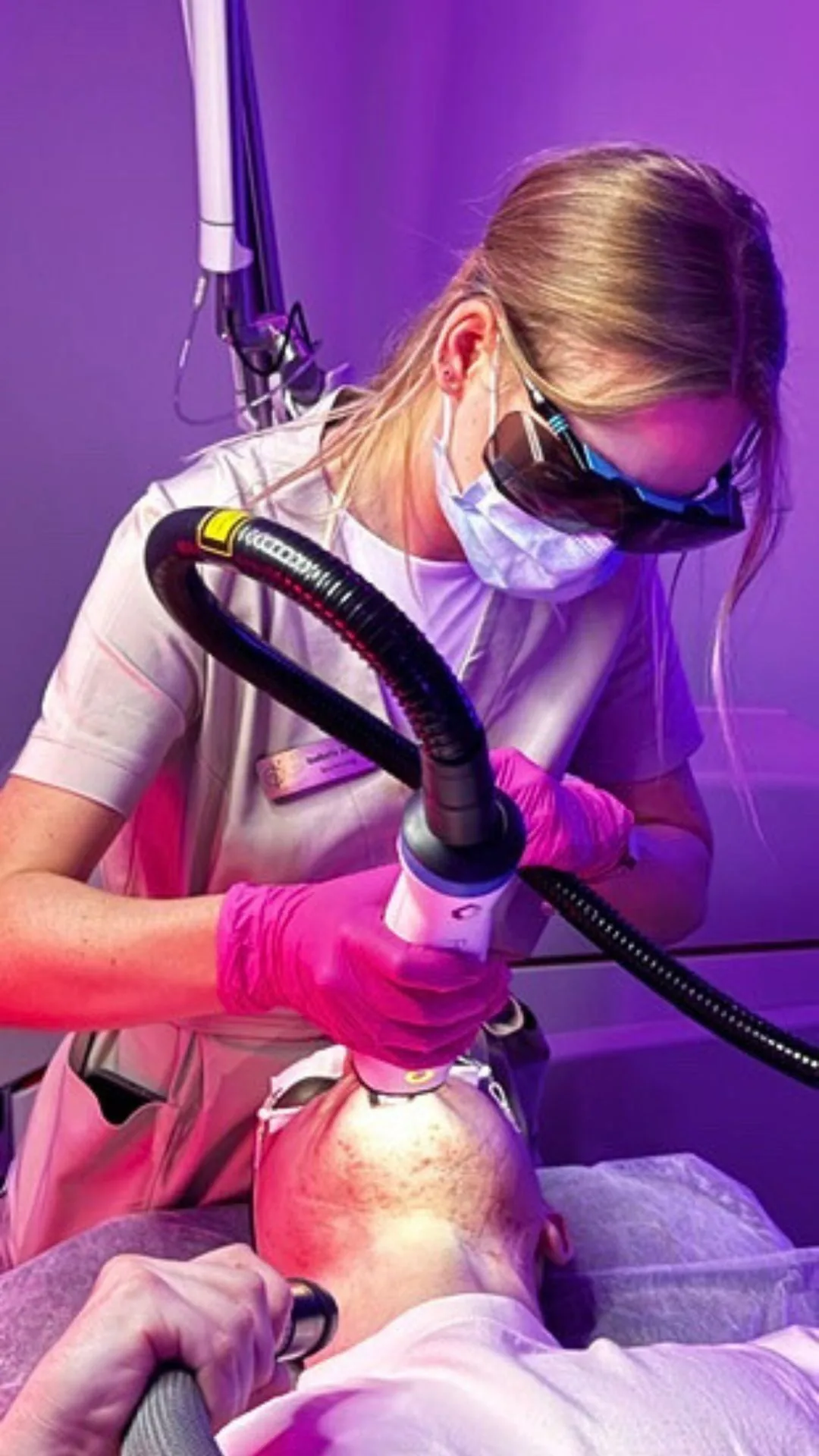
The handpiece moves over the skin sector by sector, systematically, until the entire surface has been covered. During application you may feel warmth, tingling or a subtle burning sensation. Anaesthesia is not needed.
The choice of energy and pulse density is decisive here, both for safety and for the effect. Parameters that are too aggressive may lead to pigmentation and fibrotic remodelling of the skin, which is why they are escalated cautiously.
Who it suits, and who it suits less
May be considered
Androgenetic alopecia in women and men, especially in the early and moderate stages.
Alopecia areata in moderate forms, as part of combination therapy.
Telogen effluvium, to support the transition of follicles to the growth phase.
Support after hair follicle transplantation, in consultation with the treating doctor.
People who do not tolerate pharmacological therapy or who want to strengthen the effect of topical therapies.
Effectiveness may be limited
Very advanced follicle loss, including scarring alopecia. In that case, the method is at most a supplement.
Undetermined cause of hair loss. Diagnosis by a doctor comes first.
Expecting an effect after one or two sessions. The hair growth cycle is long.
Not being ready for the maintenance phase, without which the effect regresses.
The method applies to both women and men. It is sometimes chosen by people who do not tolerate pharmacological therapy or who are looking for a less demanding solution. We describe possible causes of hair loss and types of alopecia on the hair loss page.
Treatment plan: induction and maintenance
Induction phase
From 8 to 12 sessions, usually at intervals of 1 to 2 weeks. The aim is to activate the follicles and initiate regenerative processes.
Maintenance phase
From 6 to 12 sessions a year, that is one session every 4 to 8 weeks. It maintains the effect and counteracts regression.
The parameters can be changed during therapy. If no improvement is seen after several sessions, the energy, pulse density or intervals between sessions are modified, instead of continuing with the same protocol.
Combining with other methods
This method does not replace others, it complements them. Microchannelling of the skin improves the penetration of topically applied preparations, while regenerative stimulation works at a different level than topical or injection therapies.
Topical therapies
Microchannelling improves the penetration of preparations applied to the scalp. The choice and use of medicinal products is decided by the doctor.
Mesotherapy and platelet-rich plasma
The laser acts as an initiator of microchannelling and a stimulator of regeneration, while preparations administered into the skin work at a different level. The order and intervals are determined by the person conducting the therapy.
After hair transplantation
Support for angiogenesis, healing and maintenance of the grafts has been described. The start date is agreed with the doctor who performed the transplant.
Pharmacotherapy is decided solely by the doctor.
Medicines used for hair loss are medicinal products, some of which are available on prescription. We do not recommend them, do not modify doses and do not carry out pharmacological treatment. If you are taking such medicines, mention this at the consultation, so that the treatment plan does not conflict with the therapy conducted by your doctor.
The treatment on video
The recording shows the handpiece working over the scalp, sector by sector. This answers the most common question before the first visit: what the treatment itself looks like and whether it requires preparing your hairstyle.
A recording from the NL Clinic practice. It plays after clicking, with no background sound and no automatic start.
Recommendations before and after the treatment
Before the treatment
No tanning of the scalp for at least a few days before the session.
No irritating products: acids, retinoids and peels.
Reporting photosensitising medication and recurrent herpes.
No inflammation, wounds or active infections in the treatment area.
After the treatment
The skin may be slightly red, tight, sometimes with itching. Symptoms usually subside within a dozen or so minutes to a few hours.
No intense exercise, sauna or harsh cosmetics for 12 to 24 hours.
Limit the scalp's exposure to ultraviolet radiation.
You can return to daily activities immediately after the treatment.
Contraindications
For this treatment, the list is longer than for most laser treatments, because the treatment area is the scalp.
Report relative contraindications separately: a tendency to scarring, healing disorders, autoimmune skin diseases, immunosuppression, recent tanning, photosensitive epilepsy and unregulated systemic diseases. These do not automatically rule out the treatment, but they change the qualification and the treatment parameters.
A skin lesion on the scalp or a suspected proliferative lesion rules out the treatment until a medical assessment. We support the assessment of lesions with digital dermoscopy, but this supports the decision, it is not a diagnosis.
Editorial responsibility
Responsible for the content
NL Clinic, Katowice
How the content is created
Last updated
14 August 2026
We do not give the trade names of devices, because regulations restrict the advertising of medical devices directed at the general public. The material is informational in nature and does not replace consultation, examination or treatment provided by a doctor.
The questions we are asked most often
What is photobiomodulation?
It is the use of light of a specific wavelength and low intensity, which does not significantly damage tissue but triggers intracellular stimulation: activation of mitochondria, remodelling of the tissue microenvironment and modulation of the inflammatory response. In trichology, it is used to support hair growth.
Why is this treatment called hybrid?
Because it combines two mechanisms. The first is classic photobiomodulation, meaning cellular stimulation and metabolic effects. The second is a microtrauma component: the fractional laser emits pulses in a fractionated way and creates microcoagulations in the dermis, which trigger regenerative processes. This allows the follicles to be stimulated more deeply, without damaging the epidermis.
Does the treatment cure alopecia?
No. Androgenetic alopecia, alopecia areata and telogen effluvium are medical diagnoses, and their diagnosis and treatment are carried out by a doctor, most often a dermatologist. The treatment is a supporting measure: it can improve the conditions for hair follicles and strengthen the effect of therapy led by a doctor, but it does not replace it.
How many treatments does the therapy include?
The protocol is divided into two phases. The induction phase is usually 8 to 12 sessions at intervals of 1 to 2 weeks, the aim of which is to activate the follicles. The maintenance phase is 6 to 12 sessions a year, meaning one session every 4 to 8 weeks, to maintain the effect. The parameters can be changed during the therapy if no improvement is seen after a few sessions.
When do you see effects?
Not after the first session. The hair growth cycle is long, and the treatment works on moving follicles from the resting phase to the growth phase, which takes time. In a clinical study on androgenetic alopecia, a significant increase in hair count and diameter was reported from the fourth month of therapy. This is data from a study, not a promise of a result for a specific person.
Do metal implants within the skull rule out the treatment?
Yes, the presence of metal cranial implants in the treatment area is a contraindication, because they may interact with the laser energy. Report them at the consultation, along with any previous operations on the head.
Does the treatment help after a hair transplant?
It is sometimes used as support after a hair follicle transplant: its effect on angiogenesis, healing and graft survival has been described. The timing for starting after the transplant should be agreed with the doctor who performed the procedure.
The content is informational in nature. It does not replace a consultation, examination or treatment carried out by a doctor.