
Aesthetic medicine
Botulinum toxin in powder and in liquid form
The question about the preparation comes up often in the practice, and it usually sounds as if the result of the treatment depended on the answer. It depends on something else. The form of the preparation concerns how it is prepared for administration, not how it acts on the muscle.
Published 15 July 2024. Last verified 24 August 2026.
Category
Aesthetic medicine
Leads to
Starting point
Medical assessment
Verification
24 August 2026
The treatment is carried out only by a doctor, and the preparations used in this method are medicinal products available on prescription. That is why this text does not include trade names, comparisons of specific products or prices. We describe the method and what actually determines its result.
Substance name and common name
In everyday speech people say “Botox”, and that is usually how this treatment is asked about. The word, however, comes from the trade name of one of the preparations, not from the substance itself. The substance is botulinum toxin type A, and that is the name we use, because we are describing the method, not a specific medicinal product. We write more about this on the facial expression wrinkles page.
What the method involves
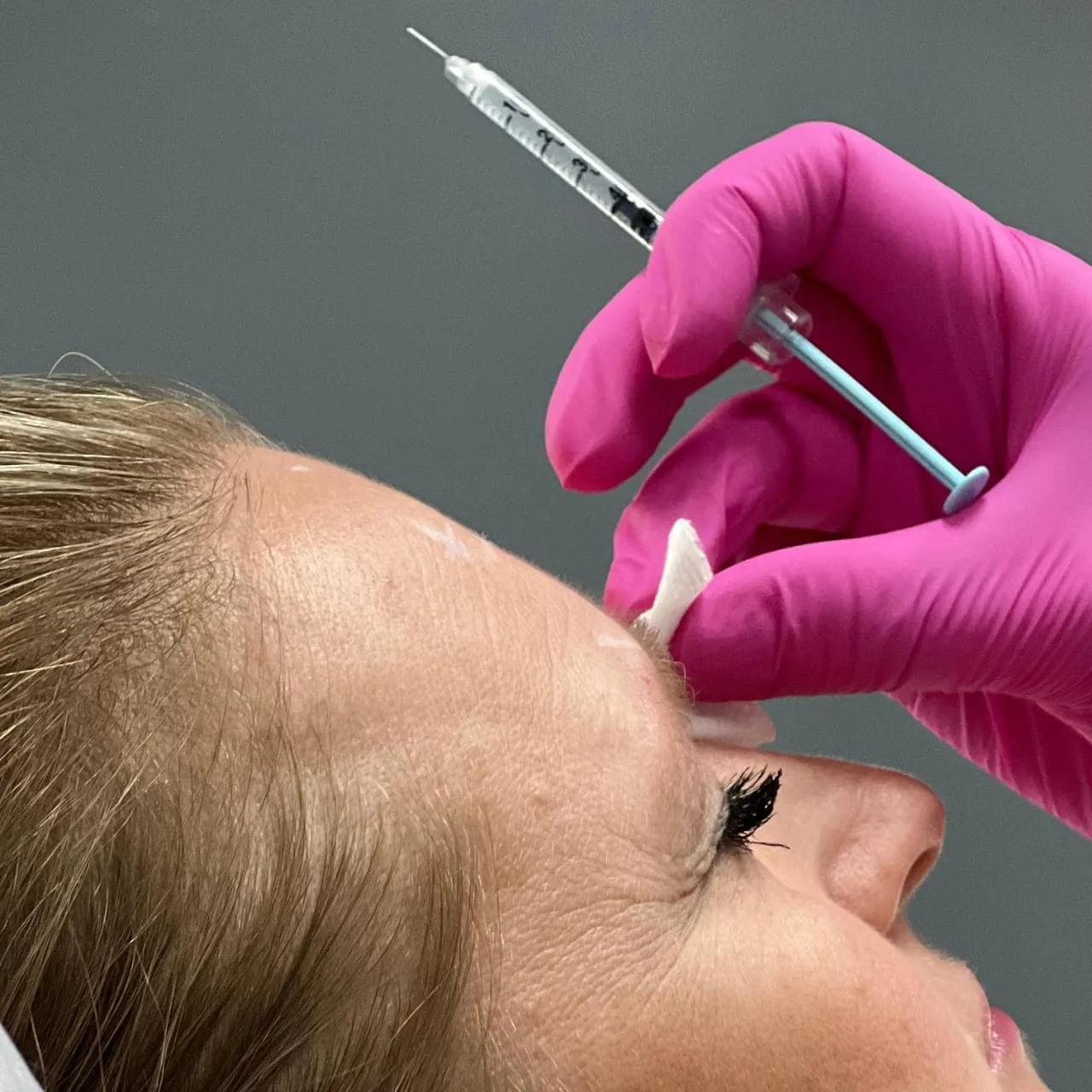
Facial expression muscles attach to the skin, so every movement folds it in the same places. Administering the preparation temporarily reduces neuromuscular conduction at the injection site, the muscle relaxes, and the skin above it stops being repeatedly creased. The mechanism is the same regardless of the form of the preparation, and we describe it on the treatment page.
Powder and liquid form
Preparations in powder form need to be dissolved before administration. The doctor chooses the solvent and volume in line with the specific product's characteristics, and preparation takes place directly before the treatment. Preparations in liquid form arrive at the practice ready to use, so this stage does not occur.
From the patient's point of view, the difference therefore concerns preparation of the product in the practice, not the mechanism of action or the course of the injection itself. The form itself is also not an indicator of effectiveness: it does not result in either a greater scope of change or a longer lasting effect.
We do not state which preparations come in which form, because that is information about specific medicinal products. Which preparation will be used is decided by the doctor at the qualification stage.
Why units are not compared
Dosing in this method is expressed in units, but the units of different preparations are not convertible one to one. This means that comparing the number of units between preparations, let alone the price per unit, leads to conclusions that have no basis in reality.
This is one of the reasons why we do not include price comparisons between preparations in our informational content. The second is that these are medicinal products available on prescription.
What determines the result
Assessment
Establishing whether the wrinkle results from muscle movement or another mechanism. This determines whether the method is appropriate, not just possible.
Knowledge of anatomy
Facial expression muscles work as a system, in which relaxing one changes how the others act. The plan concerns the face as a whole, not a single line.
Dose and injection points
Too small a dose gives an unnoticeable effect, too large a dose changes facial expression. The dose is set by the doctor for the specific preparation and the specific area.
Assessment after two weeks
The full effect is visible after a dozen or so days, and that is when the result and any possible correction are assessed. Assessing earlier leads to incorrect conclusions.
History of previous treatments
Information about previous administrations, their timing and the skin's reaction has more influence on the plan than the choice of preparation.
None of these things follow from the name of the preparation or its form. All of them follow from the qualification and the doctor's work.
What the method will not do
- It does not work on wrinkles that do not result from muscle movement. Changes resulting from volume loss fall under volumetry, and those resulting from sun exposure are covered by the approach described under photoageing.
- It is not a one-off treatment in the sense of a permanent effect. The action of the preparation is temporary, and the scope and duration are described on the treatment page.
- It does not give the expected effect in every person. The reasons for a lack of response to treatment are described separately, on the treatment page.
- It does not replace qualification. The list of contraindications is part of the treatment, not a formality beforehand.
Further on the site
- Mechanism, treatment areas, procedure, contraindications: expression lines and botulinum toxin.
- If the topic is loss of volume: facial volumetry.
- If the topic is skin quality: hyaluronic acid revitalisation.
- Other indications for the same substance: treatment of excessive sweating.
The questions we are asked most often
How does botulinum toxin in powder form differ from the liquid form
The form in which the preparation arrives at the practice. Powder requires dissolving before administration, the liquid form is ready for use. The difference concerns how the product is prepared, not its mechanism of action on the muscle.
Does the liquid form work better
The form alone is not proof of effectiveness. The result depends on qualification, dose selection and precision of administration. The choice of preparation belongs to the doctor and follows from assessment of the individual case, not the patient's preference.
Can units of different preparations be compared
No. Units are not convertible one to one between preparations, so comparing doses or the price per unit between preparations leads to incorrect conclusions. The dose is set by the doctor for the specific preparation and the specific area.
Is this the same treatment that people refer to by its common name
Yes. The common name derives from the trade name of one of the preparations, and the substance is botulinum toxin type A. We use the name of the substance because we are describing the method, not a specific medicinal product.
Who decides on the choice of preparation
The aesthetic medicine doctor, at the qualification stage. The doctor takes into account the treatment area, facial expression activity, previous treatments and their course. The name of the preparation is not a matter of choice for the patient.
Does the treatment remove all wrinkles
No. Botulinum toxin works on wrinkles that form from muscle movement. Wrinkles resulting from loss of volume or from photoageing have a different mechanism and require a different approach.
What the research says
Two papers without trade names in their titles, both about the substance, not the product. The second explains why units are not compared between preparations.
A randomised controlled trial with a placebo group, in which the preparation was administered at five sites in the glabellar area, and patients were observed for 120 days. This is one of the papers on which knowledge of the time-limited nature of the method's action is based.
Carruthers JA, Lowe NJ, Menter MA, Gibson J, Nordquist M, Mordaunt J, Walker P, Eadie N. A multicenter, double-blind, randomized, placebo-controlled study of the efficacy and safety of botulinum toxin type A in the treatment of glabellar lines. Journal of the American Academy of Dermatology. 2002;46(6):840-849.
A direct comparison of two forms of the preparation in 62 people. To achieve a comparable scope of work, one group was given 20 units, the other 50. The authors state directly that different forms behave differently. Hence the rule that unit numbers are not converted between preparations.
Lowe P, Patnaik R, Lowe N. Comparison of two formulations of botulinum toxin type A for the treatment of glabellar lines: a double-blind, randomized study. Journal of the American Academy of Dermatology. 2006;55(6):975-980.
Sources
References for the time-limited action of the preparation and for the differences between forms are given in the section What the research says. The description of the mechanism and the scope of the method have been carried over from the NL Clinic treatment page. Information about individual medicinal products is contained in their summary of product characteristics, not in this text.
About this text
The text was prepared by the NL Clinic team. Published 15 July 2024, verified 24 August 2026.
The content is for information only and does not replace a consultation or the information contained in the summary of product characteristics.
Where to look next
How the treatment goes, the areas, on-label and off-label indications, aftercare and contraindications are described on the treatment page. The choice of preparation and dose is made by the doctor during qualification.