
Start with a doctor, not a treatment, if
The sweating appeared suddenly in an adult and was not a problem before.
It affects the whole body rather than specific areas, or occurs asymmetrically, on one side.
It also occurs at night, during sleep.
It is accompanied by fever, weight loss, weakness, heart palpitations or enlarged lymph nodes.
It started after beginning a new medication or changing the dose.
It occurs together with other new symptoms that were not there before.
Each of these points shifts the suspicion towards secondary hyperhidrosis, meaning sweating that is a symptom of another condition or a medication side effect. Management then starts with a visit to a GP or an internist.
On this page
Primary or secondary
This distinction puts everything else in order. It is not difficult, it rests on a few features that a doctor would ask about during the history anyway.
Feature
Primary hyperhidrosis
Secondary hyperhidrosis
Location
Specific areas: armpits, hands, feet, face and the scalp.
The whole body or areas that do not fit the typical pattern.
Symmetry
Usually symmetrical, on both sides of the body.
It can be asymmetrical, which is a warning sign.
Onset
In childhood or during puberty, increasing gradually.
Sudden, often in an adult.
At night
It stops during sleep.
It also occurs at night, and can be heavy.
Additional symptoms
No other general symptoms.
Fever, weight loss, weakness, changes in wellbeing.
Management
Symptomatic treatment, stepped up from simpler methods.
Diagnosis and treatment of the cause. The symptom itself is not the target.
Primary hyperhidrosis is a chronic condition, usually starting in childhood or during puberty, and it is not a sign of illness. Secondary hyperhidrosis can be the first noticeable symptom of a condition requiring treatment, and treatment therefore does not start by suppressing it.
Order of steps
In primary hyperhidrosis, the order runs from simpler methods to more complex ones. This has practical significance: some people come in for a treatment without having properly tried a cheaper method that does not require an appointment.
1
Confirming the diagnosis
A history that determines whether the sweating is primary. It includes questions about onset, location, occurrence at night, medications taken and accompanying symptoms.
2
Antiperspirants with aluminium salts
First-choice management, available without a visit. Effectiveness depends largely on how it is used, as explained below.
3
Topical and procedural treatment
When first-choice methods are not enough, management led by a doctor is considered, including botulinum toxin injections in the affected area.
4
Specialist management
If there is no response to the above, systemic or surgical treatment is considered, carried out outside an aesthetic medicine practice and associated with a separate risk profile.
The most common mistake with antiperspirants containing aluminium salts
Using them in the morning, on damp skin, after shaving. Preparations of this type are usually applied in the evening, on completely dry skin, and washed off in the morning. Incorrect use causes irritation and the impression that the method does not work. It is worth confirming the way of use with a doctor or pharmacist, as it differs between preparations.
The treatment using botulinum toxin is described on a separate page: hyperhidrosis treatment. There you will find the course of the treatment, preparation, contraindications and recommendations after the treatment.
Areas and what makes them different
Primary hyperhidrosis usually affects specific areas, symmetrically. These areas differ in the course of treatment and risk profile, so the decision is made separately for each one.
Underarms
The area treated most often and best tolerated. The injection is less painful than in other areas, and the impact on daily functioning is reported as the greatest, mainly because of stains on clothing.
Hands
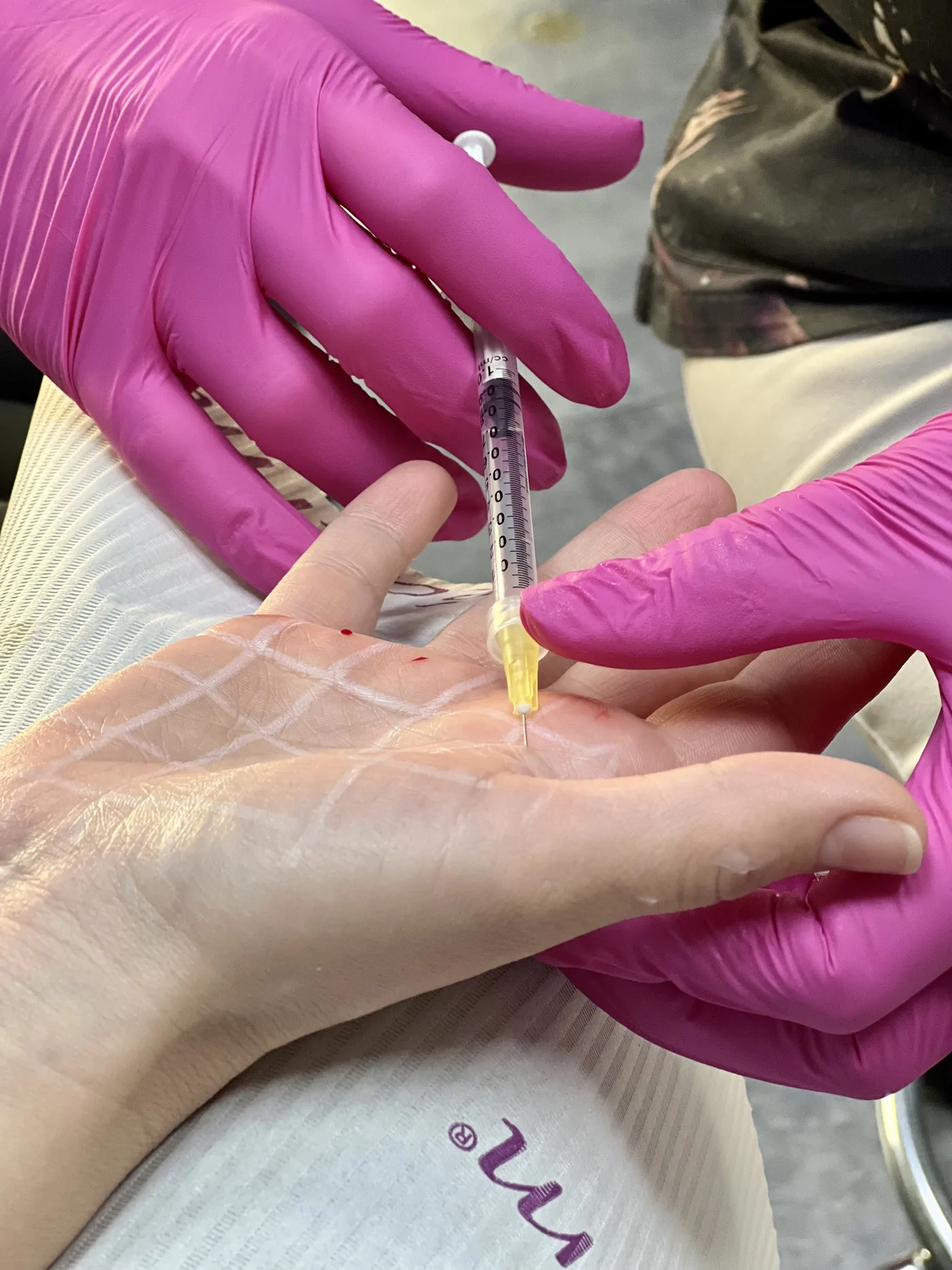
The injection is markedly more painful and requires appropriate anaesthesia. Temporary weakening of grip strength has been reported in this area, which is discussed before the decision, especially for work requiring precision.
Feet
The skin is thick, which makes the injection more difficult and usually means lower effectiveness than in other areas. It also happens that with foot hyperhidrosis, skin care and choice of footwear matter more.
Face and hair-bearing scalp
An area requiring particular caution due to facial expression muscles in the immediate vicinity. The decision and scope are determined individually at the consultation.
What management will not do
It will not remove the cause. Primary hyperhidrosis is a chronic condition, and the available methods control the symptom for as long as they work.
It will not replace diagnostics if secondary hyperhidrosis is suspected. Suppressing the symptom may delay the diagnosis of what is behind it.
It does not work the same way in all areas. Feet and hands usually respond less well than armpits.
It is not a one-off treatment. The effect of the injection is temporary and requires repeating, and its duration is determined by observation, not set in advance.
We do not carry out internal medicine or endocrinology diagnostics. If the clinical picture suggests secondary hyperhidrosis, we say so at the consultation and refer you further, instead of carrying out a treatment that suppresses the symptom.
What this looks like at our practice
Observation from the practice
We begin the interview by asking whether the sweating occurs at night, and by reviewing the list of medicines taken. These two answers settle the most, and patients rarely mention them on their own initiative, because they do not associate them with the reason for the visit.
Patients usually come to us after many years, describing the problem as embarrassing. Hyperhidrosis has a diagnosis and a treatment, and that is how we talk about it.
This is the practice's own approach, not data from the literature. We mark it separately so that it does not get mixed up with what comes from publications.
Editorial responsibility
Responsible for the content
NL Clinic, Katowice
How the content is created
Last updated
15 August 2026
This material is informational in nature and does not replace a consultation or qualification.
The questions we are asked most often
How does primary hyperhidrosis differ from secondary hyperhidrosis?
Primary hyperhidrosis affects specific areas, most often the armpits, hands, feet or face, is usually symmetrical, starts at a young age and stops during sleep. Secondary hyperhidrosis is a symptom of another condition or of a medicine: it affects the whole body or appears asymmetrically, starts suddenly in an adult and also occurs at night. This distinction determines further management, because in secondary hyperhidrosis the cause is treated, not the symptom.
When does sweating require diagnostics rather than a treatment?
When it appeared suddenly in an adult, affects the whole body, occurs at night, or is accompanied by fever, weight loss, weakness, heart palpitations, enlarged lymph nodes or other new symptoms. Diagnostics are also required for sweating that is asymmetrical, and for sweating that started after beginning a new medicine. In these situations, the first step is a visit to a general practitioner or an internal medicine doctor.
Can hyperhidrosis be cured permanently?
Primary hyperhidrosis is a chronic condition, and the available methods control the symptom rather than remove its cause. Antiperspirants with aluminium chloride and topical treatment work for as long as they are used. Botulinum toxin injections give a temporary reduction in sweat secretion in the treated area and require repeating. Permanent methods belong to surgery and carry a separate risk profile, including compensatory sweating in other areas of the body.
Where should management start?
With confirming that the sweating is primary, and with first-choice methods, that is antiperspirants containing aluminium salts, used as recommended on dry skin in the evening. Only when this is not enough are further stages of management considered. The order matters in practice: some people come for a treatment without having correctly tried the simpler and cheaper method first.
What does treatment with botulinum toxin involve?
The preparation is given intradermally at multiple points within the treated area, where it temporarily blocks the signalling that stimulates the sweat glands. The effect appears within a few to a dozen or so days and lasts for a limited time, after which the treatment is repeated. The treatment is carried out by a doctor, after qualification. The course, preparation and contraindications are described on the hyperhidrosis treatment page.
Does the treatment disturb the body's natural cooling?
Treatment covers a limited area, for example the armpits or hands, and thermoregulation relies on glands distributed over the whole surface of the body. Reducing sweat secretion in one area does not take away the body's ability to cool itself. The extent of the treated surface is determined at the consultation, and the doctor discusses all possible adverse effects before the treatment.
Is hand hyperhidrosis treated in the same way as armpit hyperhidrosis?
The principle is the same, but the areas differ in sensitivity and course. The hands are more painful during injection and require appropriate anaesthesia, and temporary weakening of grip strength has been reported in this area. For this reason, the decision to treat the hands is made separately, after discussing this risk.
Is hyperhidrosis an aesthetic problem?
No. Hyperhidrosis is a medical condition with a defined diagnosis, not a matter of hygiene or appearance. It affects daily functioning, work and contact with other people, and for this reason it is sometimes reported late. Proper management starts with diagnosis, not with choosing a treatment.
The content is for information. It does not replace a consultation, an examination or an individual assessment.