
On this page
Carbon as an artificial chromophore
Lasers act on chromophores, meaning substances that absorb light. In the skin the natural chromophores are melanin, haemoglobin and water. Oily skin with blackheads, however, does not contain any of these in the pores in a quantity that would let the beam act exactly where the problem is.
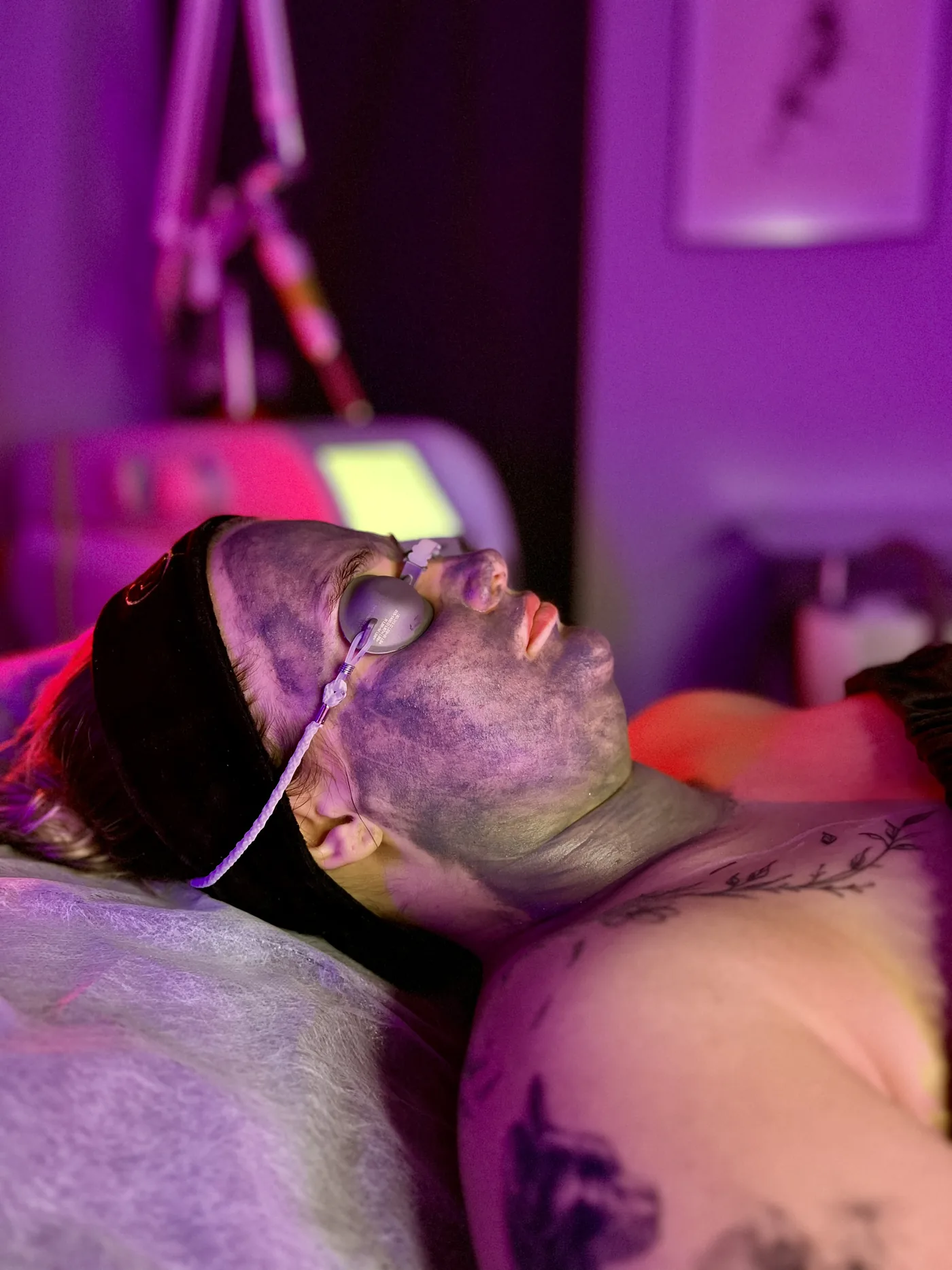
The carbon suspension solves this differently from increasing the energy: it introduces a chromophore where there was none. Carbon nanoparticles absorb light very strongly, and at the same time penetrate the openings of the sebaceous glands and the microscopic depressions of the epidermis.
We carry out the treatment with a picosecond laser. The energy is absorbed selectively by the carbon particles and leads to their rapid vaporisation, described as micro-explosions. The result is micro-exfoliation, meaning the shedding of dead epidermal cells, the clearing of the gland openings, and gentle warming of the deeper layers of the skin, which stimulates fibroblasts to produce collagen and elastin. The energy acts on the carbon particles, not directly on the tissues, and this is why the treatment does not require anaesthesia.
This is why the treatment makes sense for oily skin and blackheads, and less sense for dry skin with visible vessels: without content in the pores there is nothing for the carbon to take away.
The treatment step by step
How it differs from an acid peel
Acid peel
Works chemically: it loosens the connections between the cells of the stratum corneum and leads to exfoliation. After stronger protocols the skin peels.
Carbon peel
Works by breaking apart the carbon particles, which are removed together with the contents of the pores. Visible peeling is not typical here.
They do not replace each other and can be elements of the same plan. The intervals between them are set by the person carrying out the treatment, because the skin needs time after each one. We describe the types of acids and exfoliation depths on the chemical peels page.
Indications
The treatment does not treat acne. Acne is a disease, and its treatment is led by a doctor, most often a dermatologist.
With inflammatory lesions and pronounced acne, the first step is a medical assessment. We describe accompanying management, including laser based, on the laser acne reduction page, and the mechanism of the condition itself on the acne page.
What one session gives, and what a course gives
This question is worth resolving before the treatment, because it determines whether you will be satisfied with the result.
One session
Pore cleansing and a short term improvement in skin appearance. This is a good choice before an event, but it does not change the nature of the skin.
Series
Management of seborrhoea and skin texture, carried out at intervals. Maintaining the result depends on proper home care, without which the skin returns to its initial state.
We do not give the number of treatments before qualification. It depends on the condition of the skin, the severity of seborrhoea and the aim of the management.
The treatment on video
The recording shows the application of the carbon paste and the work of the handpiece. This is the most illustrative part of this treatment, and it also answers the question of whether the treatment can be felt.
A recording from the NL Clinic practice. It plays after clicking, with no background sound and no automatic start.
After the treatment
The skin can be pink for a few hours. Temporary swelling and tenderness are also possible.
Make-up can usually be applied the next day, not on the day of the treatment.
SPF 50 plus sun protection for at least two weeks, avoiding intense sun and sunbeds.
For 48 to 72 hours, avoid acids, retinoids and sonic brushes. On the day of the treatment, avoid the sauna, swimming pool and intense exercise.
Home care is selected by the cosmetologist: for oily skin, sebum normalising products, for pigmentation, products with antioxidants and sun protection.
Contraindications
Editorial responsibility
Responsible for the content
NL Clinic, Katowice
How the content is created
Last updated
14 August 2026
Data confirmed by the clinic's materials: the treatment is carried out by a cosmetologist, lasts 30 to 45 minutes, and is performed with a picosecond laser, with a course usually comprising 3 to 4 treatments at intervals of 2 to 4 weeks. We do not give trade names of devices, because we do not build an advantage on equipment brand, and regulations restrict the advertising of medical devices directed at the general public. This material is for information purposes and does not replace a consultation or qualification.
The questions we are asked most often
Why is carbon applied before the treatment?
To give the beam a target. Skin without a distinct pigment absorbs this wavelength poorly, so the carbon paste acts as an artificial chromophore: it penetrates the pores and irregularities of the epidermis, and the beam targets it directly. The carbon is removed together with everything that has settled in it.
How does this treatment differ from a chemical peel?
In the mechanism of action. A chemical peel exfoliates chemically, loosening the connections between the cells of the stratum corneum. A carbon peel works mechanically and thermally: the energy breaks down the carbon particles, which are removed together with the contents of the pores. They do not replace each other and can be elements of the same plan, at intervals set by the person carrying out the treatment.
Does the treatment treat acne?
No. Acne is a disease, and its treatment is led by a doctor, most often a dermatologist. A carbon peel is an aesthetic procedure aimed at cleansing the pores and improving the appearance of oily skin. With inflammatory lesions and pronounced acne, the first step is a medical assessment.
Does the skin peel after the treatment?
Usually not visibly. The skin can be temporarily reddened and may feel warm, and visible flaking is not typical for this treatment. This distinguishes it from exfoliating peels and ablative treatments.
How many treatments are needed?
3 to 4 treatments at intervals of 2 to 4 weeks are usually recommended, followed by maintenance care. A single treatment works as an intensive cleansing and refreshing of the skin, whereas for chronic conditions such as seborrhoea, enlarged pores or post-inflammatory pigmentation, a course is needed. The plan is set by the cosmetologist after a skin assessment.
Can the treatment be carried out on areas other than the face?
Yes. The treatment is also carried out on the neck and decolletage, and in selected cases also on the back, particularly with excess sebum and post-acne changes. The area is determined at the consultation.
When can I go back to wearing make-up?
Usually the next day. Immediately after the treatment, the skin can be pink and more sensitive, so we advise against heavily covering cosmetics during the first 24 hours.
Can the treatment be carried out before an important event?
Usually yes, because it does not interfere with daily activities and does not leave scabs. However, it is worth allowing for possible temporary redness and not scheduling the treatment for the same day. The date is set by the person carrying out the treatment, taking the condition of the skin into account.
The content is for information. It does not replace a consultation, an examination or an individual assessment.