
Patient guide
Body hair, where it comes from and how a laser acts on it
Where this hair comes from, why we have it and why it grows more abundantly in some people than in others. The answers to these questions also explain why laser hair removal requires a series of treatments rather than a single visit.
Published 17 January 2021. Last reviewed 16 August 2026.
Functions of hair
Hair, along with nails, sebaceous glands and eccrine and apocrine sweat glands, belongs to the skin appendages, meaning skin elements with strictly defined functions. It is found across the whole body apart from the inner surface of the hands and feet. In some places it is light, soft vellus hair, in others thick and dark hair, but each type has its role.
- Thermoregulation. When the temperature drops, the arrector pili muscles contract and the hair rises slightly, creating a layer of air that slows heat loss. This phenomenon is commonly known as goosebumps. Today this function is less significant, because clothing and heating provide warmth.
- Protection against chafing and improved airflow, mainly in the groin and underarm areas.
- Protection against microorganisms, for example pubic hair and hair in the nose and ears.
- Protection against dust and sweat, meaning eyelashes and eyebrows.
- Head protection against UV radiation and overheating.
- Appearance, including emphasising male features, such as facial hair, and female features, such as hair on the head.
- Sensing external stimuli.
These functions overlap with one another, and the location of the hair determines which of them is the main one.
Why hair is thicker in some places
Hormones are responsible for differences in thickness and colour. During adolescence, androgen levels rise, especially testosterone, to which hair follicles become sensitised. That is why hair in the pubic area and underarms becomes thicker and darker. On the head, a testosterone derivative, dihydrotestosterone, acts and causes hair to start falling out, which leads to hair loss. This mainly affects men, less often women.
Hair colour is genetically determined and results from a mix of genes inherited from ancestors.
Hair removal methods
Methods are divided into temporary ones and those that lead to permanent hair reduction. Temporary methods include shaving with a razor or trimmer, cutting, removal with wax, tweezers or an epilator, and hair removal creams. The method that leads to permanent reduction is laser hair removal.
It is worth knowing the correct term: device manufacturers and the literature refer to permanent hair reduction, not permanent removal. This means a decrease in the number of regrowing hairs that lasts longer than a full growth cycle, not the complete and irreversible removal of hair. Some hair regrows thinner and lighter, and some people need maintenance treatments.
Hair structure
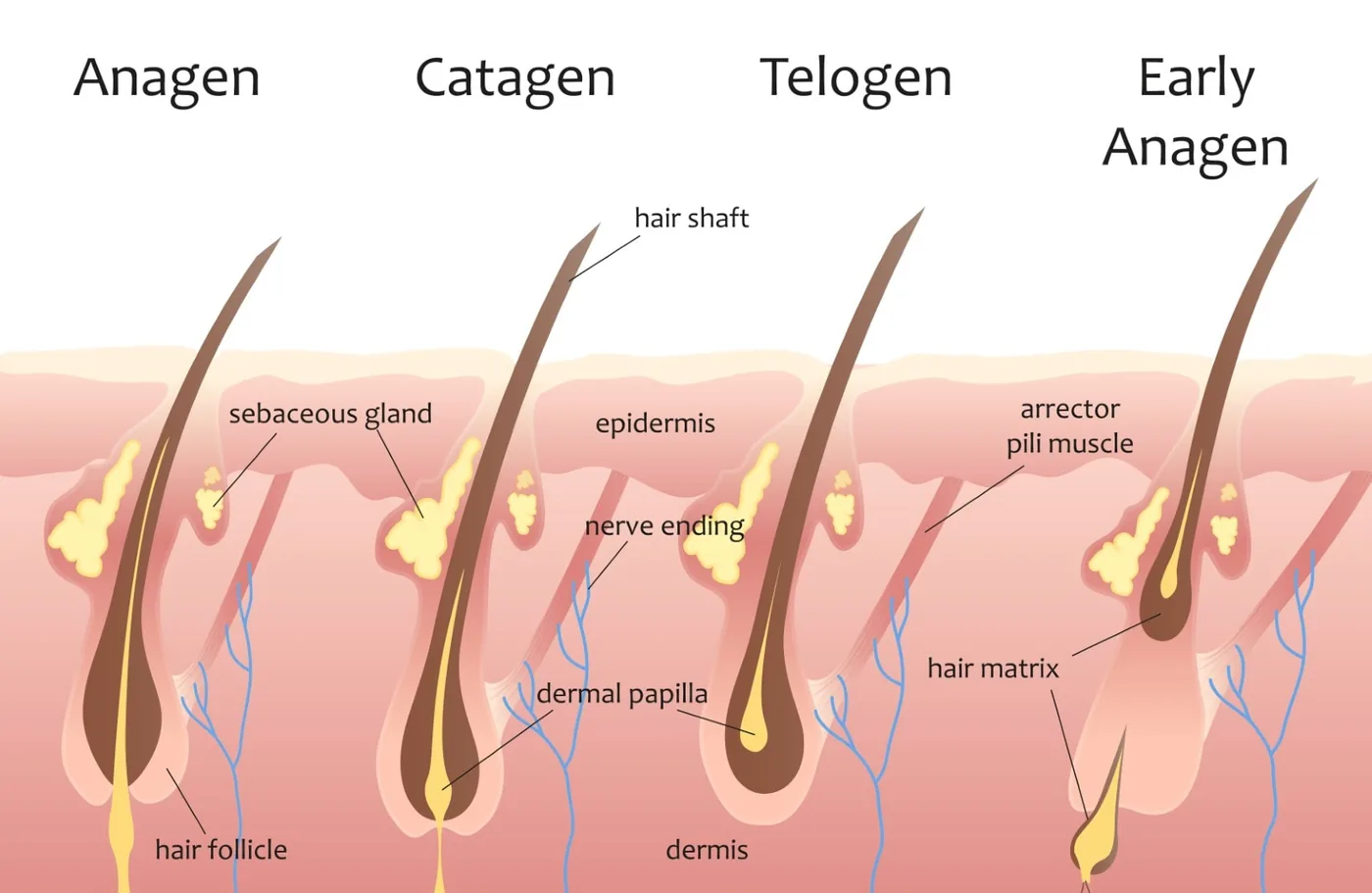
To understand how the laser works, you need to know the structure of hair. Hair is not just the shaft, the dead part that protrudes above the skin, but also living structures located within the skin.
The root is an extension of the shaft and reaches deep into the skin, into a depression in the epidermis called the hair follicle. At the bottom, the root widens into a bulb shape, forming the hair bulb. This is where the hair matrix cells are found, capable of multiplying and building the hair.
Hair needs a blood supply, oxygen and nerve supply. Blood vessels are carried by the hair papilla, which pushes up into the bulb from below. Between the papilla and the bulb lie melanocytes that produce melanin, the pigment that gives hair its colour. A distinction is made between eumelanin, a black-brown pigment, and pheomelanin, a yellow-red pigment. The final colour depends on the proportion of each.
Attached to the follicle is the arrector pili muscle, running up to the epidermis, responsible for raising the hair. In the angle between the muscle and the follicle is the sebaceous gland, whose secretion moisturises and lubricates the skin around the hair and the hair itself.
Chemically, hair is made of keratin, a hard fibrous protein produced by keratinocytes. The hair shaft itself has three layers:
- Medulla, present only in thick hair. It may contain gas bubbles that give hair a grey tinge, and there are few pigment granules in it.
- Cortex, responsible for hardness, elasticity and colour, because this is where melanin is found.
- Cuticle, the outer layer. It protects the interior from radiation and moisture loss and gives shine.
Hair itself is divided into vellus hair, found mainly in newborns, short hair, such as eyelashes and eyebrows, and long hair, growing throughout life, such as hair on the head.
Three phases of the growth cycle
- Anagen, the active growth phase. Cells in the follicle divide intensively and produce new hair. On the head this phase lasts from 2 to 7 years, on the body from 4 to 12 weeks, depending on the area.
- Catagen, the transitional phase. The hair's reproductive processes are halted, and the matrix disappears.
- Telogen, the resting phase. The hair dies and is pushed out of the follicle until it falls out.
How a hair removal laser works
The aim of the treatment is not to remove the hair shaft, but to disable the living structures responsible for hair growth. Regardless of the technology, that is whether it uses an alexandrite laser, a diode laser or an Nd:YAG laser, the principle is the same: photothermolysis. Energy is absorbed where melanin is concentrated, that is in the hair, and in a short pulse it damages the structures that build the hair.
The treatment works on hair that is in the anagen phase, because only then is the hair connected to the follicle. At any given moment, only part of the hair in the area is in this phase, not all of it. Hence the need for a series of treatments and intervals between them.
The length of the growth phase depends on the area of the body: on the face around 4 to 6 weeks, in the bikini area and underarms around 6, and in other areas from 8 to 12 weeks. This is why the interval between treatments is chosen according to the area, rather than being set the same for the whole body.
About this text
Text prepared by the NL Clinic team. Published on 17 January 2021, verified on 16 August 2026.
The content is for information and does not replace a consultation.
Laser test before the series
Before the first treatment, we assess the skin phototype, hair colour and thickness, and any contraindications. We select the parameters after the laser test.