
Laser treatments
Laser hair removal, alexandrite 755 nm or diode laser
Unwanted hair is a common reason for visits. The question that comes up most often concerns the device: alexandrite or diode. The answer depends on the skin phototype and the type of hair, not the name of the laser.
Published 12 July 2020. Last verified 16 August 2026.
Category
Laser treatments
Treatment page
Author
NL Clinic team
What laser hair removal is
The treatment, commonly called laser hair removal, is technically epilation. The beam of light is absorbed by the melanin contained in the hair follicle, the light energy turns into heat, and this can damage the structures responsible for hair regrowth. The phenomenon is called selective photothermolysis, because the energy selectively targets the structure containing the pigment, which limits the effect on the surrounding skin. This does not mean that the treatment is free of risk.
In everyday language people speak of depilation, and that term is more widely recognised. The word epilation is more accurate, though, because the laser acts not on the visible part of the hair, but on the follicle.
Not all hairs disappear after one visit. Hairs do not grow at the same time: some are in the active growth phase, some in the transitional phase, some in the resting phase. The laser works best on hairs that contain melanin and are in the right phase, which is why treatments are planned as a course. A hair that regrows can be weaker, thinner or less visible.
Dark, thicker hairs that clearly stand out against the colour of the skin respond best. Very fair, grey, white, red and vellus hairs respond more weakly, because they contain less melanin or a different type of it.
Three wavelengths and their use
Modern devices emit more than one wavelength from a single handpiece. In epilation, the following are used above all:
- 755 nm, that is the alexandrite laser: strong affinity for melanin, used with lighter skin phototypes and darker hair,
- 810 nm, that is the diode laser: reaches deeper than 755 nm, considered for thicker, more deeply rooted hair and across a wider range of phototypes,
- 1064 nm, or Nd:YAG: least absorbed by epidermal melanin, which is why it comes into play for darker skin phototypes, where the risk of epidermal damage is greater.
The treatment documentation for our device shows this directly. The chart for 755 nm alone covers phototypes I to IV, while the combined mode, in which 755 nm and 1064 nm are emitted simultaneously, extends the range to phototype V (sources 1 and 2). Adding the longer wavelength therefore does not serve a stronger effect but safer work on darker skin.
The second variable, besides phototype, is hair thickness. The manufacturer separates parameters for fine and coarse hair, and for darker phototypes extends the pulse duration so the energy is distributed more gently for the epidermis.
Our diode laser operates at two wavelengths simultaneously, 810 and 940 nm, and its interface allows you to set the phototype from I to VI as well as hair density and thickness (source 3). It is precisely this difference in phototype range, not the power of the device alone, that decides the division of roles between alexandrite and diode. Technical details are described on the device pages: alexandrite laser and Nd:YAG laser.
When alexandrite 755 nm may be considered
The 755 nm wavelength is well absorbed by melanin, which is why the technology may be considered particularly for people with a lighter skin phototype and darker or medium dark hair. The literature describes it as one of the technologies used in hair reduction, especially for lighter skin types.
In clinical practice, alexandrite is sometimes chosen when strong affinity for melanin and fast work on larger areas matter, for example the legs, arms or back. With a fresh tan, darker phototype or high skin sensitivity, particular caution is needed, because a greater amount of melanin in the epidermis increases the risk of irritation, pigmentation and burns.
When a diode laser may be the better choice
Diode laser is one of the most widely used technologies in hair removal, most often described in the literature in the context of a wavelength of around 810 nm. The longer wavelength penetrates the skin more deeply than 755 nm, which is why the technology may be considered for thicker, darker hair and for people with a somewhat higher skin phototype.
This does not mean diode is better for everyone. The choice depends on the skin, the hair, the treatment area, the device parameters, the experience of the person performing the treatment and the skin’s response during the trial and first treatments.
What really decides the choice
There is no single answer that suits everyone. What matters is:
- skin phototype,
- hair colour, thickness and density,
- treatment area,
- a fresh tan or the use of a self-tanning product,
- photosensitising medications and herbs being taken,
- skin conditions and general health conditions,
- previous skin reactions to laser treatments,
- patient expectations,
- the possibility of completing a full course of treatments.
That is why the consultation before hair removal is not a formality. It is the stage at which the method is selected, limitations are discussed and safe intervals between treatments are planned.
Does the treatment hurt
Sensations are individual. Some people describe the pulses as short stings, warmth, a burning sensation or the feeling of an elastic band snapping against the skin. What matters is the treatment area, hair density, skin sensitivity, day of the cycle, the parameters set and the cooling system. Cooling the skin improves comfort and reduces the risk of overheating the epidermis, but it is not a guarantee of no sensation, which is why we do not describe the treatment as painless.
Preparing the skin
- No sunbathing, sunbeds or self-tanning products before the treatment.
- No hair removal by waxing, tweezing or epilator for several weeks before the visit.
- Shaving the treatment area as advised by the practice, usually 24 to 48 hours before the visit. The device documentation states hair trimmed to a maximum of 2 mm.
- No irritating cosmetics, retinoids or acids in the treatment area, if the specialist recommends a break.
- Information about medications, supplements and herbs, especially those that increase the skin’s sensitivity to light.
- Clean skin: no lotion, oil, deodorant or make-up in the treatment area.
You will find the full list of contraindications and recommendations on the laser hair removal page.
Course and number of treatments
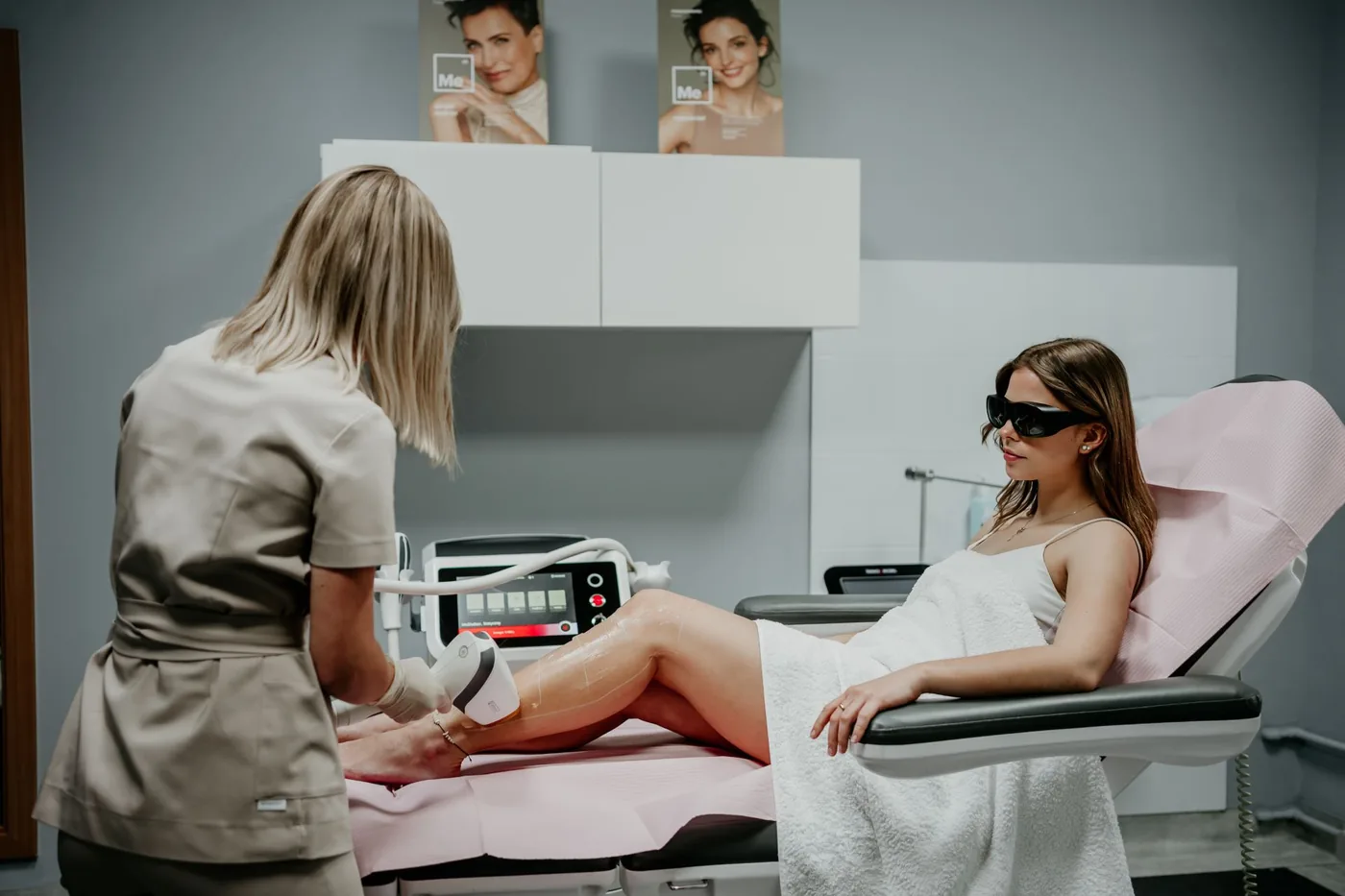
The visit begins with a conversation and a skin assessment. The specialist checks the treatment area, rules out contraindications, and selects the technology and parameters. During the treatment, the patient and the person performing the procedure wear protective goggles, because lasers used in hair removal can be dangerous for the eyes.
The handpiece is applied to the skin, and the device emits pulses of light. Depending on the technology, contact cooling, cold air flow, cooling spray or gel is used. Treatment time depends on the area: the upper lip or chin take considerably less time than the legs or back.
A course of treatments is usually needed, but it is not possible to responsibly state a single number of visits for everyone. The result depends on hair colour and thickness, the area, the type of laser and skin colour. A course is needed because the laser works best on hair in the active growth phase, and not all hairs are in that phase during a single visit.
Intervals are set by the person conducting the treatment. The device’s treatment documentation states subsequent treatments after 30 to 60 days, and for visibly darker skin recommends postponing the treatment by a month or two, until the tan has faded (source 1).
When to start a course and how to plan it around the season, we have described separately: when is the best time to start laser hair removal.
Possible reactions and contraindications
After the treatment, temporary skin reactions may appear: redness, a feeling of warmth, tenderness, slight swelling, perifollicular swelling, that is a small raising of the skin around the follicles, temporary darkening or lightening of the skin, small scabs and irritation for sensitive skin.
Less often, blisters, burns, infections, scars or lasting changes in skin colour occur. The risk increases with a fresh tan, poorly selected parameters, failure to follow recommendations and performing the treatment despite contraindications.
The treatment may be postponed or not advised in the case of a fresh tan, active skin infections, certain dermatological conditions, taking photosensitising medications, pregnancy and breastfeeding, a tendency to abnormal healing, active cold sores in the treatment area, and conditions requiring prior medical consultation.
After the treatment, the skin needs gentle care: no exposure to sun, sunbeds, saunas, hot baths or intense irritation for the time indicated by the specialist, with photoprotection on exposed areas. Between treatments hair is not pulled out, shaving is allowed because it does not remove the follicle. Hairs may gradually work their way out of the skin over several days or weeks, which can be mistaken for regrowth.
The questions we are asked most often
Is an alexandrite laser better than a diode laser
There is no single technology that is best for everyone. Alexandrite 755 nm can be beneficial for lighter skin phototypes and dark hair. Diode laser is sometimes considered across a wider range of phototypes, especially for thicker, deeper set hair. The final choice results from the qualification.
Does laser hair removal remove hair permanently
It is safer to speak of long term hair reduction. In some people, hair may not regrow for many months or years, but partial regrowth is also possible. Hair that does regrow is often weaker, finer or lighter.
Does laser hair removal hurt
Sensations are individual. Some people feel short stings, warmth or a burning sensation, others describe the treatment as well tolerated. Comfort depends on the area, hair type, laser settings, skin sensitivity and cooling.
How many treatments are needed
A course is usually needed. The number of visits depends on the area, hair colour and thickness, skin phototype, technology and individual response of the body. Intervals are set by the specialist.
Does the laser work on light or grey hair
Very light, grey, white and red hair responds less well, because it contains less melanin or a different type of melanin. In such cases, individual assessment and discussion of realistic options are necessary.
Can laser hair removal be carried out in summer
This depends on the skin, sun exposure, phototype and the chosen technology. Fresh tanning is a common reason for postponing the treatment. Before and after hair removal, avoiding intense sun and using photoprotection is recommended.
Sources
- Quanta System, Suprema Series 755 P, Application Charts, document DGM001640.03, table "Permanent Hair Reduction @ 755 nm": phototypes I to IV, parameters given separately for thin and thick hair.
- Quanta System, Suprema Series 1064 + 755 MIX P, Application Charts, document DGM001638.01, version dated 31 July 2025, table "Permanent Hair Reduction": simultaneous emission of both wavelengths, phototypes I to V.
- Asclepion Laser Technologies, documentation for the MeDioStar device with Monolith heads: wavelengths of 810 and 940 nm, phototype selection from I to VI, 360-degree contact cooling, variable pulse duration.
Treatment parameters come from the device manufacturer's documentation and are not a recommendation for the patient.
About this text
The text was prepared by the NL Clinic team. Published on 12 July 2020, verified on 16 August 2026.
The content is for information and does not replace a consultation.
Selecting technology for skin and hair
At the consultation, we assess phototype, hair colour and thickness, and tanning history, then determine the technology and parameters.