
Aesthetic medicine
Three scar treatments: microneedling mesotherapy, CO2 laser and tropocollagen
A scar is a result of healing, not a flaw in it. Some scars can be smoothed and brought closer in colour to the surrounding skin, but none can be reversed. The choice of method depends on the type of scar, its age and the way the skin healed.
Published 3 July 2024. Last reviewed 18 August 2026.
Category
Aesthetic medicine
Applies to
Condition
Identifying the type and maturity of the scar
How a scar forms and why its type matters
A scar forms when the damage reaches the dermis. The defect is filled with fibrous tissue, in which collagen fibres are arranged differently than in undamaged skin. Whether too little or too much collagen forms determines the appearance of the scar and the approach to treatment.
- Atrophic scars, also called atrophic. Depressions and pits that form with tissue loss, common after acne and chickenpox.
- Hypertrophic scars, also called overgrown scars. They protrude above the skin surface, are firm, pink or red, form with collagen overproduction and stay within the original wound.
- Keloid scars. Overgrowth extending beyond the wound area, thick and raised, coloured from red to purple, with a tendency to recur after removal.
- Contracture scars, also known as retractile scars. They tighten the skin and can limit movement in the affected area. They form most often after burns.
The methods described below apply mainly to atrophic scars and mature flat scars. For hypertrophic, keloid and contracture scars the approach is different, and needling and ablative treatments can worsen the scar in people prone to keloids. That is why diagnosis comes before the choice of method.
When a scar needs a doctor's assessment
- The scar is growing, extends beyond the wound area, itches or is painful.
- The scar tightens the surrounding skin or limits movement.
- An ulcer, oozing, a lump or a lesion that does not heal appears within the scar.
- The scar is fresh, from a recent injury or treatment, and has not finished maturing.
- Earlier wounds healed with overgrowth or there is a history of keloids.
In these situations, therapy begins with diagnosis. Qualification is carried out by a doctor, and in some cases dermatological or surgical care is more appropriate than an aesthetic treatment.
Microneedling
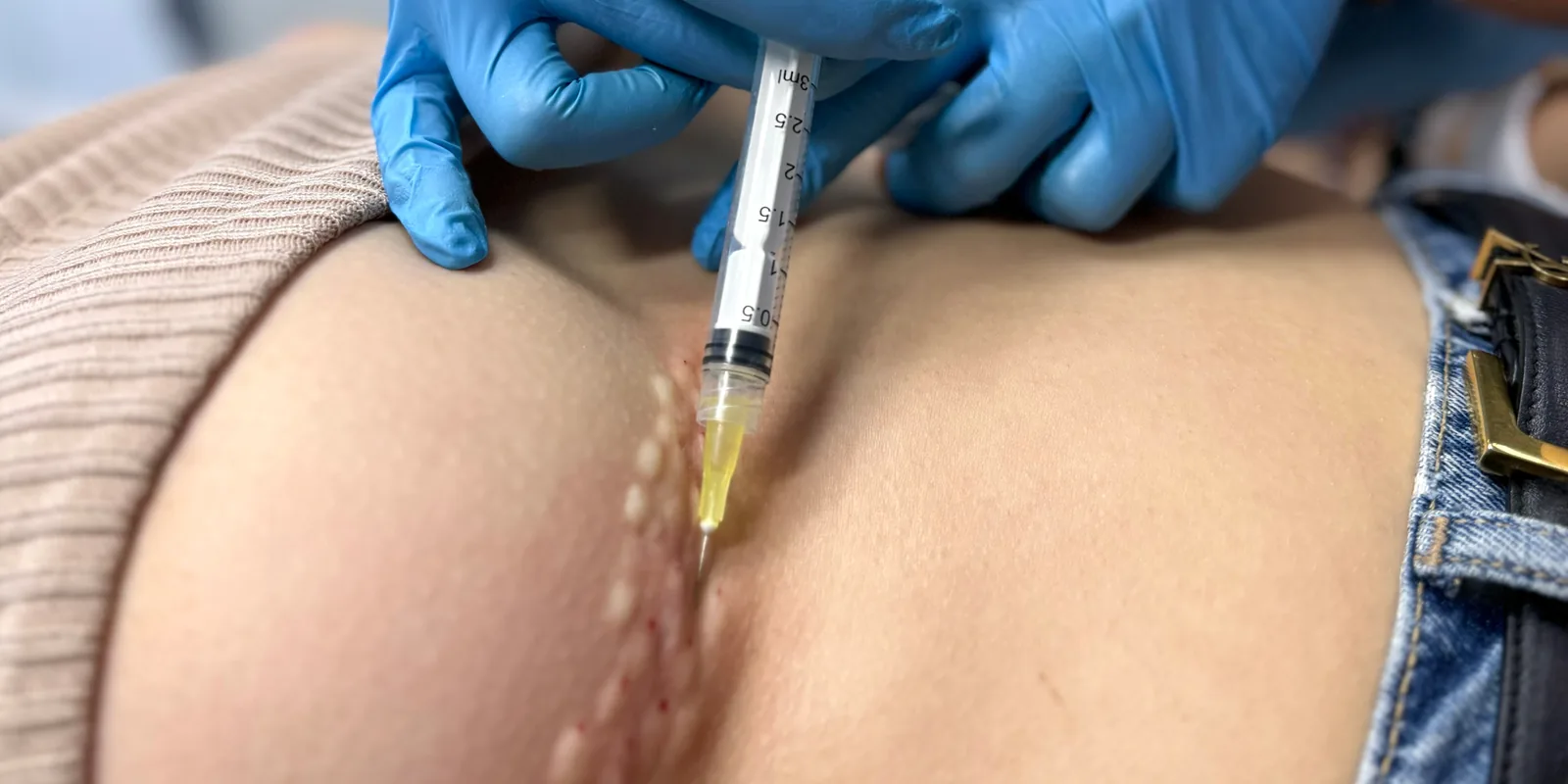
Microneedling mesotherapy, also simply known as microneedling, involves controlled needling of the skin with fine needles. The micro-injuries trigger healing and, with it, the remodelling of collagen and elastin. The depth of the needling and the number of passes follow from the assessment of the scar and the skin thickness in the area, not from a fixed protocol.
The effectiveness of the method in atrophic scars was described in an observational study from 2009: thirty-seven patients with atrophic facial scars of various aetiology were assessed clinically and on photographs before a series of treatments and two months after its completion. The study had no control group or blinded assessment, so it indicates a direction, not the scale of improvement in a particular person.
After the treatment the skin can be red and swollen for a few days. A systematic review of needling side effects also lists post-inflammatory pigmentation, infections and hypersensitivity reactions to preparations introduced into the skin during the treatment. This is an argument for a pre-treatment history and caution in choosing the preparation, not against the method.
Fractional CO2 laser resurfacing
Fractional CO2 laser splits the beam into microcolumns that vaporise tissue at individual points and leave untouched epidermis between them. Around each column a coagulation zone forms, triggering remodelling of the dermis. The treatment is carried out by a doctor, and the parameters depend on the type of scar and the area.
In a study from 2014, fractional CO2 resurfacing used as the sole method for atrophic facial scars was assessed as improving their appearance. In a split-face study, fractional CO2 laser and microneedling radiofrequency gave comparable improvement in post-acne scars, with differences in the course of healing. The choice between them is therefore a matter of qualification, not a hierarchy of methods.
Skin after an ablative treatment needs several days to heal and is sensitive to UV radiation during this time. Sun protection here is a condition for continuing the therapy, not an additional recommendation, because exposure increases the risk of post-inflammatory pigmentation. The rules for laser work in months with high sun exposure are described in the post about laser therapy in summer.
Collagen preparations, including tropocollagen
Tropocollagen is the starting molecular form of collagen, from which fibres form in the dermis. Injectable preparations contain collagen or tropocollagen and serve two functions: for a time they act as a scaffold for fibroblasts, while also signalling them to rebuild. The group is described on the page about soft tissue biostimulators.
In scar therapy, collagen preparations are sometimes given in a series or combined with needling. The evidence for this indication is more limited than for needling and fractional laser, so this entry does not give figures.
Preparations of animal origin may cause a hypersensitivity reaction, so the pre-treatment history includes allergies and previous reactions to injectable preparations. The names of preparations and prices are given in the cosmetology price list, in the section on scars and stretch marks.
What to expect
The aim of the therapy is to reduce the visibility of the scar: levelling the surface, bringing the colour closer to the surrounding skin, improving tissue elasticity. None of the methods described restores undamaged skin, and none gives the same result in two people with a similar scar.
Treatments are planned in a series, because collagen remodelling is spread out over time. Assessing the effect is possible a few months after the series ends, not after a single treatment, when mainly the healing is visible.
Methods are sometimes combined: needling with the injection of a preparation, laser with treatment supporting healing. Which method to use and in what order is decided by the assessment of the scar at the consultation. Sometimes the right answer is to postpone the treatment until the scar has matured.
After the treatment
Throughout the therapy, daily sun protection of the treated area applies, also on cloudy days. Immediately after the treatment, the sauna, swimming pool, intensive exercise and exfoliating preparations are stopped, for the time indicated by the person carrying out the treatment.
Contact the clinic if increasing pain, swelling lasting longer than a few days, blisters, oozing, fever or redness spreading beyond the treatment area appear. Such symptoms are not part of the expected course.
The questions we are asked most often
Will the scar disappear after the treatments
No. The aim of the therapy is to reduce the visibility of the scar: levelling the surface, bringing the colour closer to the surrounding skin and improving tissue elasticity. None of the available methods restores undamaged skin.
How long after surgery or injury can scar therapy begin
There is no single date. A scar matures over months and changes on its own during this time, so the doctor sets the start of therapy after assessing the scar and how healing has progressed. The wound must be completely healed.
Are treatments for keloid scars safe
Keloid and hypertrophic scars are managed differently from atrophic ones, and some needling and ablative methods can make the scar worse in people prone to keloids. In this group the doctor decides on the approach, and the starting point is diagnosis, not treatment.
Can scar therapy be carried out in summer
Some treatments can, provided sun protection is applied consistently. Ablative treatments, including fractional CO2 laser, are more often postponed to months with less sunshine, because the skin is more sensitive to UV radiation afterwards.
How many treatments does a course include
The number of treatments depends on the type of scar, its age and the skin's response to the first treatments, so it is set after assessment, not in advance. Packages in the price list are a form of billing, not a therapeutic recommendation.
Sources
- Majid I. Microneedling therapy in atrophic facial scars: an objective assessment. Journal of Cutaneous and Aesthetic Surgery 2009;2(1):26-30. PMID 20300368.
- Majid I, Imran S. Fractional CO2 laser resurfacing as monotherapy in the treatment of atrophic facial acne scars. Journal of Cutaneous and Aesthetic Surgery 2014;7(2):87-92. PMID 25136208.
- Gowda A, Healey B, Ezaldein H, Merati M. A systematic review examining the potential adverse effects of microneedling. Journal of Clinical and Aesthetic Dermatology 2021;14(1):45-54. PMID 33584968.
- Hendel K, Karmisholt K, Hedelund L et al. Fractional CO2 laser versus microneedle radiofrequency for acne scars: a randomized, single treatment, split-face trial. Lasers in Surgery and Medicine 2023;55(4):335-343.
About this text
Text prepared by the NL Clinic team. Published 3 July 2024, verified 18 August 2026.
The content is for information and does not replace a consultation.
Scar assessment at the consultation
At the consultation we determine the type of scar, its stage of maturation and how earlier wounds healed. This determines which method we suggest and whether treatment makes sense now.